Molinara: the subtle freshness of Verona's grapes
The subtle freshness of Verona's grapes

Verona, the Adige and Lake Garda on a map published by Joan Blaeu in 1667. The document introduces the regional landscape associated with Molinara. Its boundaries are historical; it is not a map of present-day vineyards or wine appellations.
Joan Blaeu · 1667 · Digitisation: British Library, London · Document source · Public domain
An old Venetian variety
Molinara is a historic grape from the Verona region. It has accompanied Valpolicella and Bardolino blends, often alongside Corvina and Rondinella. Its local synonyms include Rossanella and Rossano. Its identity is not about intense colour or great concentration: it contributes more to a wine's balance. At La Corte Segreta, its presence in a list of grapes therefore deserves explanation, even when it represents a small proportion.
Flour on the berries
The name Molinara is traditionally associated with mills and flour. It evokes the abundant bloom covering the grapes: this fine, pale, waxy coating can give the berries a powdery appearance. It is neither added flour nor a sign of diseased grapes. Observing the fruit tells the story of a name's origin. This bloom is not unique to Molinara; it is also found on other varieties, including Nebbiolo.
The role of freshness
Molinara is valued for bringing freshness and sometimes savoury sensations to a blend. Its colour is generally less concentrated than that of partners richer in pigments. Delicate fruit notes can accompany this expression, but promising the same aromas in every bottle would be misleading. Maceration, the proportion used and grape ripeness alter its influence on the final wine.
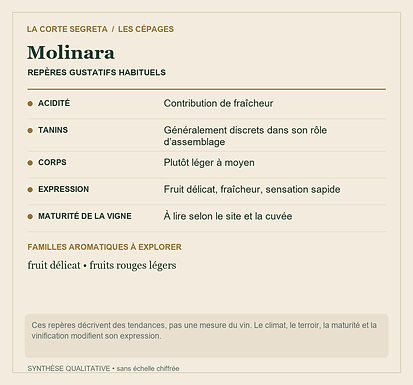
Typical flavour markers for Molinara — a qualitative overview by La Corte Segreta. Terroir and winemaking can alter the profile.
Campagnola: a family and the landscapes of Verona →
Corvina: the fruity heart of Valpolicella →
Rondinella: a regular partner in Veronese blends →