Music
Music at La Corte Segreta: piano, lounge, classical music and tarantellas. Selection and sound distribution designed to accompany the meal.
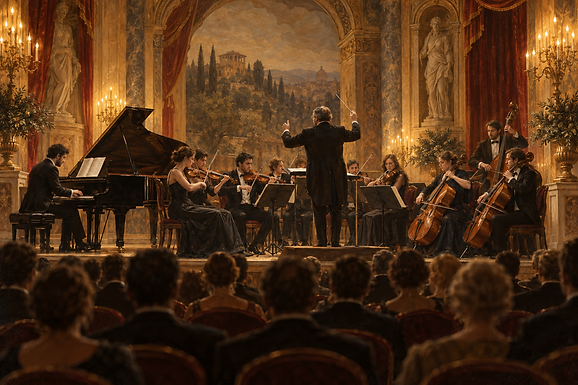
An atmosphere you can listen to without it taking over
Background music should be enjoyable without demanding all your attention. At the table, people also come to talk, listen to loved ones and speak with the team. The choice of tracks and their volume should support that moment.
A gentle melody played too loudly can become intrusive. Conversely, music that is almost inaudible at one table but very present at another creates an uneven atmosphere. Comfort therefore depends as much on sound distribution as on musical style.
Why install fifteen speakers?
Our system includes two amplifiers powering fifteen THX-certified Logitech speakers. These are distributed around the restaurant to bring the sound sources closer to the different spaces.
With only two speakers far from some tables, it can be tempting to turn up the volume so that the music reaches the whole room. People sitting nearby then experience a higher sound level. Using more sound sources aims to spread the music more evenly, at a more moderate volume in each place.
We seek a consistent, pleasant, enveloping musical presence through the positioning of the speakers, their settings and attention to the room’s acoustics.
From the entrance to the different spaces
At the entrance: a speaker is positioned right at the pizzeria entrance. As soon as a customer steps through the door, they encounter the restaurant’s musical atmosphere.
In the welcome areas and at the bar: music accompanies our customers and the life of the restaurant. The bar has speakers.
In the toilets: a speaker extends this continuity so that the atmosphere does not stop when someone briefly leaves the dining room.
In the pizza and kitchen work areas: no speakers are installed.
What style of music at La Corte Segreta?
The selection favours lounge music, classical music and instrumental pieces, usually without vocals. ‘Instrumental’ means that instruments carry the piece, without a sung part. Here, ‘lounge’ describes a relaxed atmosphere suited to background listening.
The repertoire extends from the early 19th century, around 1800, to today. This period refers to the works and styles: an old composition can, of course, be played in a recent recording.
Italian identity provides a thread, with classical melodies, film music and contemporary compositions. The choice of a passage and its performance matters: not every work by the same composer has the same intensity.
Tarantellas: a touch of Italian folk tradition
We also sometimes play tarantellas, called tarantelle in Italian. This name refers to traditional dances from southern Italy and the music that accompanies them. Their generally fast, lively rhythm adds a brighter colour to the musical selection.
There are different regional traditions: the tarantella is not a single piece. It may be instrumental or sung, with accompaniment that can include tambourine or guitar. It evokes another side of Italian culture, that of folk dances and celebrations.
The piano: our favourite instrument
The piano is our favourite instrument and features in the music played at La Corte Segreta. A piano melody can create a gentle, intimate presence, but it can also become fuller and more expressive. The choice of piece and performance therefore remains essential in accompanying a meal.
A brief history of the piano
The piano originated in Italy around 1700. Bartolomeo Cristofori, an instrument maker from Padua, developed it in Florence, where he worked for the Medici court. An instrument maker is a craftsperson who builds and adjusts instruments.
His innovation relied on small hammers striking the strings. Musicians could thus vary the intensity of the sound through their touch. Unlike the harpsichord, whose strings are plucked, this new instrument made it possible to move from soft to loud through the action of the fingers.
This is the origin of the name pianoforte: in Italian, piano means ‘softly’ and forte means ‘loudly’. The name was later shortened to ‘piano’. The instrument developed through the 18th and 19th centuries and gained a major place in concerts, salons and music education.
Some great Italian composers
The composer writes the music; the performer plays or sings it. Here are some reference points for discovering the richness of the Italian repertoire:
Gioachino Rossini : a major figure in 19th-century Italian opera, particularly known for his orchestral overtures.
Vincenzo Bellini : a composer associated with bel canto, a tradition that gives great importance to the beauty and flexibility of singing.
Gaetano Donizetti : another great name in bel canto and Italian opera.
Giuseppe Verdi : a central figure in opera whose works give a prominent role to dramatic expression.
Giacomo Puccini : a composer of operas with expressive melodies, among the most famous in the Italian repertoire.
Ennio Morricone : a major film composer whose world extends well beyond the Western.
Ludovico Einaudi : a contemporary composer and pianist who offers an introduction to another side of Italian instrumental music.
These names are examples to help understand the musical worlds discussed in this article.
When voices become part of the atmosphere
The music remains mostly instrumental, but voices also have a place. Opera and Italian song offer different colours: a great operatic voice and a gentle song do not create the same presence in the room.
Luciano Pavarotti : an iconic tenor of Italian opera. A tenor is a high male voice.
Giuseppe Di Stefano : a great Italian tenor and a prominent figure in the operatic repertoire.
Achille Togliani : an important Italian singer for discovering melodic song and a more nostalgic atmosphere.
Andrea Bocelli : a tenor whose career connects the classical repertoire with popular song.
These performers offer examples of voices to explore. To accompany a meal, the gentleness of the piece, its arrangement and changes in volume remain as important as the artist’s fame.
How we approach it at La Corte Segreta
The team’s guide is the actual comfort of those present: music should accompany the table and allow people to follow a conversation or an exchange with the staff. If it forces people to raise their voices, its level needs reassessing.
We must also listen to what is happening near the speakers and in more distant spaces. Turning up the overall volume is not always the right response to an area with less coverage. Paying attention to differences between tracks helps maintain a coherent atmosphere.
Related archive articles
