Matilda di Canossa: a great lady between Italy and Orval
From Canossa to the legend of the ring, a story connecting our Italy with Belgium.
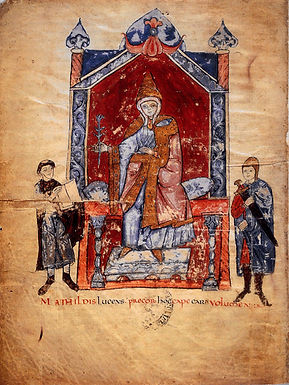
Matilda di Canossa on her throne, miniature from Donizo's Vita Mathildis, around 1115. Vatican Apostolic Library, Vat. lat. 4922, fol. 7v — Wikimedia Commons, public domain.
Matilda di Canossa, known in French as Mathilde de Toscane, was a major figure in medieval Europe. Her life belongs to Italy's history; her name also accompanies the legend of Orval. At La Corte Segreta, these two threads meet in our signature pizza La Matilda.
Who was Matilda di Canossa?
Born around 1046 and dying in 1115, Matilda belonged to a powerful family of lords in northern and central Italy. The daughter of Boniface of Canossa and Beatrice of Lorraine, she inherited extensive territories, rights and fortresses. Her authority extended notably across Lombardy, Emilia and Tuscany. Canossa, in the Reggio Apennines, became the best-known setting in this story.
She was nicknamed the Grancontessa, the Great Countess. She exercised power, supported monasteries and took part in the conflicts of her time. Her life also crossed borders: her first marriage, to Godfrey the Hunchback, took her temporarily to Lorraine before she returned to Italy.
Canossa: the castle where a king sought forgiveness
In the 11th century, the Investiture Controversy set the pope against the German ruler: who could choose bishops and confer their authority? These religious offices also held land and considerable political influence. Matilda supported Pope Gregory VII.
In January 1077, King Henry IV, the future emperor, arrived at Canossa Castle seeking to have his excommunication lifted. Matilda hosted the pope and, with Abbot Hugh of Cluny, took part in negotiations between the two men. The image of the ruler as a penitent before the fortress has endured through the centuries. Yet this pardon did not end their conflict: Matilda subsequently had to defend her possessions, confront rebellions and support her side for many years.
Her legacy extends beyond this episode. Her deeds and letters reveal a woman who administered her lands, granted rights and intervened in their affairs. After her death, her memory retained such prestige that her remains were transferred to St Peter's Basilica in Rome in the 17th century.
The ring, the trout and the legend of Orval
In Belgium, Matilda's name accompanies another story. Legend has it that the countess dropped her wedding ring into a spring. She prayed; a trout rose to the surface with the ring in its mouth. Astonished, Matilda recognised the place as a ‘valley of gold’ and decided, in gratitude, to establish a monastery there.
This account belongs to Orval's legend: it is not historical proof that Matilda founded the abbey. The trout and ring became its emblems. Today, they lead us to the history of Orval, of which we offer several expressions at La Corte Segreta.
There is also an Italian connection in the monastery's beginnings: the first monks to arrive at Orval in 1070 came from southern Italy. Their settlement, made possible by the Count of Chiny, is part of the site's history.
Why Matilda belongs at La Corte Segreta
We enjoy this meeting between a great Italian figure and the stories surrounding a Belgian abbey. It gives particular meaning to our signature pizza La Matilda, created to be enjoyed with Orval. Its name brings this story to our table.
Another pairing we tried at the table: Lambrusco
We also particularly enjoyed La Matilda with a Lambrusco. Added towards the end of cooking, the fontina melts partly and coats the ingredients underneath. After a bite, we love the contrast with the liveliness of the wine and the refreshing sensation on the palate. This pairing comes from our own tastings at La Corte Segreta.
Fior di sale from Cervia provides the finishing touch, chosen for its clean saltiness and the delicate crystals we look for on the palate. This choice also reflects our interest in the history of Italian dining.
What the times demanded
Four years after the pardon at Canossa, Matilda’s decision to support Gregory VII costs her some of her power. In Lucca in 1081, Henry IV strips her of the authority the Empire had entrusted to her. Towns in her domains rebel and she falls back on her castles in the Apennines. In 1084 her forces win at Sorbara and she regains strongholds along the Po. Some of her holdings in Lorraine slip away, however. At Bianello in 1111, Henry V, the son of her adversary, restores the governing powers taken from her thirty years earlier.
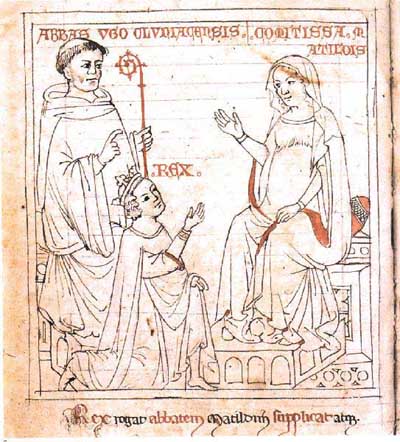
Hugh of Cluny and Henry IV before Matilda at Canossa. This fourteenth-century miniature shows how the meeting of 1077 was depicted long after the event.
Acta Comitissae Mathildis, after Donizo · Biblioteca Panizzi, Reggio Emilia · Public domain · Original document · Licence
Fior di sale from Cervia, from the salt pans to the table
Sources
Treccani · Biography of Matilda of Canossa