Parmigiano Reggiano DOP
Parmigiano Reggiano DOP: understanding this aged cheese and why La Corte Segreta offers it for grating at the table, at the last moment.
Key points
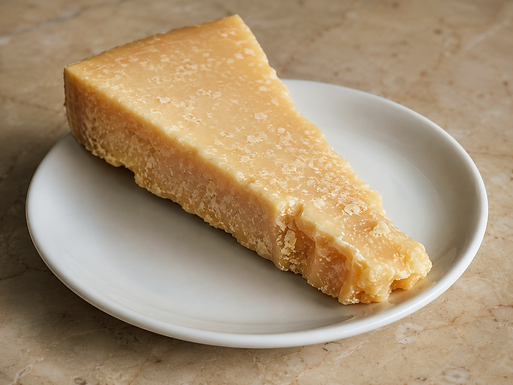
Parmigiano Reggiano is a hard cheese made from raw cow’s milk.
The production stages
Parmigiano Reggiano’s specification prohibits additives. It also prohibits silage in the feed of cows producing the milk. The diet is based mainly on forage from the area of origin, with precise rules.
Another important detail concerns the starter. Cheesemakers use naturally fermented whey from the previous day’s work. This whey contains natural lactic acid bacteria and maintains a direct connection between cheese, dairy and territory. Laboratory-selected cultures are prohibited for Parmigiano Reggiano.
Parmigiano Reggiano DOP and Grana Padano DOP: related but different cheeses
Parmigiano Reggiano DOP and Grana Padano DOP are two great Italian hard cheeses. Both belong to the ‘grana’ family, with a granular paste that breaks into shards. Both are protected by a DOP.
Parmigiano Reggiano and Grana Padano have their own production specifications and areas, with distinct flavour profiles and uses that can complement one another in the kitchen.
Parmigiano Reggiano is produced in a more limited area. Grana Padano covers a wider area in the Po Valley.
Minimum ageing also differs. Parmigiano Reggiano is assessed from a minimum of 12 months, while Grana Padano can be branded from 9 months. Grana Padano is often eaten younger, although longer-aged versions also exist.
Another difference: Grana Padano permits lysozyme, a protein extracted from egg white, to control certain unwanted fermentations. Parmigiano Reggiano does not allow additives.
Why we do not grate it in advance
A cheese such as Parmigiano Reggiano loses some of its aroma when grated too early. Once exposed to air, it dries faster, its aromas open up and then fade, and its texture changes.
That is why, at La Corte Segreta, when it is served on a pizza, it comes to the table as a small piece with a grater. Customers grate the cheese onto the pizza themselves, at the last moment.
The gesture is simple, but it changes a great deal. The cheese stays more vibrant, the aroma reaches the table directly and everyone can choose the amount to suit their taste.
Parmigiano Reggiano in antipasti
In certain antipasti, Parmigiano Reggiano can be served in pieces. This makes its structure easier to appreciate: the granular paste, irregular break, salty flavour, nutty character and sometimes a hint of broth or butter, depending on ageing.
Served in a piece, it can accompany charcuterie, olive oil, a marinated product or something milder. The cheese brings depth as well as savoury flavour.
A historical story: Boccaccio and the mountain of Parmesan
In the 14th century, Giovanni Boccaccio already mentioned Parmesan in the Decameron. In his imaginary land of Bengodi, he described a mountain of grated Parmesan where gnocchi and ravioli were prepared.
The image is exaggerated, almost comic, but it says something important: this cheese was already familiar enough to enter literature. Not as an everyday product, but as a sign of abundance, cooking and pleasure.
Parmigiano Reggiano DOP is more than a famous Italian cheese. It is a product of patience, place and precision.
Useful links and source:
Consorzio del Formaggio Parmigiano-Reggiano [‘Parmigiano Reggiano’ Cheese Consortium]
Head office: Via J.F. Kennedy, 18
42124 Reggio Emilia (RE)
ITALIA
https://www.parmigianoreggiano.com/
Glossary parmigianoreggiano.com
The history parmigianoreggiano.com
Related archive articles
