How the outside temperature affects pizza dough fermentation
The seasons, the heat from Ignis Pvgnax and our cooler spaces: how we manage two stages of fermentation and prepare for resting times of 50 to 90 hours from November 2026.
Pizza dough fermentation depends on flour, water, the ferment used, time and temperature. If these elements are not controlled, the same recipe can produce different results in winter and summer.
The outside temperature does not act directly on dough enclosed in a refrigerator. It first affects everything in the pizzeria: the room's air, flour, water, mixer bowl, mixing arm, containers and the preparations carried out before refrigeration.
The dough's temperature at the end of mixing thus becomes one of the main indicators of consistency. It influences fermentation speed and the dough's behaviour in the hours that follow. Research into breadmaking confirms that dough temperature acts directly on yeast activity and on the rate of production of the gas responsible for its rise.
Why dough can change between winter and summer
In a properly heated pizzeria, room temperature may be around 21°C in winter. During hot weather, a workspace can exceed 30°C.
A difference of almost 10°C is significant for dough. It changes the starting temperature of ingredients and equipment before mixing even begins.
If the recipe, water temperature and mixing time remain identical all year, dough made in summer may finish mixing at a higher temperature. It will then begin fermenting more quickly.
Flour temperature
Flour makes up most of a dough's mass. Its temperature therefore strongly influences the temperature of the mixture.
Flour stored in a room at 21°C does not behave exactly like flour left for several hours in a space at 30°C. Even if the difference is not directly visible in the bag, it appears in the dough after water is added and mixing begins.
Storage temperature can also affect how well flour keeps. Humidity, packaging and temperature variations must be controlled to limit changes in water content and absorption capacity. Properly protected flour remains much more stable than flour exposed to a hot, damp environment.
The temperature of the bowl and mixing arm
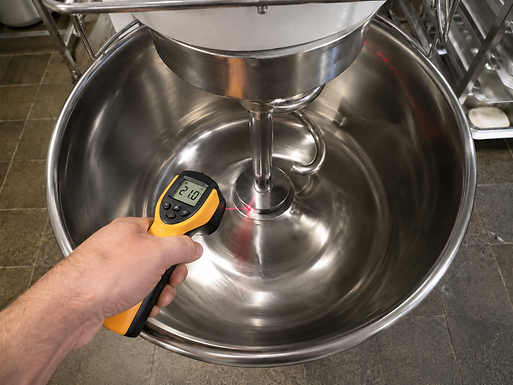
The mixer bowl and arm are metal. They gradually take on the room's temperature.
In winter, a bowl in a workspace at 21°C begins at a moderate temperature. In summer, the same bowl may already be above 30°C before the mixer is switched on.
This difference adds to the heat produced during mixing. Not all the mechanical movement transferred to the dough goes into forming the gluten network. Some of this energy becomes heat through viscous dissipation.
Trials with a spiral mixer have shown that increasing mixing speed increases the energy transferred and the dough's final temperature. Mixing duration, machine speed, dough consistency and batch size therefore all contribute to heating.
When the metal is already warm before starting, the temperature rise begins at a higher level. A warm bowl does not necessarily create more friction, but it absorbs less heat from the dough and may even transfer heat to it at the start.
Temperature during mixing
In a cool workspace, the bowl and surrounding air can absorb some of the heat produced by mechanical work.
In a very hot workspace, this exchange becomes less effective. The dough retains more of the heat created by the mixer.
Two batches mixed with the same quantities can also finish at different temperatures when the machine has already made several batches. The bowl, arm, motor and certain mechanical parts may have accumulated heat.
The refrigerator does not remove differences immediately
Refrigerating dough greatly slows fermentation, but does not immediately bring every dough to the same state.
Dough that enters refrigeration at a high temperature retains warmth at its core. It continues fermenting while cooling. Colder dough slows more quickly.
Baker's yeast can also remain active at low temperatures. This activity becomes much slower, but does not automatically disappear as soon as dough enters the refrigerator. Studies of cold fermentation show that low temperatures prolong fermentation rather than stop it entirely.
The quantity of dough introduced at once, dough-ball size, stacked containers, air circulation and door openings also influence the cooling rate.
The setting displayed on the fridge is therefore not enough. Attention must be paid to the dough's actual temperature and the time needed for its core to cool.
Does humidity have an effect?
Ambient humidity is secondary to temperature, but it should not be ignored.
When flour remains properly packaged and protected, daily humidity variations have a limited effect. However, flour exposed to damp air for a long time can absorb water. Its behaviour during hydration may then change slightly.
Humidity also affects the surface of dough balls. Dough left uncovered in a dry environment can form a skin. This surface becomes less extensible and can hinder shaping. Containers must therefore remain properly protected.
How we apply this at La Corte Segreta
The aim is not to use exactly the same water temperature in January and July. It is to obtain dough with the same temperature and behaviour every time we make it.
From the oven to the cellar: choosing the right spot
At La Corte Segreta, we use several areas to manage the temperature of our sourdough starter, dough and pasta di riporto throughout the year. We move preparations on trolleys, choosing the right spot for their stage of production and the temperatures we actually measure.
Ignis Pvgnax is the main source of heat in the dining room. Even when closed, the oven continues to release stored heat into the building. The extractor fans help remove some of that accumulated heat; in summer, this allows us to bring the room temperature as close as possible to the temperature outside.
The sheltered area near the cellar entrance gives us another option. During a test in the summer of 2025, we measured 21 °C in the corridor where some of our wine is stored while it was 33 °C outside, with no air conditioning running. That 12 °C difference was a reading taken at a particular moment: we always choose a location according to the day’s measurements. This use of our different spaces also helps us store our bottles of wine.
First fermentation: a cold stage at 4 °C
Once prepared, the dough begins with a first fermentation at 4 °C. We calculate its duration on the production planning chart, mainly according to the amounts of pasta di riporto and sourdough starter added. We monitor the actual temperature of the dough during this cold stage.
Second fermentation: a maximum of 27 °C
The second fermentation takes place in the designated area to the left of Ignis Pvgnax, at a maximum temperature of 27 °C. As a guide, when it is 20 °C outside, this spot can be around 27 °C. We adjust the distance between the dough balls and the oven using dough thermometers, according to the conditions that day.
In very hot weather, we move the trolleys closer to the cool area near the cellar entrance. This lets us use the temperature differences within the pizzeria to slow the progress of the dough balls. We calculate the duration of this second stage on the chart, taking account of the resting time already completed during the first fermentation.
From November 2026: a total rest of 50 to 90 hours
Before this change, our dough rests for around 48 hours in total. From November 2026, we plan to extend this to a minimum of around 50 hours, with an upper limit of 90 hours across the two stages of fermentation. The time allocated to each stage will still be calculated on the chart for the preparation in question.
Better control of locations and temperatures allows us to extend the resting time while preserving the dough’s structure. We aim for more developed aromas, particularly from the wholegrain wheat in our blend, and a structure that handles well on the bench during service and holds up well in the oven.
Controlled flour storage
Some flour stocks are kept in the pizzeria's coolest areas. Bags currently in use are stored in a cold room intended for this purpose.
The flour's temperature can thus be adjusted according to the temperature of the workspace where the dough will be prepared.
Flour must not, however, be considered alone. Its temperature is interpreted alongside those of the water, room, equipment and other elements added to the dough.
Water as the main means of adjustment
Water is the element whose temperature can be adjusted most quickly before mixing.
At La Corte Segreta, water is used at a temperature calculated according to several parameters:
the duration and temperature of autolyse ;
the flour's temperature;
the mixing workspace's temperature;
the quantity and temperature of pasta di riporto added;
the mixer's temperature;
the expected warming during mechanical work.
Water alone does not control the whole fermentation. The quantity and activity of the ferment, temperature, salt, time and dough composition also play a role.
It is nevertheless the most direct means of correction. Adjusting its temperature can compensate for warmer flour or a warmer bowl and help achieve the dough's specified final temperature.
Its quantity also influences consistency, extensibility, water mobility in the dough and the gluten network's behaviour. Water temperature and quantity are therefore measured separately and precisely. Our mixing tests identify water temperature, total water quantity, duration, speed and dough temperature among the process's important parameters.
Pasta di riporto
Pasta di riporto is fermented dough from an earlier batch, incorporated into new dough in a defined proportion.
It already brings fermentation activity, aromatic compounds and some acidity. Its quantity, maturity and temperature influence the new dough's starting conditions.
At La Corte Segreta, its exact proportion belongs to our own method. It is nevertheless taken into account when calculating water temperature and assessing the dough's behaviour.
Changing the quantity of pasta di riporto without adjusting the other parameters would not be consistent. A change in inoculation alters the speed at which fermentation can begin.
Measuring rather than assuming
La Corte Segreta has the instruments needed to check:
flour temperature;
water temperature;
workspace temperature;
equipment temperature;
pasta di riporto temperature;
dough temperature during and after mixing;
storage temperature;
the development of dough balls as they mature.
Seeking consistent dough all year round
A pizza eaten in January should have the same characteristics when ordered in July: the same structure, rise, sensation when tasting and overall balance.
This stability has been noticed by guests who travel from afar and return weeks or months apart. They are not comparing two pizzas ordered a few minutes apart. They encounter the dough again in a different season and recognise its continuity.
Why dough-ball weight changes with the season
The recipe and dough behaviour remain stable, but La Corte Segreta slightly adjusts its dough-ball weight according to the season.
In summer, dough balls are reduced by 30 grams. In winter, they are slightly more generous.
Cold can increase energy expenditure when a person is actually exposed to it, as the body produces heat to maintain its temperature. La Corte Segreta's 30-gram difference should therefore be understood as a culinary portion choice. In winter, the pizza is slightly higher in calories. In summer, it is a little lighter to better suit hot conditions and the comfort sought during a meal.
This adjustment changes neither the dough's quality, its fermentation method nor its recipe.
Useful links and sources:
Proving of Bread Dough II: Measurement of Gas Production and Retention - ScienceDirect
Related archives
