Barbera: Piedmont’s freshness, from everyday wines to ageworthy expressions
Piedmont’s freshness, from everyday wines to ageworthy expressions
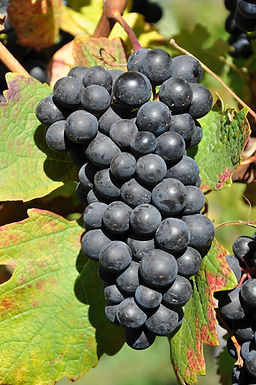
Doris Schneider, Julius Kühn-Institut (JKI), Federal Research Centre for Cultivated Plants, Institute for Grapevine Breeding Geilweilerhof, 76833 Siebeldingen, Germany · Original photograph · CC BY-SA 4.0
An ancient presence in Monferrato
Barbera belongs to Piedmont’s heritage, particularly Monferrato. A mention in Chieri’s land register in 1512 is among its earliest known historical reference points. It long accompanied families’ everyday lives and vineyard work. Its modern history shows how the same grape can produce a simple, immediately enjoyable wine, then more ambitious expressions when vineyards, yields and ageing are approached differently.
From the railway to new ambitions
The development of connections to the port of Genoa helped Barbera wines travel beyond their region. Later, work devoted to quality renewed their reputation. We enjoy this journey at La Corte Segreta: a variety does not become interesting only when it is rare. A grape firmly rooted in everyday habits can reveal other facets without losing its connection to its territory.
In the vineyard
The bunches are generally compact, cylindrical to pyramidal; the berries are slightly elongated and blue-black when ripe. Barbera can be productive and needs attention to yields. Good exposure helps grapes ripen while retaining the acidity that often characterises the wines. Plot, harvest and extraction choices alter the balance between freshness, colour and body.
In the glass
Typical characteristics suggest cherry, plum, blackberry or other red fruits. The palate can combine marked acidity with a round texture, with tannins often less dominant than in some other Piedmontese reds. Young versions readily highlight fruit; wood can add vanilla, cocoa or spices according to ageing. Barbera is not another name for Nebbiolo: the two precisely allow us to explore different balances. We approach every bottle through its own style, keeping the variety as a useful guide.

Typical flavour characteristics of Barbera — a qualitative overview by La Corte Segreta. Terroir and winemaking influence the profile.
Roberto Ferraris: Barbera, the vine and the hand →
Prunotto: the Langhe saved by a couple →
Nebbiolo: the long passage of time in Piedmont and the Alps →