Prunotto: a couple who saved a Langhe winery
Alba, Piedmont's great crus and a story of knowledge passed on.
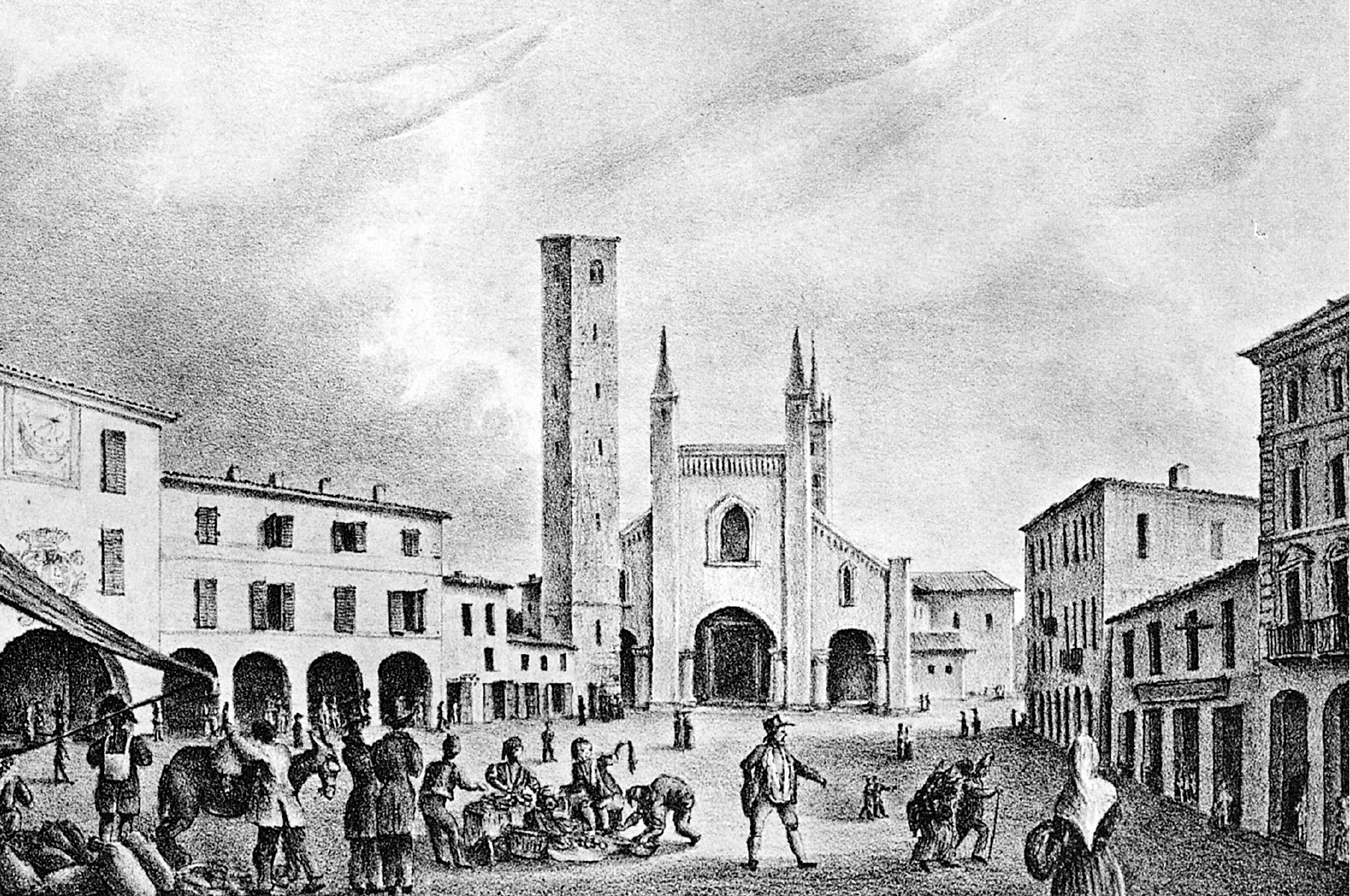
Alba and San Lorenzo cathedral in 1839 — drawing by Clemente Rovere, digitised by CoBiS / Wikimedia Commons, CC BY 4.0. Historic view of the city where Prunotto is based. — Clemente Rovere / CoBiS · Original image · CC BY 4.0
At La Corte Segreta, Occhetti opens a door to Piedmont: a Nebbiolo whose name takes us to the hills of Roero. Behind this bottle, Prunotto tells a story that began as a collective venture, became a family business and developed into a patient exploration of individual sites. Its historic home is in Alba, in the province of Cuneo, at the heart of the Langhe.
1904: a winery that brings growers together
The Ai Vini delle Langhe cooperative was founded in 1904. The young Alfredo Prunotto attended its founding; the first harvest followed in 1905. After the war, economic difficulties and the departure of several members weakened the winery. In 1922, a small harvest left the business in further difficulty, despite the remarkable quality of the vintage.
Alfredo and his wife Luigina then took over the winery and gave it their name. This is the part of the story that moves us: the name we read on a bottle today preserves the memory of a couple who chose to keep a struggling business alive. In 1956, Alfredo passed the business to Beppe Colla and Carlo Filiberti, who were later joined by Tino Colla.
The character of a cru before the character of a recipe
In 1961, Prunotto chose to distinguish specific sites, including Bussia for Barolo and Pian Romualdo for Barbera. This approach places the vineyard centre stage: two wines made from the same grape can express very different soils, aspects and altitudes. At Bussia, in the municipality of Monforte d'Alba, the winery and Nebbiolo vines stand in a landscape of hills whose folds alter the conditions in which the grapes ripen.
The relationship with the Antinori family began in 1989 with wine distribution. In 1994, the Antinori family also took over production. Prunotto's Piedmontese identity remains tied to its appellations and vineyards.
From the Langhe to Roero and Monferrato
The main names to remember are Bussia and Colonnello in Monforte d'Alba, and Bric Turot in the Barbaresco area, for Nebbiolo. In Agliano Terme, the vineyards of Bansella and Costamiòle place Barbera at the forefront. Monferrato is also home to Albarossa at Bricco Colma. This network of sites explains the producer's diversity.
Occhetti at our table
Occhetti Langhe DOC Nebbiolo, made since the 1970s, is a Nebbiolo wine. Roero's soils combine surface sands with gravel, clay and limestone. We appreciate how this bottle introduces the grape through finesse and freshness. Prunotto earns its place on our wine list through this attention to individual sites: a wine that is easy to understand, yet whose story continues far beyond the glass.

Prunotto: documented regions, locations and grape varieties. Mapping: ISTAT boundaries, distributed by openpolis / geojson-italy, CC BY 4.0. Projection and colours adapted; a regional location map, not a cadastral map. Map boundaries · CC BY 4.0
Nebbiolo: the slow pace of Piedmont and the Alps →
Barbera: Piedmont's freshness, from everyday wines to wines for ageing →
Antinori: six centuries and the courage to pass on a legacy →