Est Est Est Bonum: history and legend
From an inn door in Montefiascone to our wine cellar: an Italian legend we wanted to bring to life at La Corte Segreta.
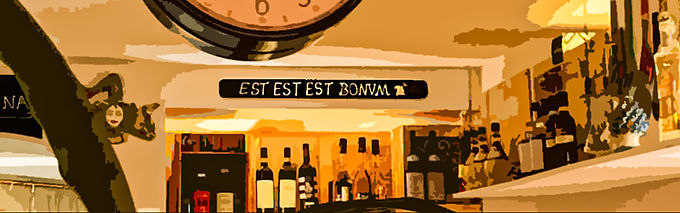
Our wine cellar and its inscription ‘EST EST EST BONUM’ — photograph taken at La Corte Segreta by Crimi Salvatore.
A master, a servant and a taste for good wine
The legend begins in 1111, on the roads through Italy to Rome. Henry V was travelling there to receive the imperial crown. It is among these travellers, stopping places and inns that tradition places Johannes Defuk, a German wine enthusiast, and his servant Martino.
Defuk gave Martino a rather enjoyable task: travel ahead, taste the wines at the inns and point out places worth stopping. They agreed on a simple sign. On the door of an inn where the wine was good, Martino was to write ‘Est’. The Latin word means ‘it is’; in their private code, it announced that the wine was good. A fine discovery could merit two ‘Ests’.
In Montefiascone, two words were no longer enough
Martino arrived in Montefiascone, in Lazio, near Lake Bolsena. The wine seemed so remarkable that he went beyond the usual signal. On the door, he wrote ‘Est! Est!! Est!!!’. The same word three times, as though a single recommendation could not contain his enthusiasm.
Following his servant's signs, Defuk discovered the wine in turn. The rest of the tale describes an attachment to Montefiascone so strong that he stayed there, then died after drinking it to excess. In the church of San Flaviano, a tomb attributed to him keeps alive the memory of this famous ending.
Versions of the story have varied over time, and the figure retains an element of mystery. But the legend has left a deep mark on Montefiascone: it survives in the name of its white wine and is still told during a historical procession in the town. An inn's little message has thus travelled through the centuries.
Three ‘Ests’ above our cellar
At La Corte Segreta, we immediately loved this story. A man goes ahead, discovers a wine, then leaves someone else the pleasure of encountering it. There is something simple and generous in this gesture: tasting, choosing and sharing.
We wanted to bring this legend to life in our establishment, with the inscription ‘EST EST EST BONUM’ above our wine cellar. The three ‘Ests’ repeat Martino's famous signal. The word Bonum, meaning ‘good’, extends the reference. It is our tribute to Montefiascone's history, now part of La Corte Segreta's décor.
It also expresses our confidence in the wines we offer. We choose them carefully, taste them and give them a place because we enjoy them. We are proud to offer excellent wines at La Corte Segreta, and the pleasure of sharing them is part of our welcome.
Crimi Salvatore — pizzaiolo in Casteau →
Villa Caviciana — Aleatico and the landscape entrusted to the FAI →
