Crimi Salvatore — pizzaiolo in Casteau
The journey of La Corte Segreta’s creator: family knowledge passed down, wholewheat sourdough, a wood-fired oven and Italian culture.

Crimi Salvatore is the pizzaiolo and creator of La Corte Segreta, which opened on 7 November 2024 in Casteau, in the municipality of Soignies, Hainaut, Belgium. His story began in the pizzerias where his father worked, then continued at the family restaurant Da Salvo and at La Bottega Della Pizza. Through learning, service experience, culinary creations, personal hardships and reading about Italian history, he developed a vision of the profession that brings together expertise, organisation, hospitality and the atmosphere of the place.
At La Corte Segreta, this experience continues through homemade wholewheat sourdough and baking over beechwood in his IGNIS PVGNAX oven, where every pizza is turned by hand. It is also present in his topping techniques, the dry-cured ham sliced to order and the balance of his homemade tomato sauce, which combines two Italian varieties to bring together their natural sweetness and acidity. These choices belong to a single project: welcoming customers into a place he designed and sharing his love of work, cooking and Italian culture.
Da Pietro and Da Salvo: the first pizza memories
Salvatore’s earliest memories in a pizzeria date from around the age of three. His father was then working at Da Pietro in Braine-l’Alleud. Both parents worked, and their finances did not allow them to pay someone to look after him. His father therefore took him along to the restaurant in the evening.
Salvatore stayed in the space beneath the oven, where wood was normally stored. As a tiny child, he watched pizzas pass above his head, going in and coming out of the oven. This was his very first connection with the world of pizza.
In 1994, his parents opened their restaurant, Da Salvo. A few years after those first memories at Da Pietro, at around five years old, Salvatore wanted to see what happened inside the family restaurant’s wood-fired oven. He asked for a small stool so he could look.
His father put the pizzas in, turned them and took them out. Salvatore climbed onto the stool and discovered a fierce fire. His father had just placed a log with its bark in the hearth. The flames were particularly powerful. The sight left a deep impression on him.
Many years later, he would seek to recreate that image with his own oven at La Corte Segreta. It would become the starting point for the photograph and story in his first Facebook post, on 31 October 2024.
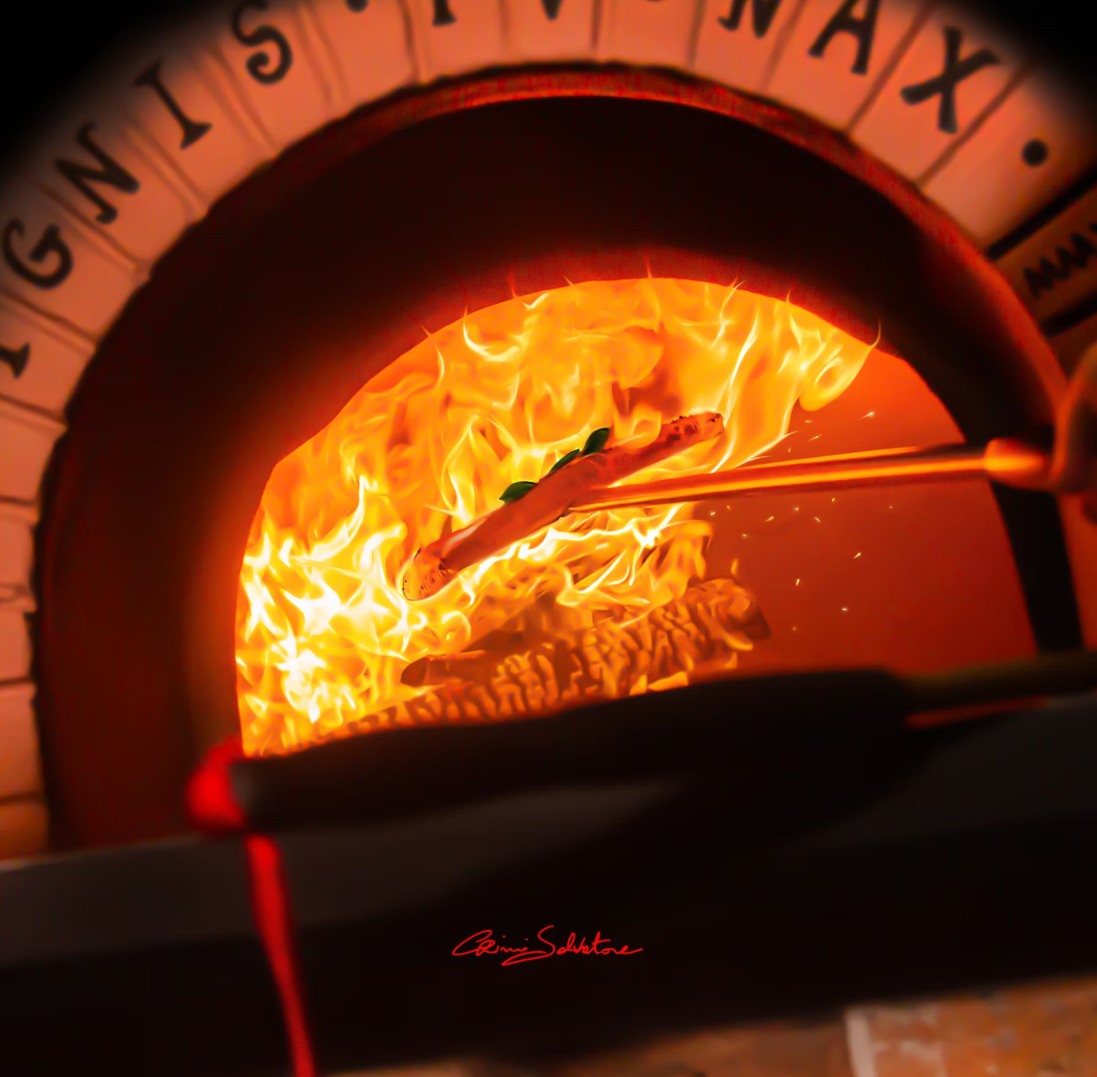
Margherita before the flames of IGNIS PVGNAX: a photograph created by Salvatore to echo his childhood memory at Da Salvo.
The first pizza creations with his grandfather
His first pizza creations were with his grandfather. Together, they combined ingredients to try pairings and discover the resulting flavours.
His grandfather had him get his hands into the dough, but also taught him to eat pizza. When he was very young, Salvatore removed all the toppings. With his grandfather, he learned early to taste a wide variety of pizzas, even spicy ones. This discovery of flavours accompanied his first attempts at making them.
Salvatore particularly remembers the first time he put rocket on a pizza. Many people thought the idea strange, and nobody wanted it. During those early trials, rocket was not yet a usual topping. It has now become a classic, and that contrast remains a memory of his beginnings.
His fondest memory of his grandfather is a small scene at the table. He always saw him drinking red wine and asked for some. His grandfather replied that he could pour a finger’s worth into his glass, but specified that the finger must be horizontal. Only when he was older would he be allowed a vertical finger’s worth. This detail remains one of his most treasured memories with him.
At fourteen: learning responsibility during service
At fourteen, Salvatore worked weekends at Da Salvo and made the pizzas himself. At first, he baked only two at a time, as he did not dare put more into the oven. His father was very strict. Coming from a poor Sicily, he had learned the trade in a tough environment and belonged to the old school.
One evening, a table of six complained: their pizzas had not arrived together. His father came to fetch him and took him to the customers. He asked him to explain himself and listen to their complaint. Salvatore was fourteen.
The experience made him realise that he had to take responsibility. After that evening, he began putting more pizzas in the oven. It was designed to hold five; he eventually baked six at a time.
Another evening, while still fourteen and approaching fifteen, he burned a pizza. The customer complained. His father made him go to the table. The customer confronted him while his father watched without intervening.
Salvatore remembers this scene as another lesson in responsibility. He understood that a dish must reach the customer in the best possible condition, after being checked. The mistake and the customer’s reaction permanently changed his way of working.
From CEFA to WEBI: discovering ovens and his own abilities
At fifteen, he joined CEFA, following a course combining school and work. Students spent two or three days a week at school and worked on the other days. His restaurant activity now extended beyond weekends alone. Until nineteen, he discovered the different aspects of cooking, pizza-making and running the establishment.
At nineteen, he left the family restaurant to explore other horizons. He held different jobs during the week but continued working weekends in Belgian pizzerias. He learned to work with different ovens: gas, electric, conveyor and belt ovens.
At that age, he took part in WEBI, a Belgian-Italian festival in Tubize. He rented a pitch and an oven. He had never worked with that type of appliance: the wood fire burned in a combustion chamber below, while pizzas cooked in a separate chamber above.
The oven was designed for a maximum of three pizzas. A rack allowed an upper section to be used for other preparations, but was not originally intended for pizzas. Salvatore nevertheless adapted his way of working.
He began by baking three pizzas in the lower part of the cooking chamber. As soon as their dough firmed sufficiently, he moved them to the upper rack. He could then put three new pizzas below. This organisation allowed him to work with six pizzas in the small oven.
The event ran from Friday to Sunday, from noon to ten in the evening. He offered six kinds of pizza at five euros each. Across those three days, he made almost nine hundred pizzas: a personal record he never forgot.
Other participants and restaurateurs at the event were impressed by his speed, consistency and way of adapting the wood-fired oven. Some offered him work.
This experience made him aware of his abilities. His very strict father had never complimented him or said well done. The reactions he received in Tubize helped him view his own work differently.
The event was a success. He took part again the following year, with another success. He then continued in Belgian pizzerias, pizza trucks and various events. He also helped friends open or launch their pizzerias; some still exist today.
When he was around twenty-one, his parents closed Da Salvo. The restaurant had become too large for the two of them to manage: around eighty covers in its usual configuration, up to a maximum of one hundred and twenty. Their move away from the restaurant also contributed to the decision.
2014: La Bottega Della Pizza, a name born from a wooden display
A few years later, his father suggested opening a pizzeria together. The project took shape in early 2014. Salvatore was then twenty-four and would turn twenty-five before the end of the year.
When he entered the building that would house La Bottega Della Pizza, he found it old and unattractive. He wanted to do as much as possible to make the interior warmer, more Italian and more welcoming. He began with various decorations, without yet choosing a name.
One day, he went to collect large wooden boards with his father. He wanted to build a large display in the dining room. Customers would see the products being used, but also watch the team come to collect a bag of flour while they ate. The work and raw materials would thus have a visible presence in the place.
While building this large wooden structure, he thought of the word bottega, a shop. His imagination suggested a pizza shop: he pictured pizzas laid out on the display for customers to choose from.
That would not be how the restaurant actually operated, but the image gave it its name: La Bottega Della Pizza. The idea arose in early 2014, and the pizzeria opened towards the end of the same year.
Initially, Salvatore and his father did not yet know local customers’ expectations well. They offered a varied menu that included, at that time, a pineapple pizza.
The early days were difficult. Several pizzerias had already occupied the same premises, and customers had eventually turned away from the address. The new team had to rebuild their trust.
2015–2017: Foodprint recognition and La Bottega’s creations
A few months after opening, recognition changed the restaurant’s course. In February 2015, an anonymous jury visited the pizzeria. Salvatore then received an invitation to Genk. The organisation was Dutch-speaking. This period brought him recognition within Pizzaiolo of the Year and a place in the Foodprint selection among the country’s award recipients, for Hainaut.
He received the Hainaut distinction in 2015, then again in 2016 and 2017. La Bottega Della Pizza featured among the provincial award recipients in the Foodprint selection.
What made him particularly proud was being assessed in his own pizzeria during real service. He had not had to travel to make a pizza under the special conditions of a competition: the people who came to taste ate what he actually prepared for his customers.
This recognition strengthened his sense of responsibility. People now came to taste his pizzas with additional expectations. He wanted to keep progressing, refined his homemade starter and experimented with different flours, including some from ancient wheats.
He also developed pizza specials with seasonal products or combinations inspired by cooking. Foodprint praised this approach and its originality in Belgium at the time.
La Cacciatore: a duck and red-fruit creation in 2015
La Cacciatore was one of those creations. Salvatore made it in 2015. It notably combined duck, homemade red-fruit sauce and chestnuts. It contained neither tomato nor cheese.
It also included apples, the fruit, pan-cooked with a little coffee according to a special and little-known Sicilian recipe. He worked on this cooking method so they would literally melt in the mouth. For the dough, he added an ancient-wheat flour and potato starch.
The complete composition remains secret: other ingredients complete the combination. La Cacciatore stood out in Belgium at the time for this unusual preparation, whose originality was praised by Foodprint.
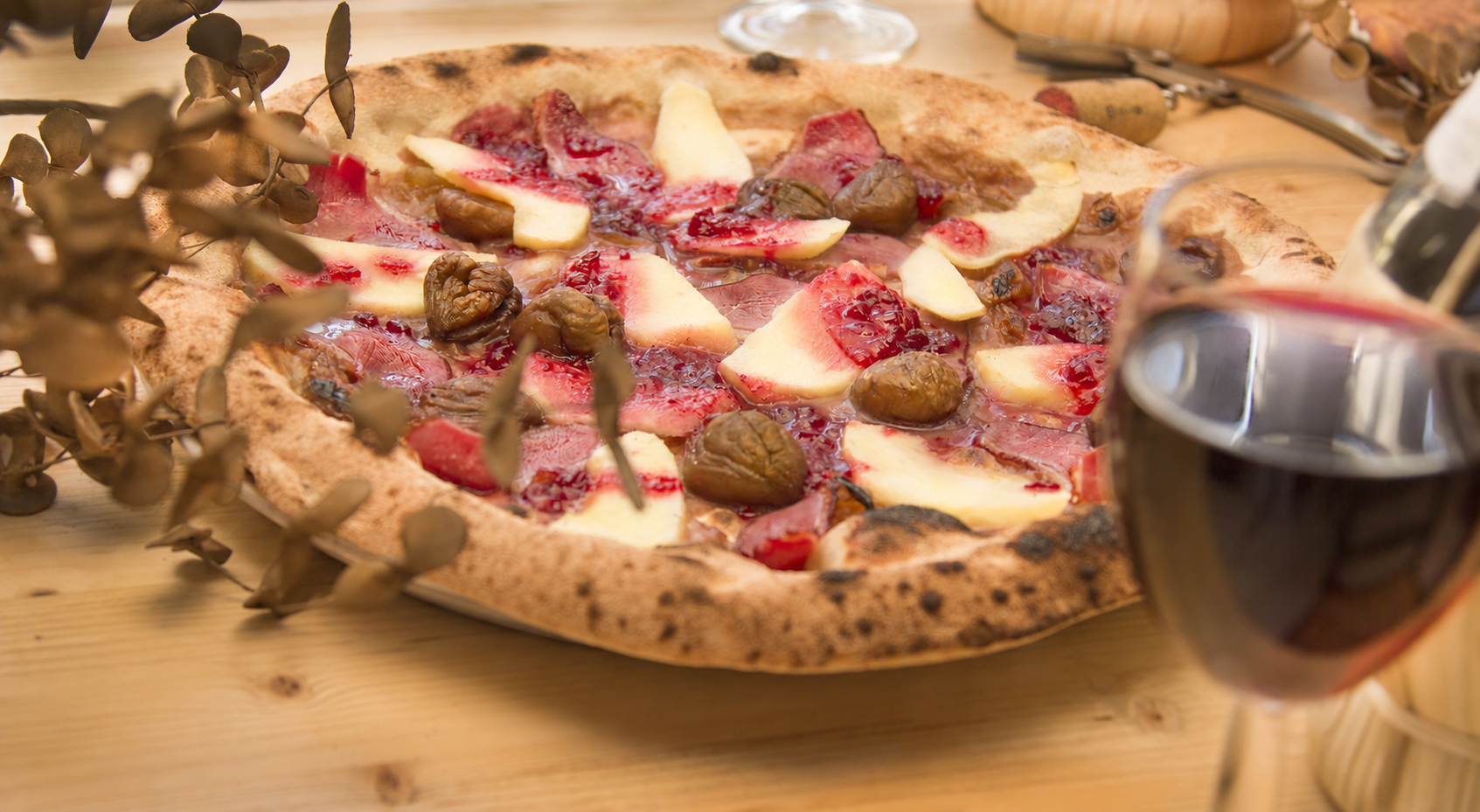
La Cacciatore, a 2015 creation at La Bottega Della Pizza, with duck, red-fruit sauce, apples and chestnuts.
2017: finding a place in Casteau for his project
La Bottega Della Pizza marked the beginning of his growth in the restaurant world. It also gave him certainty that hospitality, particularly being a pizzaiolo, would be his lifelong profession. But some limitations of the building prevented him from offering the overall experience he wanted.
He did not own the premises and could not make all the changes he wanted. The rectangular dining room limited the atmosphere he imagined; in this building, he feared a canteen or refectory feel.
There was only one toilet, shared by men and women, an arrangement that did not fit his project. The façade presented another difficulty: the building was divided among three dwellings, with another entrance to the left of the pizzeria and a separate flat upstairs. Even with alterations, he felt the result would not meet what he sought.
In mid-2017, he realised he needed another building and was determined to stay in Casteau. He already lived there and had established La Bottega Della Pizza there. He knew his customers, saw regulars and had watched some relationships become friendships. Changing buildings would allow him to develop his project while keeping those connections.
He had also studied the region, from Braine-le-Comte to Mons via Jurbise and Le Rœulx. He knew the towns and villages around Casteau. A location on the N6 seemed important: the road connects part of this region and places the pizzeria in an environment he already knew well.
La Bottega Della Pizza was at number 90. He discovered a property at number 85, around eighty metres further down, on the opposite side of the road.
He liked the structure. During the viewing, he had to quickly imagine the oven, toilets, dining areas, different workstations and drainage. He considered the alterations needed.
He realised the project was possible. Everything would need customising, but he believed in the result he could achieve. In summer 2017, he bought the building that would become La Corte Segreta much later.
The interrupted building work and delayed return to La Bottega
In summer 2017, Salvatore bought the Casteau building where he wanted to establish his future pizzeria. Several customers would tell him that the site had once housed a butcher’s shop. He did not know its date or name, but kept that memory passed on by residents and customers.
As soon as he bought the house, he began work. He already knew some stages would take time, notably because some materials had to come from Italy. He continued working at La Bottega Della Pizza while progressing with the new building. He could then count on two people: his partner’s father and her elder brother.
In January 2018, a car accident shattered this balance. His partner’s brother died at thirty. The accident’s suddenness deeply affected Salvatore and his family. Work on the pizzeria stopped. His father-in-law naturally stopped taking part in the project after losing his son.
Salvatore was himself so affected that he stepped away from La Bottega Della Pizza. His father and mother took over at the restaurant. His initial intention was to return when he felt better. But he also needed to be there for his partner, who was going through severe depression. He continued some of the work alone, now for their home rather than the future pizzeria.
This period lasted around twenty-two months. In early 2020, the home was finished and Salvatore considered returning to La Bottega. The Covid-19 pandemic, however, changed that plan. Restrictions imposed on Belgian hospitality made returning inappropriate at that moment.
During Covid: reading Italian history to rethink his profession
He found this period difficult, particularly the restrictions and lockdown. He nevertheless used some of the time to read and explore a subject that had long fascinated him: history. His conviction was simple: to know where you are going, you need to know where you came from.
One day, during an internet search whose exact purpose he no longer remembers, he discovered a collection of Italian books on an online platform: Storia d’Italia by Indro Montanelli, with Roberto Gervaso and Mario Cervi. He bought this fifty-three-volume collection in the 1994 Fabbri edition.
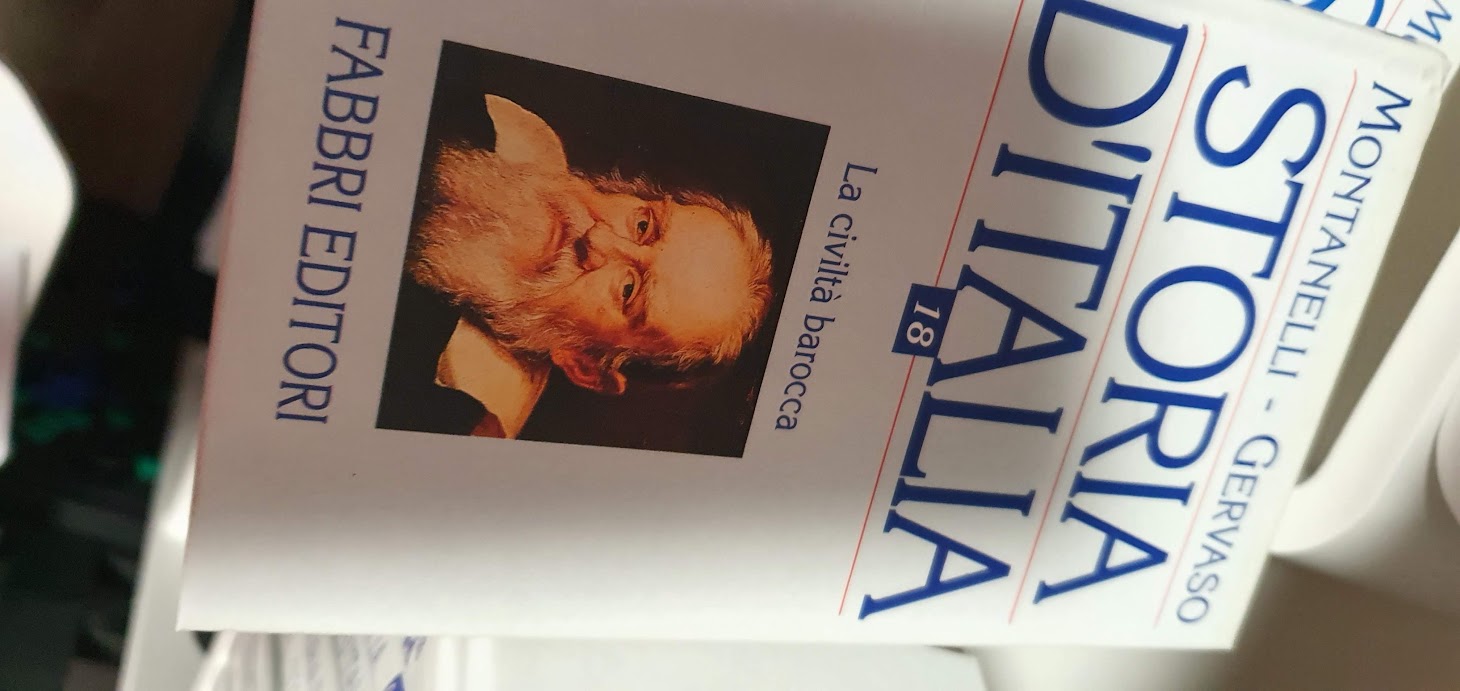
Volume 18, La civiltà barocca, photographed as Salvatore unpacked his books.
He read the collection alongside other works. When he finished, for example, the volumes on the Roman Empire, he sought other books to explore that period further. His reading constantly mixed French and Italian. The collection provided a guiding thread; each subject then opened onto more focused research.
The beginnings of Italian history particularly interested him, followed by the age of communes, humanism and the Renaissance. The centuries from roughly 1000 to 1400 left a deep impression. He continued with the Quattrocento, the 15th century, then the Renaissance courts. Books that would inform his thinking about hospitality and cooking belonged notably to the 15th and 16th centuries.
He was struck by a peninsula divided among several cities, states and powers. He reflected on the limits of this fragmentation for building a political whole, but also on the cultural richness of centres such as Milan, Florence and many others. He compared this development with kingdoms such as France, which followed a different political path, without imagining a uniform history on either side.
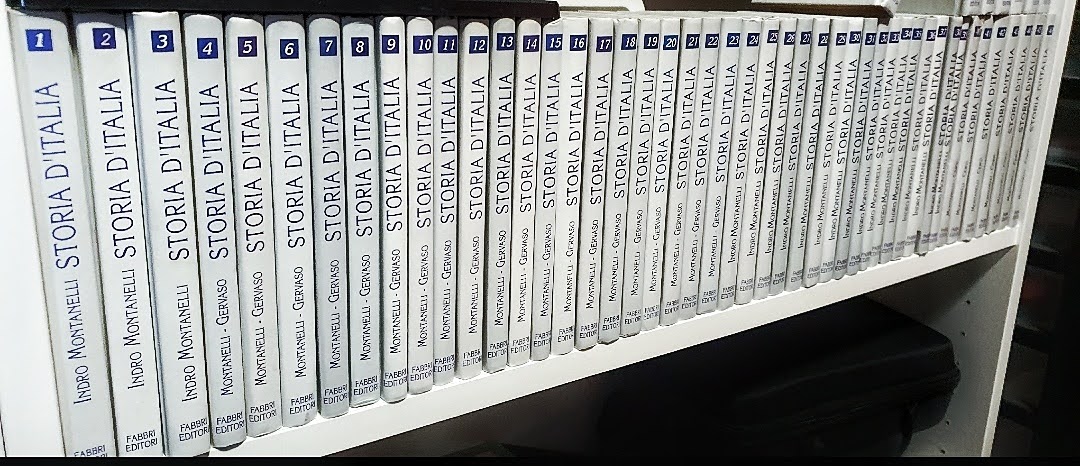
Salvatore’s Storia d’Italia collection, now displayed at La Corte Segreta.
Italian courts and the art of hospitality
His attention then turned to families and courts. Corte means a court; corti is its plural. He discovered a world where influence and power took several forms. Physical and military strength mattered, but prestige was also built through what people chose to show.
Banquets and the art of hospitality particularly fascinated him. He imagined the skills brought together to welcome guests: hunters, butchers, bakers, cooks and the people responsible for organisation and service. What he saw in these readings went beyond preparing a dish. He found many questions from his own profession as a restaurateur.
He notably read Maestro Martino’s Libro de arte coquinaria, Giovanni Della Casa’s Galateo and Baldassare Castiglione’s Il libro del cortegiano. Galateo informed his thinking about speaking, dressing, presenting oneself, welcoming, table manners and behaviour towards others.
One idea in Castiglione particularly struck him: sprezzatura. He recognised in it a carefully developed ease that makes something appear natural despite the learning, effort and mastery it required. He saw it as a profoundly Italian notion. This way of thinking about gesture and presence fascinated him.
He also discovered Bartolomeo Sacchi, known as Platina, and his De honesta voluptate et valetudine, recognised as the first printed cookbook in Europe. These readings helped him appreciate the place of cooking and hospitality in passing on knowledge.
Cristoforo Messisbugo held a special place in this journey. His work on banquets, preparations and their organisation helped Salvatore understand court life. Messisbugo worked for the Este in Ferrara. Salvatore found material for thinking about how a place functions, welcoming guests and the relationship between preparation and service.
The depictions of kitchen spaces, gestures and utensils in Bartolomeo Scappi’s Opera also fed his imagination. They made him want to illustrate his own menus: he draws the pizzas himself for his customers. He also sketched the future restaurant, collected layout ideas and drew what would become his IGNIS PVGNAX oven.
Domenico Romoli informed his thinking about work organisation and training future employees. Vincenzo Cervio, with Il trinciante and carving before guests, inspired another way to connect preparation with what customers see. Giovan Battista Rossetti was also among the authors he read on these questions.
Today, this inspiration finds expression in La Corte Segreta’s open kitchen. Customers sometimes see Salvatore cutting vegetables, working pizza dough and yeasts or cooking sauces. He returns to the idea of a craft whose gestures can sometimes be seen and understood while guests are welcomed.
His aim is to enrich his method with practical situations and knowledge. From these readings, he selects principles of organisation, service, elegance and hospitality, then asks which can still be adapted to restaurant life five centuries later. They strengthened his conviction that Italy played a pioneering role in the art of hospitality. He found knowledge passed down that contributes to education and culture, as well as principles for making social relationships more pleasant and society more beautiful and happier.
This reflection on hospitality also takes practical form in training the people who work in La Corte Segreta’s dining room. Salvatore’s first rule combines three qualities: kindness, helpfulness and honesty. He gives them equal importance in a waiter or a cook. He considers that an honest, helpful and truly kind person has already done 80 % of the work. The rest is acquired through theory, practice and experience. How one treats others is therefore placed at the beginning of learning.
The future restaurant’s architecture, light and materials
His research extended to architecture and the arts. In Leon Battista Alberti’s De re aedificatoria, he found reflection on proportion and harmony. He took from it the idea that abundant decoration requires greater restraint: the more numerous the elements, the more carefully their relationships must be managed.
This research informed his choice of materials: real wooden tables without laminate tops, wrought-iron legs and a Venetian glass chandelier. It also accompanied his contemporary thinking about lighting, warm and cool tones, their positioning and intensity. He wanted a comfortable, enveloping, beautiful place where these choices complemented each other.
Sebastiano Serlio’s Tutte l’opere d’architettura et prospetiva inspired several façade elements: colours, window surrounds, the balcony and the canopy. Inside, he worked on transitions between spaces: changes in tiling between dining room and corridor, between dining areas and at the entrance to the pizzeria area, arches over passageways and ceiling roses.
These choices belong to a modestly sized restaurant: a main dining room divided in two by a large arch, an adjacent room and passages towards the corridor or working area. Salvatore sought to give this layout depth, with particular attention to what customers glimpse and what they discover as they move through it.
He also studied the relationship between light and depth. In the first dining area, lighting is deliberately lower than in the entrance and corridor. The room thus sits between two brighter points. Through this arrangement, he sought a sense of perspective and depth. The restaurant’s small volume required even greater meticulousness to achieve the desired effect.
Some customers notice these choices. Others appreciate the atmosphere without necessarily identifying what creates it. Salvatore values both ways of perceiving the place.
Leonardo da Vinci’s Trattato della pittura informed his thoughts on reflections and contrasts. He notably planned a bespoke mirror between two spaces separated by a wall. Customers cannot all see each other directly from one room to the other, but the mirror’s reflections create a visual connection between them.
He worked on colours and contrasts across the entire restaurant. A wall, corner or detail needed to find its place in the whole, so that the eye encountered a coherent atmosphere rather than a succession of breaks.
Cennino Cennini’s Il libro dell’arte inspired the use of some gilding in different parts of the pizzeria. For lighting, Salvatore also imagined a personal installation: light sources inside wooden boxes near the ceiling. Light is reflected towards the ceiling and becomes indirect. The effect is soft and pleasant, with a visual warmth he appreciates alongside wood.
Vincenzo Scamozzi’s L’idea dell’architettura universale accompanied some finishes and his thinking about the place’s private, intimate character. Hypnerotomachia Poliphili, attributed to Francesco Colonna, provided other decorative inspiration. Vannoccio Biringuccio’s writings contributed to his reflections on iron’s place in the overall harmony.
He also read Pierluigi Ridolfi’s Rinascimento a tavola, a modern work on cooking and banquets in Italian courts. Together with Messisbugo, Romoli and Scappi, these readings revealed a world of knowledge, experience and secrets. He imagined the moment before a banquet, when everything had been prepared for guests expected that evening.
The two photographs he kept show his books as he unpacked them after buying them. These works are now displayed at La Corte Segreta. They are part of the place’s history and the personal journey that led to its design.
See the photograph of Salvatore’s Storia d’Italia collection after he bought it
In 2022, however, creating La Corte Segreta as a new project was not yet the plan. Salvatore still intended to resume work to relocate La Bottega Della Pizza. His reading had enriched his vision of hospitality, work, architecture and atmosphere. The next part of his story explains how that vision gradually took another form.
2022–2024: resuming the work and taking on the new project
In 2022, when the main Covid restrictions on hospitality were lifted, Salvatore returned to see his father. He wanted to resume the work to relocate the pizzeria and return to La Bottega Della Pizza. He still expected to continue the family adventure in the new Casteau building.
His father’s answer, however, made him wait. The financial situation, affected by the Covid period, did not allow his immediate return. His father asked him to wait until activity resumed more normally and, meanwhile, progress with work on the new place.
Salvatore therefore prepared the project and took time to save money again. In early 2023, he resumed the work. It would last longer than he had imagined: he carried out most of it himself. He entrusted some tasks to professionals, particularly electrics, but personally progressed many other aspects.
Some parts took him more than a year. Around March 2024, the project entered a finishing phase with the arrival of professionals. Salvatore began considering an opening around November 2024.
He told his father of this progress and the opening period he planned. It was then that he learned of a decision he had not imagined: his father no longer wanted to relocate La Bottega Della Pizza and intended to stay in the existing restaurant. He told him: ‘Go your own way; I’m staying here.’
He faced two difficulties. On one hand, changes at La Bottega during Covid meant he could no longer return. On the other, he was now alone in carrying the new project.
He found the decision very hard and felt abandoned after so many years of commitment: his first services at Da Salvo, learning from his father and the family adventure of La Bottega Della Pizza, which he had taken to heart. This was another shock in his life.
He then understood that the new place would no longer be a relocation of La Bottega. He had to create an entirely new establishment with its own identity. He continued work and sought new ideas while professionals finished some parts of the project.
How the name La Corte Segreta was born
One aspect of his reading had particularly intrigued him: the relationship between culinary knowledge, secrets and a court’s power. He was interested in accounts where a court developed a new way to cook food, imported a spice or found a preservation technique allowing a normally summer fruit or vegetable to be offered in midwinter. In these accounts, the knowledge was kept secret because it represented a form of power. This connection between mastering knowledge and secrecy left a deep impression.
He also lingered on alliances and their geographical dimension. An alliance with another court could open access to new spices, drinks and other products, depending on its location and the routes it made accessible. In the readings that struck him, these relationships and the possibilities they offered were also often secret. This meeting of knowledge, products and alliances added depth to his discovery of Italian courts.
In his own project, this reflection took the form of a pursuit of complete harmony. Salvatore imagined a customer coming to La Corte Segreta and having a wonderful time because atmosphere, welcome, service, dishes and drinks complemented each other. The experience rested on such a vast combination of choices, knowledge and small details that the ‘recipe for the whole’ became secret. What interested him was bringing everything together to form a harmonious whole.
The word Segreta also carried a personal intention: something hidden, a place discovered by word of mouth with a distinctive atmosphere. He wanted to offer special dishes and drinks that could be entirely fleeting, here today and gone tomorrow. He saw an exclusive aspect linked to the moment of the visit and what was offered that evening. His ambition was for every evening to become a unique experience. This is what he hoped to offer those coming to La Corte Segreta.
One evening, while enjoying an excellent red wine, he thought again about his reading, particularly Baldassare Castiglione and the authors who accompanied his discovery of Italian courts. These books had already influenced the restaurant’s structure and layout. He reread passages.
In that moment of reflection, a name came naturally to him: La Corte Segreta. He had found the name for the new establishment he was bringing into being.
In October 2024, he had around a month left to prepare for opening. He needed to finalise menus, organise positions and attend to many practical and visual details. He thought particularly about arranging equipment so customers would not see cables trailing around the pizzeria. He brought together what he had learned throughout his life, his profession and his reading to make the whole coherent.
La Corte Segreta’s logo: a life told through symbols
He also created La Corte Segreta’s logo entirely himself. Every element received a personal meaning. He wanted the composition to reflect his experience, knowledge and what the place represented.
The typography was inspired by letters he had seen in the old Italian books he read. Each letter has a different form, symbolising variety and difference. The crown on the L recalls the courts and royal histories that fed his imagination.
The emblem on the L also carries Libra, Salvatore’s sign, and just below it Aries, his partner’s. Four small circles with a base sit on either side of Aries: his parents on one side and his partner’s parents on the other. The whole is surrounded by a circle and topped by an upward-pointing spear. This arrangement symbolises protecting the family at all costs.
The C and S fit together: they are Crimi Salvatore’s initials. The other letters also join. This interlocking tells of his life, made of happy and difficult events that eventually find their places in relation to each other. The typographic construction becomes a way to represent the path that brought him here.
The starry sky represents people he cares about who are no longer here. The shooting star represents his ideas and inspirations. His mind often wanders elsewhere as he imagines his projects, the details he wants to create and the forms they might take.
The eagle represents him: he is alone and taking flight. It also symbolises freedom. The key in its talons is the key to who he is and what he knows.
The Trinacria recalls his Sicilian origins. Beside it, the round form is a sphere in which he imagines life unfolding: past, present and future. It thus brings time already lived, the present moment and what remains to be built into the logo.
The two ribbons refer to a story an elderly woman told him in Sicily, a little-known legend of the fornacciari. In this legend, dark red ribbons are tied to bread peels and associated with the joy and happiness of those who will eat the bread.
Salvatore returned to this story in his logo and restaurant. Ribbons are now tied to La Corte Segreta’s pizza peel.
The Italian flag represents Italy. The final A of Segreta is enlarged: it symbolises Alpha, the beginning. The flag and line are slightly offset to the right and extend beyond that letter, bringing the balance and harmony he seeks in the composition.
The signature commits his personal responsibility. La Corte Segreta is a life project he takes to heart. By signing, he commits to taking responsibility for what happens, in successes and difficulties alike.
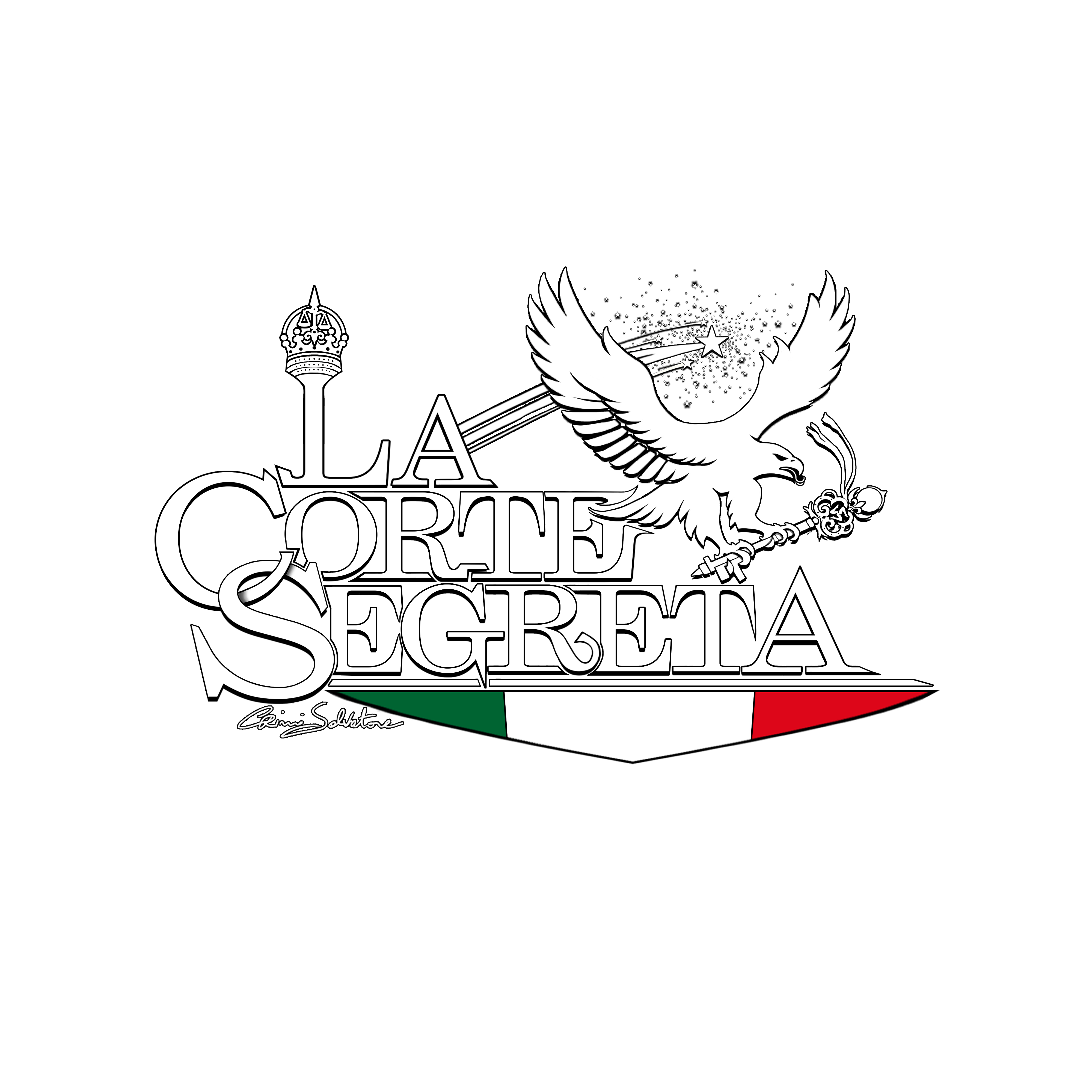
La Corte Segreta’s logo, drawn by Crimi Salvatore.
From 2014 to 2024: the birth of the signature wholewheat sourdough
The idea of approaching pizza dough differently came to Salvatore in early 2014, even before La Bottega Della Pizza was born. He had long read to educate himself. Books on flour production led him to look more closely at what makes up a wheat grain and what milling retains or separates.
He discovered the difference between bran from the grain’s outer layers, the germ and the endosperm, which notably contains the starch and proteins needed for dough. Very refined tipo 00 flour comes mainly from the endosperm. Wholemeal flour retains the grain’s different parts. This difference prompted questions about flavour as well as the fibre and nutrients flours can provide.
His interest in history fed this research. He sought to understand how food had developed in society since Roman times. This curiosity even led him to make garum at home to imagine what that ancient preparation might have been like. The experiment remained personal: it did not take place at the pizzeria.
Reading milling history, he became interested in the changes brought by industrialisation. White flour already existed through milling and sifting. Industrial processes made its production more efficient and consistent. What Salvatore wanted to rediscover in his own cooking, however, was another relationship with the grain: more material retained, a more evident flavour and different characteristics from very refined flour.
Whiteness, long associated with progress and refinement, therefore did not by itself represent progress in what he sought for his pizza. His choice developed around wheat flavour and the result he wanted to achieve through his own techniques.
Old pizzas and the question of flour
In Alexandre Dumas’s Le Corricolo, published in 1843, he discovered descriptions of Neapolitan pizzas predating the famous Margherita story associated with Queen Margherita of Savoy in 1889. Pizza already existed in several forms; its history did not begin with that single topping.
He was particularly interested in Marinara and Mastunicola. The story linking the latter’s name to a master called Nicola, with mastu meaning ‘master’ in Neapolitan, caught his attention. This legend formed part of his discovery of pizza traditions.
Reading Giovan Battista Del Tufo provided another reference point, with Ritratto o modello delle grandezze, delizie e maraviglie della nobilissima città di Napoli, composed around 1588. Salvatore discovered an early mention of pizza. The term was therefore used long before 1889 and the industrialisation of milling. Not all the old preparations described by it correspond to today’s Neapolitan pizza, but they opened a very practical question for him: what flours were used to make them?
He thought about milling, sifting and the material that might remain in old flours. A few years later, mentions of fior di farina in Bartolomeo Scappi’s Opera would extend this question. This ‘flower of flour’ describes a fine, selected flour; it alone does not allow its exact composition to be reconstructed.
Salvatore imagined a possible resemblance to what is now called tipo 1. This comparison fed his desire to work with less refined flours.
He gradually turned towards a dough incorporating more of the grain, through to wholemeal flour. tipo 1 offers an intermediate stage: it retains more outer fractions than tipo 00 without being wholemeal flour.
2015: two days of trials at La Bottega Della Pizza
The discussion with his father was brief. His father did not think the result would be satisfactory and mainly saw the technical difficulty: keeping dough that developed correctly with bran and germ, then stretching it thinly enough for pizza.
Salvatore agreed to set the idea aside. Yet it did not disappear from his mind.
In 2015, at La Bottega Della Pizza, he carried out a trial without telling his father. He prepared a special blend of several flours, mainly tipo 1. This dough was served for two days at the pizzeria.
The test succeeded. He did not, however, reopen the discussion with his father or repeat the experiment at La Bottega. This short trial remained a stage in research he would return to later, in another setting.
2019: research at home and mastering the dough
In 2019, Salvatore carried out various trials at home. He worked with wholemeal flour, tipo 1 and tipo 2 flours and semolina milled in different ways. He compared results and continued until he found a wholewheat sourdough that met what he sought.
He wanted to combine an open crumb with a very thin centre. Bran and germ needed to find their place in the dough without preventing a sufficiently developed gluten network from forming to hold, stretch and support the topping.
Autolyse, pauses during kneading and temperature control became elements of this work. He also studied water hardness. The trials thus covered the entire process: flour, water, starter, kneading, resting times and the way the dough reacted.
This research combined grain flavour, texture and the interest in retaining more fibre and micronutrients. Salvatore wanted a nourishing pizza and an enjoyable tasting experience.
2024: one dough, without tipo 00 flour
By La Corte Segreta’s opening in November 2024, Salvatore had already devoted several years to this way of working. He made a complete choice: only one dough would be offered, his signature wholewheat sourdough. He does not use tipo 00 flour for his dough.
The desired result combines the open crumb of the Neapolitan style, a thin centre and slightly longer baking inspired by some Roman pizzas. This work allows him to unite influences that informed his reading, experiences and trials.
Durum wheat semolina S1 is used when stretching the dough. As early as 2013, books on breadmaking had sparked his interest in semolina. He appreciates the texture it leaves on the crust and also notes, under his working conditions, a cleaner oven and less burned dusting residue beneath the pizza.
After opening, a report for Sudinfo took an interest in La Corte Segreta and highlighted the choice to offer only this wholewheat-based dough.
For Salvatore, tipo 00 flour does not match the relationship with grain and flavour he wants to develop. Leaving it out of his dough is a personal craft choice, built on reading and experience. He has never used it at La Corte Segreta and intends to maintain that decision.
IGNIS PVGNAX: the story of a wood-fired oven
For his new restaurant, Salvatore wanted a traditional wood-fired oven. He had already worked with electric, gas, conveyor and belt ovens. This journey taught him different ways to bake, but a fully manual wood fire remained at the heart of the craft he wanted to practise.
He cares about managing the fire as much as the pizzas. The flame must be guided, heat monitored and every bake attended to. This mastery comes on top of preparation, topping and service organisation.
With a conveyor oven, the programmed passage takes care of some baking actions: the pizza enters one side and emerges from the other. A wood-fired oven, by contrast, demands decisions and movements at every moment. In his career, Salvatore saw pizzaiolos capable of turning out one hundred and fifty pizzas in an evening with a conveyor become lost in front of a wood-fired oven, with three orders representing only six pizzas.
This difference struck him. He wanted to keep practising and passing on the work of fire, even when other equipment made some tasks more automatic. This is the tradition he wants to keep alive at the Casteau pizzeria.
Initially, his intention was simply to install a beautiful wood-fired oven. While its platform was being built, a sales representative from a major Italian-products wholesaler in Belgium entered the future pizzeria.
He had heard that a new establishment was opening in his region and came to leave a leaflet. Seeing the building work, he noticed the wood-fired oven being installed and was surprised: ‘You’re putting in a wood-fired oven?’ Salvatore said yes.
The representative continued: ‘But nobody does that any more. I sold wood-fired ovens for twenty years, so I know the subject well. You’re building Belgium’s last wood-fired pizza oven, because nobody installs them any more.’ They continued drinking coffee, then the representative left.
A few hours later, Salvatore thought again about the phrase: ‘Belgium’s last wood-fired oven’. It seemed sad to him. He heard in it the risk of losing, among new generations, part of the craft he valued. This sentence, spoken during a conversation, became the starting point for reflection on his own project.
He searched online for the equipment used by thirty new pizzerias in Belgium. Among the establishments he examined, he found no oven combining both characteristics he wanted: entirely wood-fired and entirely manual. The appliances shown notably included gas or hybrid gas-and-wood ovens. He also noticed the place of rotating hearths, which turn pizzas in the oven and automate some movement during baking.
This personal research lent weight to what he had heard. The next day, he changed his oven plan. He decided to design it and make something monumental, an oven he would give a name.
He increased its size, height and diameter. He sought a golden mosaic for the covering. He also enlarged the lower wood-storage spaces: the original project allowed around one stere, while he now planned a capacity of three steres.
This reserve forms part of the organisation he seeks. At his working pace, it should allow around two months of intensive daily use without replenishing the storage beneath the oven. Baking work and wood storage were therefore planned together.
Reading accompanied this transformation of the project. Bartolomeo Scappi’s Opera informed his reflections on kitchen work and fire. Another book struck him: Bernardino Telesio’s De rerum natura iuxta propria principia.
Heat occupies a fundamental place in Telesio’s understanding of nature. Salvatore found inspiration to see fire as a force beyond a simple cooking appliance. When the flame takes hold, nature expresses itself; when it becomes powerful, that expression becomes powerful too. This reading connected with a memory he had kept since adolescence.
La Corte Segreta’s oven was finished but had not yet received its name. Salvatore waited for inspiration. One evening, drinking red wine, he recalled a scene at Da Salvo when he was fifteen.
That day, the clock had not been corrected after the time change. Salvatore usually lit the oven at around five in the afternoon. He was about to do so and placed two logs on the ashes.
The oven was still hot from lunchtime service. It had cooled, but remained at around two hundred degrees. His mother then pointed out the clock’s error: it was actually four in the afternoon, an hour earlier than he thought.
He therefore closed the oven again. The two logs remained inside. They heated in this space with limited airflow, and smoke accumulated.
Around fifty minutes later, Salvatore returned and opened the oven. Air entered. He saw the smoke and stayed briefly in front of the opening, without realising what would happen.
Suddenly, a violent ignition occurred inside. The fire took hold in a fraction of a second and a ball of flame came towards him through the opening. Everything happened extremely quickly. Instinctively, he fell backwards onto the floor. He was not burned.
The phenomenon called ‘backdraft’ can occur when a sudden supply of air enters a confined space low in oxygen and containing combustible gases from incomplete combustion. With an ignition source present, these gases can ignite violently and cause a deflagration.
The noise struck him as much as the image. He keeps a memory he knows he will never forget. That day left him feeling as though he had received a ‘punch of fire’.
Many years later, this memory finally gave his oven a name: IGNIS PVGNAX. It brings together fire’s force, lived experience and the profession he chose to continue. At La Corte Segreta, this oven remains entirely manual, fuelled by beechwood, with every pizza turned by the pizzaiolo.
Photography is one of Salvatore’s passions. For La Corte Segreta’s first Facebook post, on 31 October 2024, he chose to recreate a sight that struck him as a child: the oven’s flames and his father’s movements, watched from a small stool at Da Salvo.
He wanted to reproduce that feeling with his own IGNIS PVGNAX oven. He used his first DSLR, a Canon 700D, mounted on a Manfrotto tripod. A wired remote let him release the shutter from a distance.
He prepared a Margherita pizza. To recreate powerful combustion and give the photograph movement, he added a large piece of bark to the fire, echoing the bark-covered log he had seen in childhood.
He set a shutter speed fast enough to capture beautiful flames. But a problem arose: the fire lit the oven’s interior, while the outside remained too dim to show its outline clearly. He therefore added external light sources directed at the oven.
He also connected fire’s power and dynamism with being a pizzaiolo. The profession requires composure and speed. With wood fire, flame management comes on top of preparing and baking pizzas. This dual mastery contributes to the difficulty of finding good pizzaiolos, particularly for this type of oven.
His first post was greatly appreciated and received many views. In it, he told of that childhood moment and the connection he retrospectively made with the profession he now practises.
In La Corte Segreta’s very first Facebook post, dated 31 October 2024, Salvatore shared this photograph of Margherita before the flames of IGNIS PVGNAX. He told of the small stool at Da Salvo and the connection between that childhood sight and the birth of his pizzeria.
7 November 2024: La Corte Segreta opens its doors
The very first service went wonderfully. Conversations with the first customers continued far into the night. These discussions hold a special place in the memory of that opening evening.
Most customers who came during the first week remain extremely loyal today. Salvatore knows their names and greets them with a kiss when they return. This relationship is part of being a restaurateur and one of his favourite aspects of the profession.
There are many conversations with satisfied customers. Some describe it to him as the ‘best pizzeria in Belgium’, others as a pizzeria at ‘Top 50 level’. People congratulate him on the atmosphere and, very often, the quality of the dough.
Yet his most beautiful experience remains a customer whose table he approached to ask whether everything had gone well. She looked him in the eyes and simply said: ‘Thank you.’
That thank you had incredible depth for him. In that look and those words, Salvatore understood that she had grasped all the work behind La Corte Segreta. This recognition remains his strongest memory among the many conversations he has had with customers.
Ex Flammis Renascor, La Corte Segreta Nata EST.