Semolina
Semolina for stretching: why La Corte Segreta uses it on the work surface without incorporating it into its pizza dough.
The essentials
Semolina is not part of our pizza dough mix.
The difference between semolina and ordinary flour
In everyday language, ordinary flour means a fine powder produced by milling wheat. It quickly mixes with moisture, sticks readily to hydrated dough and easily becomes a light dust.
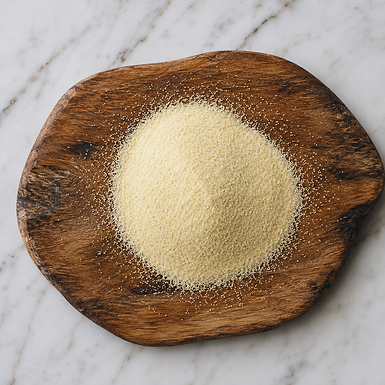
Semolina is different. It comes from durum wheat, the Italian grano duro, and has a coarser particle size. The Codex Alimentarius clearly distinguishes durum wheat semolina from durum wheat flour by particle size: semolina retains a more granular structure, while flour is finer.
An old story of grain
The Italian word semola comes from the Latin simila, associated with the idea of fine flour or ‘the finest flour’. Mediterranean peoples have long learned to separate milled products according to their fineness, use and behaviour in cooking.
In Italy, durum wheat semolina became central to pasta, but also to some southern breads. It belongs to a working food tradition: durum wheat, kneading, fermentation, hot ovens and preservation.
How we use it at La Corte Segreta
Before settling on this method, we compared several ways of stretching: fine flour alone, a flour-and-semolina mixture, then semolina alone.
The tests were carried out under the same conditions, without a nearby fan or any external factor that could change the behaviour of flour or semolina in the oven. For each trial, we used very little material for stretching, as in actual service. The pizzas were loaded using a 33 cm perforated Gi Metal peel to reproduce our usual working method.
We tested several baking sequences. Pizzas were stretched, loaded and baked repeatedly without cleaning the oven between each round, to observe clearly the residue left on the oven floor. One test involved 10 pizzas loaded at the same time, first all stretched with flour and then all stretched with semolina. We also carried out batches of 4 x 5 pizzas, 8 x 2 and 10 x 1, always under the same conditions.
We observed the whole process: the dough’s reaction, transfer onto the peel, loading into the oven, baking, residue on the oven floor, cleaning with the oven brush and the final flavour beneath the pizza.
The result was clear. Fine flour quickly dries the surface and prevents sticking, but always leaves more dust in the oven. In a very hot oven, this dust marks the floor, burns quickly, turns into residue and can transfer to subsequent pizzas even after cleaning. We also found that fine-flour residue became more embedded in the oven brush.
Semolina gave a cleaner result. It remains easier to see on the work surface, is easier to measure and remove, and leaves less of a burnt film in the oven. The grains are heavier, more visible and behave better than fine flour during stretching and loading.
Beyond the technical tests, semolina’s flavour and distinctive crunch won us over. The pizza base gains texture: not an aggressive crispness, but a fine, dry, pleasant bite.
Semolina and Italian breads
Semolina also belongs to a great Italian bread tradition. In Puglia, Pane di Altamura DOP is made with remilled durum wheat semolina, sourdough starter or mother starter, salt and water. In Basilicata, Pane di Matera IGP also relies on durum wheat semolina and a baking culture rooted in its region.
Our special wood-fired bread combines rimacinata semolina, tipo 2 flour and wholemeal flour. It is baked at 200 °C for about 40 minutes in a more humid oven than our other breads. Cut into slices, it is used for bruschette. On Wednesday mornings, the bread intended for breadcrumbs is dried in the oven at 100 °C, then turned into house-made breadcrumbs for some pizzas, notably the Mare Nostrum. The tipo 2 flour article explains this preparation in detail.
Useful links and sources:
Sémola - Significato ed etimologia - Vocabolario - Treccani
Exposure to flour dust in the occupational environment - PMC
Baker - HSE Flour dust and enzymes containing additives such as amylase are the second most common cause of occupational asthma. They also cause dermatitis.
COSHH and bakers - key messages - COSHH
Hazard Communication Guidance for Combustible Dusts | Occupational Safety and Health Administration
Related archive articles
