Wholemeal flour (T150)
Wholemeal flour: understanding the whole grain, its role in our pizza dough blend and storage instructions at La Corte Segreta.
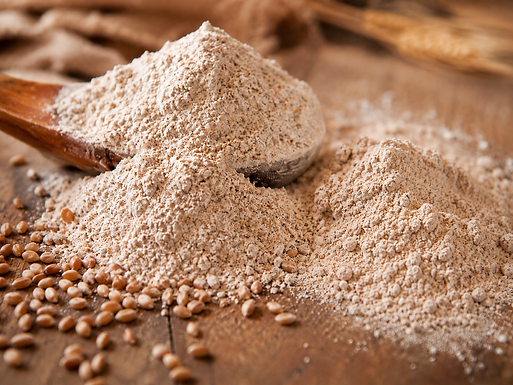
Wholemeal flour in a few words
Wholemeal, or wholegrain, flour retains the main components of the grain. In wheat, these are the bran, the germ and the starchy endosperm.
A grain of wheat in three parts
The bran: the outer layers of the grain, which provide fibre among other things.
The germ: the part from which a new plant can develop. It contains fats, among other components.
The endosperm: the inner part, which mainly provides starch and proteins.
Why the dough needs different handling
Bran and the other components of the grain change the distribution of water and the dough's structure. The fineness of the milling also matters: two wholemeal flours can behave differently.
Gluten forms a network that helps the dough retain fermentation gases. With wholemeal flour, achieving an even structure requires attention to the grain particles and their hydration.
In practice: a white-flour recipe cannot simply be transferred unchanged. Water, resting time, temperature and dough handling must be considered together. Wholemeal dough is not inevitably dense; its preparation matters.
Our choice for pizza dough
We offer pizza dough based on wholemeal flour, rather than a wholemeal option alongside a conventional white dough. This choice guides our work in Casteau.
Our recipe uses a blend of flours, including wholemeal flour and tipo 1. Each contributes to the dough’s character.
We seek cereal aromas, a dough that is pleasant to eat and a well-developed rim. The raised edge of a pizza is called the cornicione. The proportions and method remain those of our recipe.
Flavour and nutrition: being precise
The presence of the whole grain gives the flour a different profile from refined flour, particularly through the bran's fibre. Flavour and texture also depend on the wheat and how it is milled.
When discussing our pizza, we highlight our choice of flour and the work involved.
Mistakes to avoid
Confusing wholemeal flour with gluten-free dough. Our wheat flour contains gluten.
Adding water or flour at random. Follow the specified quantities and steps.
How we use it at La Corte Segreta
1. Store it in the right place. Bags are kept only in location 1 or location 2, in a clean, dry place protected from moisture. No bag should touch the floor directly, even temporarily: it must remain on a clean, raised support.
2. Open only one bag of each flour type. Before opening a new bag, check whether a bag of the same type is already open and use that one first. Follow the specific opening instructions provided in the kitchen.
3. Use a utensil to take out the flour. Always take flour with a clean, dry utensil, never with your hands. Several utensils are available. The 2,8 kg utensil is reserved exclusively for wholemeal flour: it must not be used for other flours.
4. Close the bag after every use. As soon as you have taken out the flour, fold over the top of the bag, then place a clean, dry tea towel over the folded top. Return the bag to location 1 or 2. The towel adds protection; it does not replace folding the opening closed.
For several months in 2025, Crimi Salvatore also experimented with wholemeal dough incorporating organic blue poppy seeds. This work aimed to control the development of the gluten network with these additions; the large air pockets and small dark flecks in the crumb distinguished this trial, which our guests enjoyed.
Related archives
Autolyse: preparing pizza dough →
