Organic blue poppy seeds
From wholemeal dough trials in 2025 to finishing La PeraCoscia: the story and quantity of organic blue poppy seeds at La Corte Segreta.
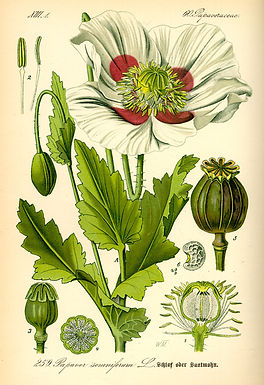
From poppy to seed: this 1885 botanical plate brings together the flower, capsule and seed details, showing where the tiny seeds used in cooking come from.
Otto Wilhelm Thomé, Flora von Deutschland, Österreich und der Schweiz · 1885 · Document source · Public domain
At La Corte Segreta, organic blue poppy seeds first featured in our pizza dough work before finding a place as a topping on La PeraCoscia, our pear pizza. These small dark seeds add a striking visual detail and delicate crunch.
An experiment with wholemeal dough in 2025
For several months in 2025, Crimi Salvatore tested incorporating them into our dough based on wholemeal flour. His aim was to better control the development of the gluten network in the presence of whole-grain components and small seeds that remain distinct in the dough.
Gluten forms a supple network capable of retaining fermentation gases. This allows air pockets to develop. With wholemeal flour, bran influences water absorption and the network's structure; adding seeds introduced another challenge to explore in our trials.
The resulting dough had large air pockets reminiscent of a Neapolitan pizza, and small dark flecks visible in the crumb. Our guests greatly enjoyed it, including professional bakers who appreciated this work. The seeds also provide fibre, whose contribution depends on the quantity added.
How we use them at La Corte Segreta
As a topping, poppy seeds accompanied the arrival of La PeraCoscia. They complement the pear's juiciness and chestnut honey with fine crunch and slight bitterness. Their small dark flecks contrast with the fior di latte.
- Add the seeds after the pizza leaves the oven, just before serving.
- Use a very discreet quantity: their presence should be mainly visual and remain extremely subtle on the palate.
Related archives
Organic chestnut honey from Piedmont →
