GioBatta Poli — the innkeeper and the still on wheels
In the Veneto countryside, a merchant who sells wine and straw hats makes a living from grappa.
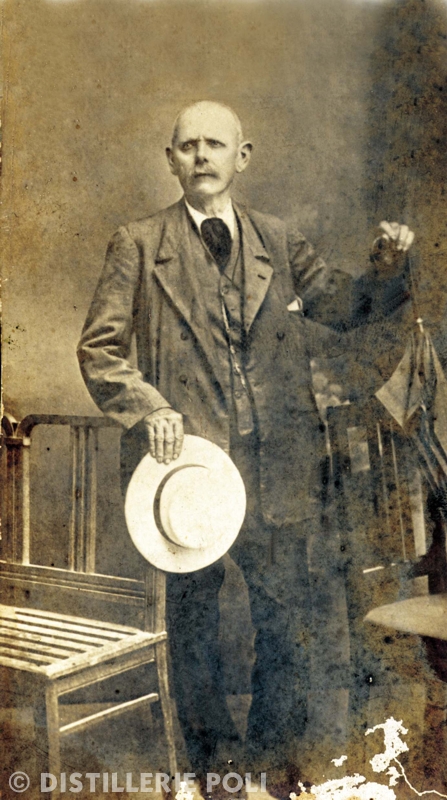
GioBatta Poli (1846–1921), from San Luca to Schiavon.
Poli Distillerie archive, via GrappaCom and Wikimedia Commons · CC BY-SA 3.0. Original document · Licence
A wager on the road
GioBatta Poli was born in 1846 in San Luca, in the hills around Marostica in Veneto. He sold wine and provisions with his brothers and ran a coaching stop where travellers heading up to the Asiago plateau could change horses. His wife, Maria Moresco, was a milliner.
Before the still come the trading rounds. The Poli brothers spend much of their time on the road selling wine, fruit and straw hats. According to the family chronicle, their earnings even allow them to lend money at a time when local banks are scarce. As the agricultural crisis hits Veneto, some of their relatives leave for America. GioBatta and Maria choose to move their business a few kilometres down the road.
In 1885 the family moved down to Schiavon. Maria bought a house and some land. Soon the Osteria al Cappello was trading in straw hats as well as wine. A steam line was in the works for the area. The tram linking Bassano and Vicenza eventually reached Schiavon in 1910, twenty-five years after the family moved.
From cart to distillery
The Poli museum preserves a nineteenth-century mobile still that it identifies as the one GioBatta used. According to the museum, tax rules put an end to travelling distillation, so in 1898 he installed a fixed still at the inn. His contacts with local winemakers gave him access to pomace, the grape skins and seeds left after pressing.
An old photograph from the distillery shows the work involved. The pomace came in wicker baskets and workers filled the three small boilers by hand. After GioBatta died in 1921, three of his sons took over. Their 1925 partnership declaration records the date of their father’s death as the start of their business together.
The amaro at the tram stop
The family tells of passengers waiting for the tram at the inn over a glass of wine or a bitter infusion of herbs, fruit peel and roots. The driver is said to have dropped in sometimes. The Vaca Mora amaro on our menu takes its name from the tram’s nickname, the ‘black cow’.
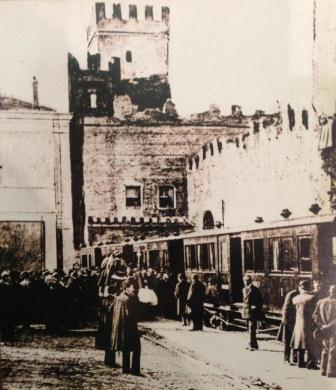
The opening of the Vicenza–Bassano tramway at Schiavon in 1910, twenty-five years after GioBatta and Maria arrived.
Photographe inconnu · Public Domain Mark 1.0 · Original document · Licence
Also in our archives
Vaca Mora · the steam tram’s amaro →
Poli Distillerie · the history of the house →
Jacopo Poli · betting on the stills →
Sources
Poli Distillerie · the account of the move to Schiavon
Unioncamere · register of historic businesses
Poli Grappa Museum · GioBatta’s mobile still
Poli archive · the three sons’ 1925 partnership declaration
Poli Distillerie · Vaca Mora and the story of the passengers