Sweet peppers
Green, yellow and red peppers on pizza: understanding their pan preparation and the importance of draining at La Corte Segreta.

A green pepper still attached to its plant. The view brings together fruit and leaves, showing the vegetable in its growing environment. Source and credit: Azorbli · 13 April 2025 · CC BY-SA 4.0.
At La Corte Segreta, the peppers on our pizzas are fresh, like our other vegetables. We work with three colours: green, yellow and red. This choice is more than visual. The three colours bring nuances of flavour and texture to our preparation.
The pepper in nature
The sweet pepper belongs to the species Capsicum annuum. This same species also includes several chillies, but the sweet pepper differs in its mild flavour and lack of heat.
In nature, the plant grows as a small upright shrub. It produces small white flowers, then fruits that can take several shapes and colours according to variety. Botanically, the pepper is a fruit, more precisely a berry.
In cooking, it is used as a vegetable.
A history from the Americas
The sweet pepper comes from the world of Capsicum, a group of plants native to the Americas. Its domestication is ancient and is notably associated with regions of Mexico and Mesoamerica.
After European voyages to the Americas, Capsicum reached Europe in the late 15th century. The name ‘poivre’ or ‘pepper’ comes from a historical confusion: Europeans were looking for spices resembling black pepper, which was very precious at the time.
Yet Capsicum does not belong to the same botanical family as black pepper.
Over time, sweet peppers and chillies established themselves in many cuisines. In the Mediterranean, they found an important place in sautéed, grilled, stuffed and simmered dishes, and in some pizza toppings.
Green, yellow and red: three colours, three roles
Colour depends on the variety and harvest stage. A green pepper is generally picked before full ripeness; when ripe, fruits can become yellow, red, orange or other colours, according to their variety. Yellow is therefore not necessarily a stage before red.
In our preparation, green pepper brings a vegetable note, firmness and slight bitterness. On a pizza, we seek its freshness and depth.
In our blend, yellow pepper brings roundness and mild flavour. It helps balance the green pepper’s vegetable note and the red pepper’s sweetness.
Red is the ripe colour of certain varieties. In our preparation, we appreciate its sweetness and texture, which becomes tender during cooking. On a pizza, it complements mozzarella, tomato, vegetables and certain charcuteries.
Sweet peppers and the Scoville scale
The sweet pepper sits at the lowest point on the Scoville scale: 0 SHU. This scale measures the sensation of heat associated with capsaicinoids, including capsaicin.
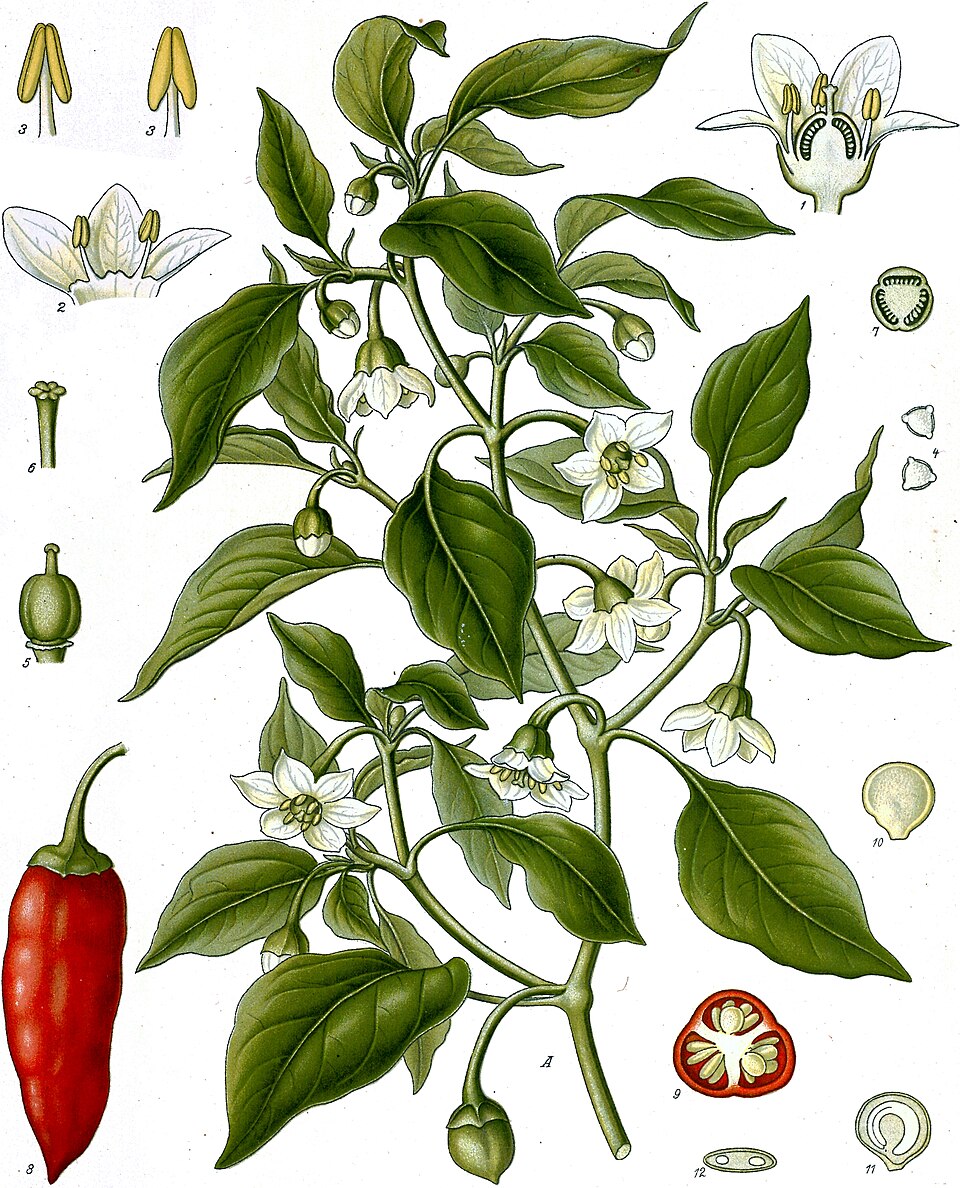
Capsicum annuum in Köhler’s medicinal plants: flowers, fruits and seeds are studied separately. This plate shows an elongated chilli, belonging to the same botanical species as many sweet peppers. Source and credit: Franz Eugen Köhler, Köhler’s Medizinal-Pflanzen · 1897 according to the document record · Historic public-domain work.
How we use them at La Corte Segreta
Whenever a pizza contains peppers, salami, aubergines or sausage, we never add extra olive oil at the end of topping. Just one of these ingredients is enough for the instruction to apply.
Pan-prepared peppers already carry the fat used in their preparation. The absence of an extra drizzle of oil is therefore deliberate and part of the recipe’s balance.
At La Corte Segreta, peppers are prepared before going onto pizzas. They are first cleaned, then thinly sliced into strips. This cut allows even cooking and good distribution across the pizza.
The strips are then sautéed in extra virgin olive oil. We add spices and iodised sea salt to season the vegetable during cooking, not only afterwards. The pan gently softens the pepper’s flesh, concentrates its flavour and mellows its texture.
After cooking, the peppers are drained. This step matters because peppers contain a lot of water. Draining preserves the pepper’s flavour without introducing excessive moisture.
The peppers are then placed in special filtered containers. This keeps the topping well drained and ready to use at the right moment.
Useful links and sources:
University of Maryland — pepper growth and ripe colours by variety
Pepper - Capsicum annuum | Kew
How Do You Measure the ‘Heat’ of a Pepper? | NIST
Peppers by Scoville Units – Gardening Solutions
A Plant from the Americas that Conquered the World – Smithsonian Affiliations
Related archive articles
