Santa Venere: the memory of land in Cirò
Calabria — the Scala family, Gaglioppo and an agricultural history centred on local grape varieties.
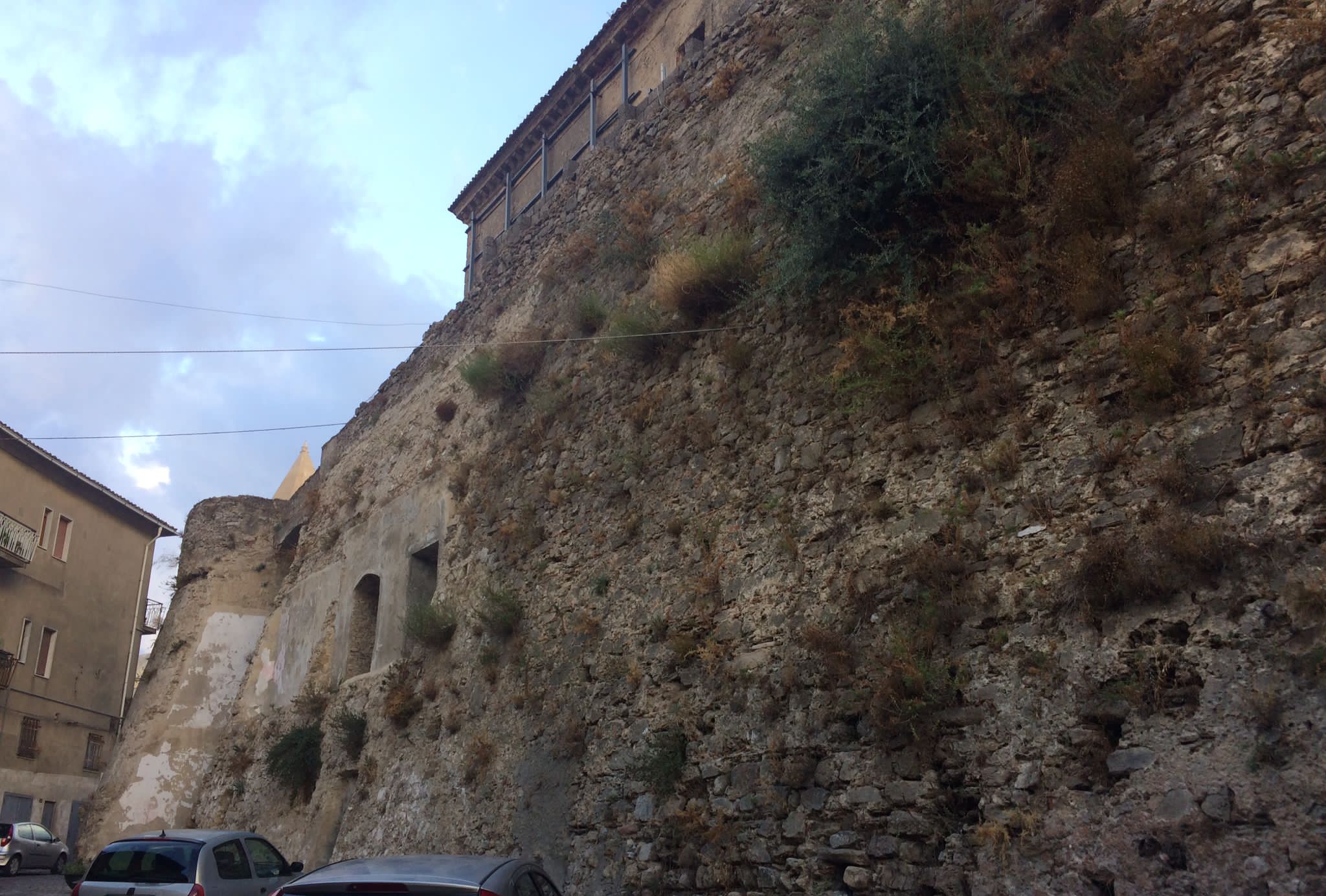
Carafa Castle in Cirò, in the province of Crotone, Calabria. — Ottantafame · Original image · CC BY-SA 4.0
A story of vines and olive trees
Santa Venere is in Cirò, in the province of Crotone, on the Ionian side of Calabria. The Scala family’s land ownership dates back to 1600. For a long time, agricultural life brought together vineyards, olive trees and oil production. Here, wine began in an inhabited, cultivated landscape before becoming the name we know today.
In 1960, Federico Scala took over his father’s business and developed Santa Venere, a name borrowed from the stream running through the property. Giuseppe later joined him and continued the venture with Francesco. The family favours regional grape varieties and organic farming. We like this continuity: a new generation brings new ways of working while maintaining the connection to the place.
Gaglioppo at the heart of Cirò
Santa Venere’s Cirò Rosso is based on organically grown Gaglioppo. The grapes come in particular from Voltagrande and other vineyards in Cirò. The family owns vineyards in several locations named Volta Grande, Vurgadà, Piana di Coletta, Sant’Angelo and Speziale. These names trace the different places in its winegrowing story.
Our Cirò Rosso Superiore BIO introduces this Gaglioppo within a controlled designation of origin. We like a Calabrian red to retain its grape name and distinctive character. Its fruit and depth offer a different encounter with southern Italy from Primitivo or Nero d’Avola alone. When choosing, it is also worth considering the texture and freshness that accompany the fruit.
The producer’s range does not stop at this red. Marsigliana Nera, Guardavalle, Greco Bianco and Nerello Cappuccio also feature in its wines. A Marsigliana Nera rosé or a Guardavalle white reminds us how many discoveries Calabria still holds. We appreciate this approach, which gives local grapes the leading role and allows the region to speak in several voices.
A red grape that also produces bubbles
One detail among the family’s projects deserves attention: Gaglioppo can also produce sparkling wines, including a white. Santa Venere uses the traditional method, in which bubbles develop through a second fermentation in the bottle. The SP1 project brings together Giuseppe Scala and his cousin Domenico De Sole, using grapes from neighbouring vineyards for this creation.
We find this collaboration interesting because it broadens our view of a grape variety. A grape known for reds can find another expression through a different winemaking process. It also shows that a producer with deep agricultural roots can continue to explore new paths. This project is part of Santa Venere’s story.
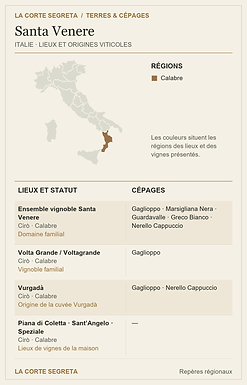
Santa Venere: documented regions, locations and grape varieties. Mapping: ISTAT boundaries, distributed by openpolis / geojson-italy, CC BY 4.0. Projection and colours adapted; a regional location map, not a cadastral map. Map boundaries · CC BY 4.0
Gaglioppo: Calabrian character and a family revealed by genetics →
Traditional method: bubbles born in the bottle →
DOC — Denominazione di Origine Controllata →