Sebastian Artois: the man behind the name
Master brewer in Leuven in 1708, owner of Den Hoorn in 1717: the man whose name runs through Stella Artois’s history.

The former Artois breweries, now De Hoorn, in Leuven. Photograph: Kris Vandevorst, 2017 — Agentschap Onroerend Erfgoed, CC BY 4.0.
A name behind a familiar beer
On a Stella Artois, ‘Artois’ is first the name of a man. Sébastien Artois, also called Sebastiaan or Sebastian, lived from 1680 to 1726. From a family originating in Herent near Leuven, he belongs to the story of a brewing craft passed on within a city, then a family.
At La Corte Segreta, we enjoy finding the people behind the names we serve. With him, a familiar beer opens a door onto early 18th-century Leuven: a world of workshops, breweries and expertise.
1708: becoming a master brewer
In June 1708, Sébastien Artois became master brewer at Den Hoorn in Leuven. He was admitted to the city’s brewers’ guild. The title reflected a recognised craft, long before industrial equipment and the international spread of the beer bearing his name.
Den Hoorn means ‘the horn’. Artois joined a producer that already had a history: a document from 1366 mentions a house called Den Horen, while a brewery of that name in the Mechelsestraat is documented at least from the early 16th century.
1717: the brewery takes his name
Nine years after becoming master brewer, he bought Den Hoorn in 1717. This move from craft to ownership was the turning point that permanently attached the Artois name to the brewery. His role in brewing history rests on this continuity: taking over an existing producer and giving it a family identity destined to last.
His descendants continued the adventure. His son Adrianus had the brewery rebuilt in 1778; in the late 18th century, Leonardus expanded the company by acquiring other Leuven breweries. The subsequent growth was therefore built over several generations.
The star appears two centuries later
The detail is surprising: Sébastien Artois never knew Stella Artois. He died in 1726; the beer called Stella was introduced in 1926, two hundred years later, as a Christmas beer for Leuven’s residents. ‘Stella’ means ‘star’ in Latin.
The name and symbols thus bring several eras together: the horn evokes Den Hoorn, Artois recalls the master brewer who became owner, and the star refers to the Christmas beer’s birth. This is the thread we follow in our archive article on Stella Artois.
What this story inspires in us
Leuven was a beer city long before its worldwide fame. In the mid-18th century, it had forty-two breweries along the Dyle. Artois’s journey makes full sense within this landscape: a craftsman, a producer and a city whose stories meet.
For us, telling Sébastien Artois’s story allows a fresh look at a familiar name. At La Corte Segreta, our library also preserves this memory of crafts and knowledge passed down: behind a beer can be a person, then several generations continuing his work.
What the times demanded
The original Den Hoorn stood on Mechelsestraat, between Penitentienenstraat and the Dyle. Merchants and craftspeople worked on the street, and the river made it a natural place for brewers. Around 1770, it still had fourteen breweries. That is the setting in which to picture Sebastian’s decision in 1717. He bought an established brewery in a working neighbourhood where his name would have to earn its place brew by brew.
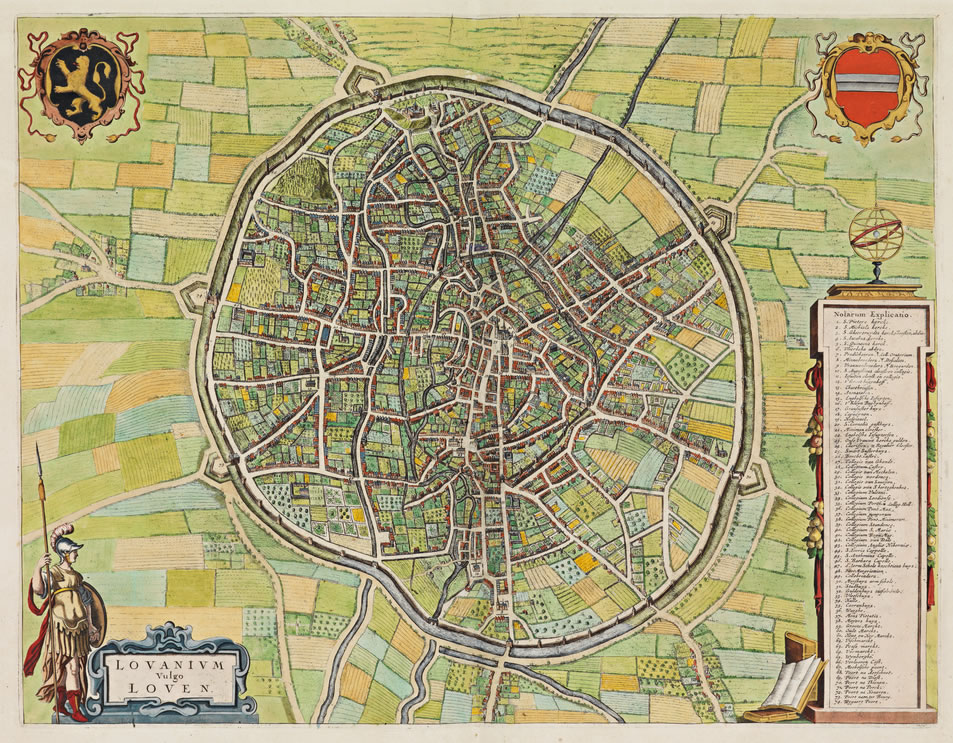
A map of Leuven around 1700, when Sebastian Artois was beginning his brewing career.
Frederik de Wit · Library of Congress · Wikimedia Commons · Original document · Licence
Père Théodore: the monk who shaped Chimay →
Sources
Flemish Heritage Inventory · Mechelsestraat
Also in our archives
Léon Verhelst, from the ruins of Leuven to the first Stella brew →