Barolo: the king of wines, the wine of kings
A marchioness, sovereigns and Piedmontese cellars: a courtly story of patience behind the famous nickname.
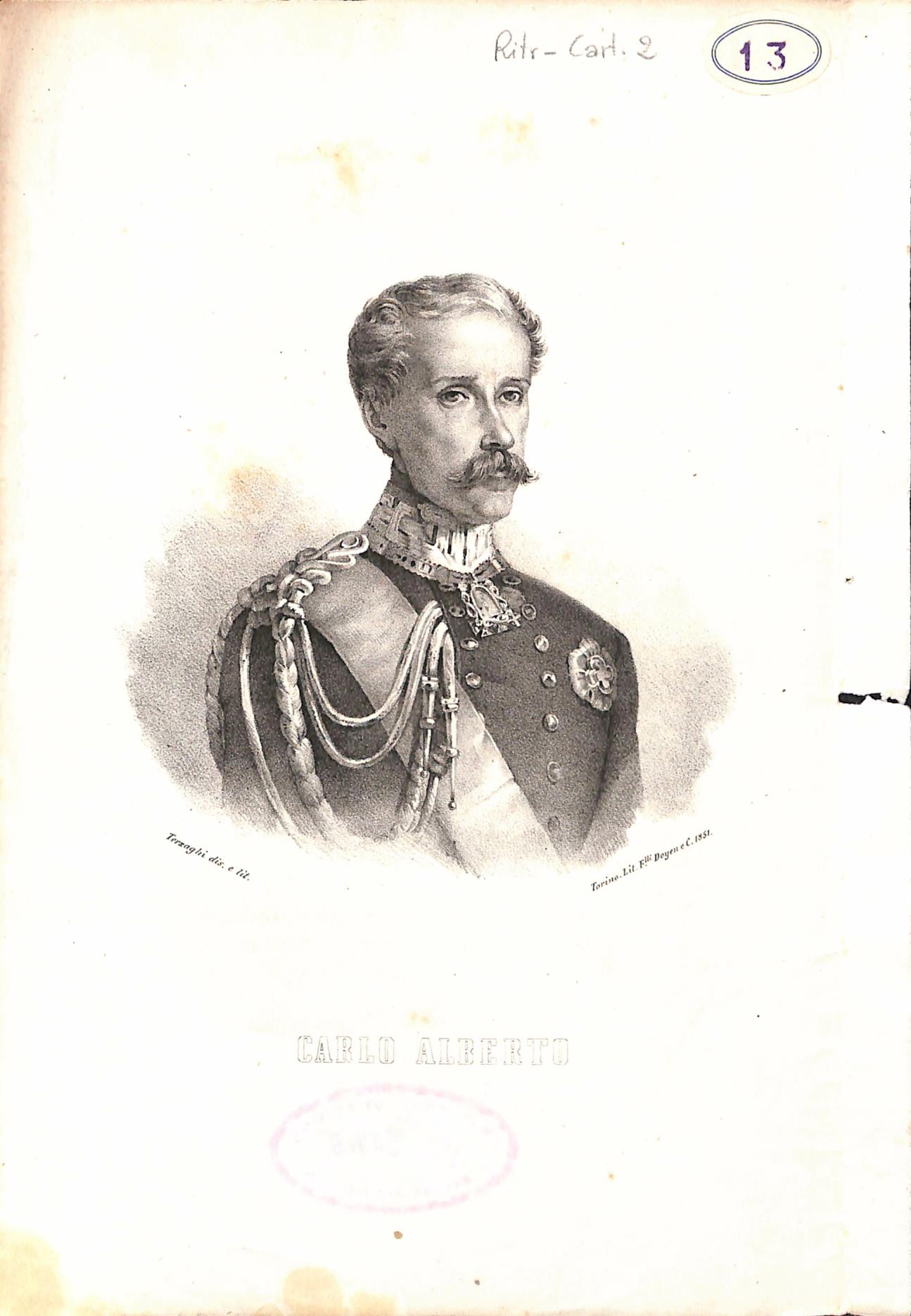
Charles Albert of Savoy, King of Sardinia. Luigi Terzaghi, lithograph published in Turin by F.lli Doyen e C., 1851. Biblioteca di Storia e Cultura del Piemonte “Giuseppe Grosso”. Public domain, via Wikimedia Commons.
Original historical image · Public domain
Two crowns for one wine
“The king of wines, the wine of kings”: Barolo carries a phrase that sounds like a courtly motto. It joins two ideas. “King of wines” celebrates its reputation and ability to age; “wine of kings” recalls its ties to the House of Savoy and the aristocratic tables of the nineteenth century.
This is no official title awarded to a competition winner. The nickname grew with a wine that became an ambassador for Piedmont. Before it became a famous name on wine lists, Barolo was a village in the Langhe, watched over by its castle.
A Frenchwoman at the court of Turin
Juliette Colbert, known in Italy as Giulia Falletti, Marchioness of Barolo, stands at the heart of this story. She settled in Turin with her husband Carlo Tancredi and took an interest in the family’s Langhe vineyards. Their cellars and connections helped spread the reputation of this Nebbiolo.
An account from 1834, reproduced by Marchesi di Barolo, is particularly telling: botanist Giorgio Gallesio noted that the marquis kept wine to send to the court of Turin. The royal link thus appears in a travel account, beyond the prestige of a label.
A gift of 325 barrels
Tradition tells of Charles Albert asking the marchioness for a taste of her famous wine. Her reply supposedly arrived in the form of 325 carrà: transport barrels carried to Turin on ox-drawn carts.
Why 325? The story allows one for every day of the year, except the forty days of Lent. Recounted by Marchesi di Barolo through Domenico Massé, this belongs to the legend passed down around the wine. The image is irresistible: for a mere “sample”, a whole procession outside the royal palace.
Cavour, the cellars and a collective endeavour
Modern Barolo did not emerge from a single invention. At the castle of Grinzane, Camillo Benso, Count of Cavour, took an interest in managing the estate and its production. The museum presents two of his collaborators: General Paolo Francesco Staglieno and French oenologist Louis Oudart.
Their presence recalls the research, trials and exchanges that accompanied the evolution of Langhe wines. Reducing the story to one Frenchman who supposedly “invented Barolo” would erase the work of estate owners, specialists and winegrowers.
Kings also owned vineyards
The Savoy connection extends beyond banquets. In 1858, Victor Emmanuel II purchased the Fontanafredda estate for Rosa Vercellana. The estate’s timeline records the purchase of a vineyard in Barolo in 1866, followed by the development of the business by their son Emanuele Alberto.
Wine is part of a story of land, families and production. Sovereigns and their descendants helped shape this winegrowing landscape directly, giving “wine of kings” a very tangible meaning.
The nobility of time, with precise rules
Today, Barolo DOCG is made exclusively from Nebbiolo within a delimited area covering eleven Langhe municipalities. DOC recognition came in 1966, followed by DOCG in 1980. The name protects a place and a method, beyond its luxurious reputation.
Its production rules require at least thirty-eight months of ageing, including eighteen in wood, counted from 1 November of the harvest year. For a Riserva, the wait rises to sixty-two months. Time is part of its identity before the bottle is even opened.
A natural place at La Corte Segreta
Our Prunotto Barolo continues that memory: the producer traces this label’s first vintage to 1905. Its own history sits within the wider story of Nebbiolo and the Langhe.
A wine linked to marchionesses, sovereigns and cellar craftsmanship had a natural place in the world of La Corte Segreta. Choosing it for our list also invites this history to the table: behind the bottle, centuries of Italian culture continue their journey.

Discover more in our wine archives
Prunotto Barolo DOCG: a thread reaching back to 1905 →
Prunotto: a couple who saved a Langhe winery →
Nebbiolo: discover the grape variety →
Sources and references
Consorzio Langhe Vini — Barolo DOCG
Marchesi di Barolo — La storia
Castello di Grinzane Cavour — I cimeli cavouriani
Consorzio Langhe Vini — Disciplinare Barolo DOCG
Wikimedia Commons — Luigi Terzaghi, Carlo Alberto, 1851
People in this story
Juliette Colbert · From the Cellars of Barolo to Turin’s Prisons →