Carlsberg · Why is there a crown on the label?
The small crown above the Carlsberg name points to a specific year. In 1904, Carlsberg became the first Danish brewery appointed as a supplier to the Royal Danish Court. The story of how that symbol reached the label begins on a hill in Copenhagen, with a stagecoach journey and a falling-out between two brewers in the same family.
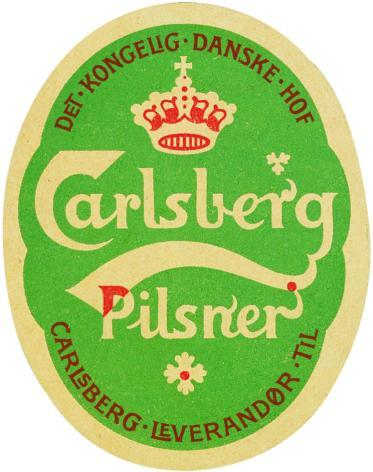
The 1904 Carlsberg Pilsner label. The red and gold crown appears above the name.
Thorvald Bindesbøll · 1904 · View the document · Public domain
Bringing yeast back from Munich
Jacob Christian Jacobsen first tries Bavarian beer at a wine shop in Copenhagen. In 1845, he travels by stagecoach to the Zum Spaten brewery in Munich to obtain yeast. According to the brewery museum, he carries the yeast in a hatbox and makes frequent stops to moisten it with cold water during the twenty-day journey home. Back in Denmark, he needs room and cool cellars to make this bottom-fermented beer. In 1847, he sets up his brewery on Valby Hill. Its name combines his son Carl’s name with berg, an old Danish word for ‘hill’.
Fire strikes the brewery in 1867. Jacobsen uses the rebuilding to modernise the brewery and chooses materials more resistant to fire. In 1875, he opens a laboratory to study questions that arise in the brewery. In 1883, Emil Christian Hansen develops a method there for growing a pure strain of yeast. It makes fermentation easier to control from batch to batch. The method is made available to other brewers free of charge. In May 1884, Jacobsen writes to Gabriel Sedlmayr, his former teacher in Munich. This time he offers to send enough pure yeast to start fermentation in a vat.
Two Carlsbergs on the same hill
The son the brewery is named after becomes his father’s competitor. In the annex J. C. has put him in charge of, Carl shortens the time his beer spends maturing, to his father’s dismay. Carl’s sales overtake his father’s, and J. C. tries to limit his son’s production and make him change his brewery’s name.
In 1882, Carl opens Ny Carlsberg, or ‘New Carlsberg’, and his father renames his own brewery Gamle Carlsberg, ‘Old Carlsberg’. They reconcile in 1886, a year before J. C. dies. From 1902, the Carlsberg Foundation owns both breweries. The 1904 label appears two years before they merge in 1906.
1904, the Royal Court and Thorvald Bindesbøll’s design
When Carlsberg receives its appointment as a supplier to the Royal Danish Court, the brewery launches a bottled pilsner with a label designed by Thorvald Bindesbøll. The crown makes the appointment visible. On the green oval, read the bottom edge first and then the top. ‘Carlsberg Leverandør til Det Kongelig Danske Hof’ means ‘Carlsberg, supplier to the Royal Danish Court’.
The hop leaf alludes to the beer’s ingredients. Designmuseum Danmark sees the hop plant echoed in the organic curves of the lettering itself. These forms are characteristic of skønvirke, a Danish movement close to Art Nouveau. The leaf and crown each tell a different story on the same small oval.
What the crown tells us today
The 2018 redesign took the lettering closer to its 1904 form. In the design subsequently launched in France, the crown sits above the name, alongside other details given fresh prominence, such as the hop leaf and a reference to Copenhagen. The design recalls a historical appointment, while the official supplier title is governed by the Royal House.
In November 2024, the Royal House of Denmark announced the phase-out of its Royal Warrant system. Businesses that held the title can use it during the transition, until 31 December 2029. The announcement sets the timetable for official titles. The 1904 label records the moment when Carlsberg chose to put its appointment on a bottle.
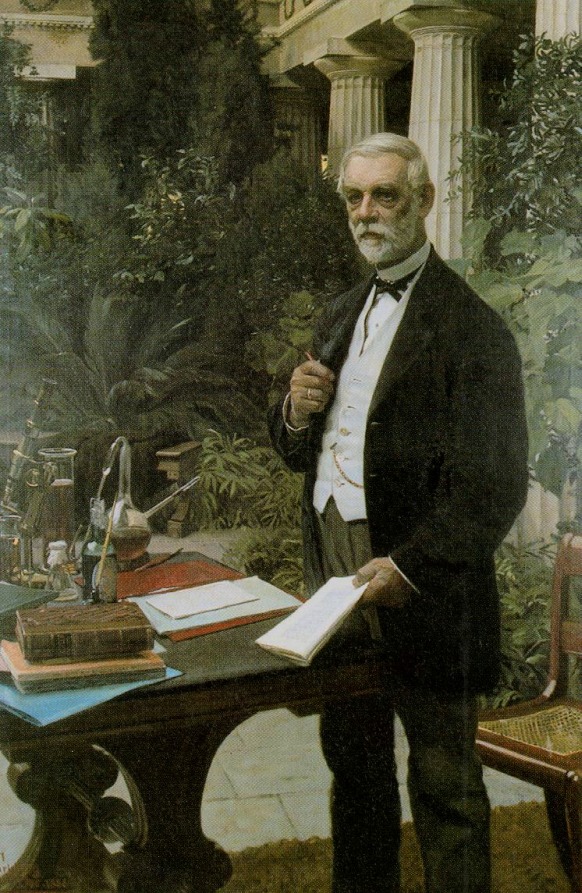
J. C. Jacobsen · August Jerndorff, 1886
August Jerndorff · Museum of National History, Frederiksborg Castle · 1886 · View the document · Public domain
Also in our archives
Emil Christian Hansen, from house painter to brewing scientist →
Sources
Home of Carlsberg · Le voyage de 1845 et la boîte à chapeau
Archives de la Fondation Carlsberg · Lettre de J. C. Jacobsen à Gabriel Sedlmayr, 7 mai 1884
Carlsberg Group · J. C. Jacobsen et le voyage à Munich
Carlsberg Group · Chronologie de la brasserie
Fondation Carlsberg · Chronologie et travaux d’Emil Christian Hansen
Carlsberg Group · Carl Jacobsen et la rivalité familiale
Fondation Carlsberg · La réunion des deux brasseries
Carlsberg Danmark · La nomination de 1904 et la couronne
Designmuseum Danmark · L’étiquette de Thorvald Bindesbøll
Carlsberg Group · Rapport annuel 2018 et nouvelle identité
Brasseries Kronenbourg · L’évolution de l’étiquette en France
Maison royale danoise · Fin progressive du régime des titres