Arneis: Roero’s white grape brought back from obscurity
Roero’s white grape brought back from obscurity

Piedmont on an early eighteenth-century map, published by the heirs of J. Ratelband and held by the Rijksmuseum. Alba and Turin are among the towns shown. It provides regional context for Arneis from the Roero, rather than mapping a present-day wine appellation.
Anonymous engraver · Publisher: heirs of J. Ratelband & Co · 18th century (1700–1706 or 1735, according to the Rijksmuseum catalogue) · Rijksmuseum, Amsterdam · Document source · CC0
A grape from Roero
Arneis is connected to Roero in Piedmont, on the left bank of the Tanaro. Old references connect its historical names to local places and vineyards; they bear witness to a heritage much older than its present popularity. In the 18th and 19th centuries, the grape could also be used for sweet wines or vermouth preparations. Its story has therefore not always been that of the dry white we encounter today.
The story of birds and Nebbiolo
In the 20th century, its cultivation declined sharply. Arneis sometimes survived close to Nebbiolo: its grapes, favoured by birds, could divert them from the red bunches. The nickname ‘white Nebbiolo’ belongs to this historical proximity; it does not mean that Arneis is a white mutation of Nebbiolo. In the 1970s, when its planted area had become very small, its revival restored its identity as a white grape in its own right.
In the vineyard
Its budbreak leaves it susceptible to spring frosts. Ripening usually occurs in September, but the date depends on the year and vineyard conditions. Work in the plots and harvest timing matter in preserving the balance between ripeness and freshness. In Roero, soils and exposures produce different expressions; a single variety does not erase the diversity of places.
In the glass
Arneis can offer a floral, fruity nose, a supple palate and a slightly almond-like finish. In these dry whites, we appreciate an elegance that does not necessarily rely on very incisive acidity. Depending on the bottle, the fruit can suggest pear or peach, while ageing on the lees sometimes adds volume. Sparkling versions also exist: Arneis is therefore not limited to a single winemaking method. At La Corte Segreta, its presence tells another story of Piedmont beyond its great reds.
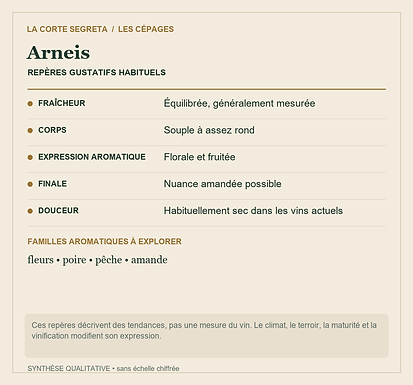
Typical flavour characteristics of Arneis — a qualitative overview by La Corte Segreta. Terroir and winemaking influence the profile.
Mario Costa: a family on the hills of Roero →
Nebbiolo: the slow rhythm of Piedmont and the Alps →
Barbera: Piedmont’s freshness, from everyday wines to ageworthy expressions →