Mario Costa: a family on the hills of Roero
From the first land purchase in 1952 to the Arneis on our list, a vineyard story in Canale and Montà.
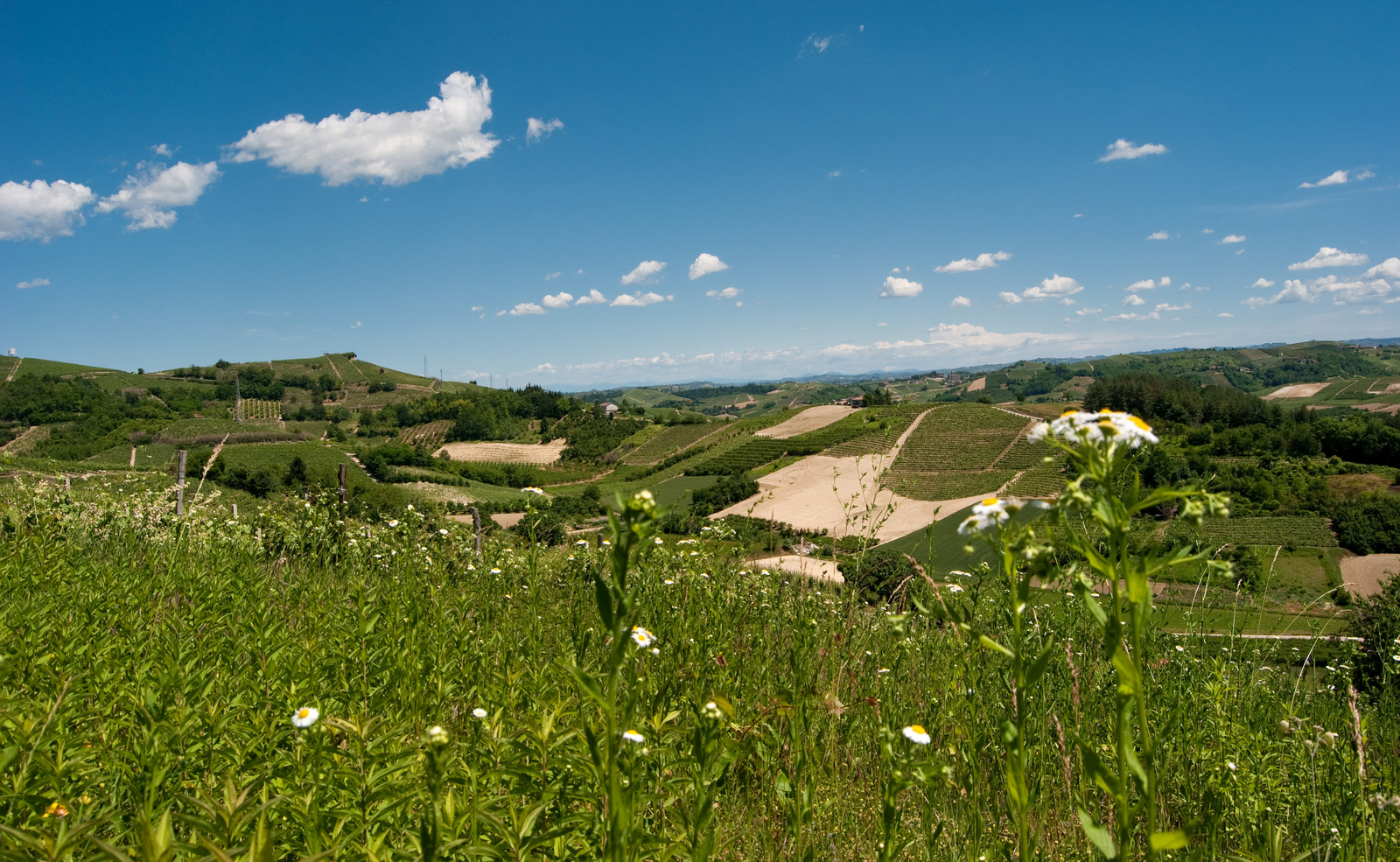
A panorama of Roero in Canale, home village of Mario Costa — Virginia Scarsi, Wikimedia Commons, CC BY-SA 3.0. · Original image · CC BY-SA 3.0
At La Corte Segreta, Mario Costa’s Roero Arneis gives space to a Piedmontese white from a clearly defined grape and territory. The winery is based in Canale, in the province of Cuneo. Its story interests us through its family scale: land gradually acquired, generations finding their place and vineyards spread between the hills of Canale and Montà.
A family’s first hectares
In 1952, Giuseppe Costa and his wife Giuseppina Pelassa bought their first vineyards in these two municipalities. In 1976, their son Mario joined the business, which took his name, and continued acquiring plots. The winery grew through choices of land, grapes and work, while remaining deeply attached to Roero.
In 2008, Giuseppe, Mario’s son, joined the business after training at Alba’s oenology school. His work focused notably on vineyards and agronomy. Luca joined in 2010, also trained in Alba, concentrating on the cellar and winemaking. We enjoy this division: passing on knowledge becomes a way of working together, with complementary responsibilities.
Roero, plot by plot
Diversity can be read through the locations. Pecetto is in Canale: seven hectares growing Arneis, Barbera and Nebbiolo. Also in Canale, Renesio Montorone has two hectares of Barbera and Nebbiolo. In Montà, Morinaldo brings together one and a half hectares of these two red varieties on particularly sandy soil.
Parere, also in Montà, comprises three hectares with Arneis, Viognier and Merlot. Arneis therefore appears alongside varieties that broaden the producer’s possibilities. Plots, soils and exposure give meaning to the bottle and help us understand the estate’s work.
Roero’s soils bear the imprint of ancient marine formations, with sands and marl layers. This origin belongs to the landscape long before the vines arrived. At La Corte Segreta, we enjoy this perspective: a village name and a grape name can also open a story of hills, an ancient sea and land now cultivated.
The Arneis we offer
Mario Costa’s Roero Arneis DOCG is made from Arneis. The grapes come from Canale and Montà. Manual harvesting is followed by gentle pressing and temperature-controlled fermentation in steel. The wine then remains in tank for several months, with lees work supporting its texture without introducing the imprint of wood ageing.
Its fresh, fruity expression, with a hint of peach, lets us add another face of Italian white wine to our list. We appreciate that it carries both a family’s name and that of a protected territory. Mario Costa thus finds its place at La Corte Segreta through this continuity between Roero’s hills, attention to plots and a wine that presents itself approachably at the table.
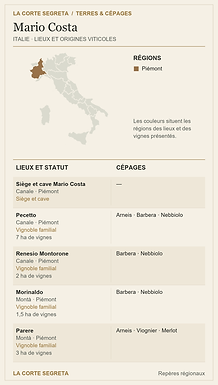
Mario Costa: documented regions, locations and grape varieties. Mapping: ISTAT boundaries, distributed by openpolis / geojson-italy, CC BY 4.0. Projection and colours adapted; a regional location map, not a cadastral map. Map boundaries · CC BY 4.0
Arneis: Roero’s white grape brought back from obscurity →
Nebbiolo: the long passage of time in Piedmont and the Alps →
Barbera: Piedmont’s freshness, from everyday wines to ageworthy expressions →