Cabernet Franc: red fruit and the finesse of an illustrious parent
Red fruit and the finesse of an illustrious parent
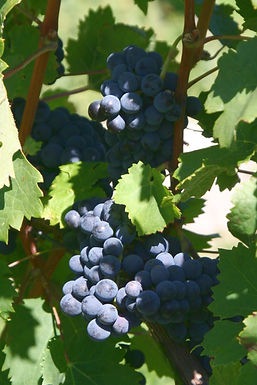
Rosenzweig · Original photograph · CC BY-SA 3.0
One grape, several names
Cabernet Franc is an old grape from south-western France. It is known as Bouchet in the Libournais and Breton in the Loire, among other names; these local names tell of its movement through vineyards. It also holds an important place in some Italian reds. Its reputation extends beyond its role in blends: grown on its own, it can produce wines with fruit, floral nuances and freshness at the forefront.
A remarkable family
Genetics has shown that it is a parent of Cabernet Sauvignon, with Sauvignon Blanc, and also of Merlot, with Magdeleine Noire des Charentes. Two of the most famous red grapes thus share this ancestor. This discovery is more precise than a simple resemblance between names.
In the vineyard
Its bunches carry small, round berries. In Bordeaux conditions, it generally ripens after Merlot and before Cabernet Sauvignon. Aspect and good vigour management matter for obtaining sufficiently ripe grapes. Well-exposed clay-limestone terroirs and some sandy soils can suit it. As with other varieties, insufficient ripening can strengthen vegetal sensations; these alone do not define its identity.
In the glass
Typical expressions evoke raspberry, other red fruit, violet and sometimes fresh herbs. Colour and power may be less pronounced than in Cabernet Sauvignon, with elegant tannins when the grapes and winemaking allow. Oak ageing adds further nuances. At La Corte Segreta, we love this possibility of an expressive red that retains liveliness. These markers provide a way into the wine while leaving room for each bottle's personality.
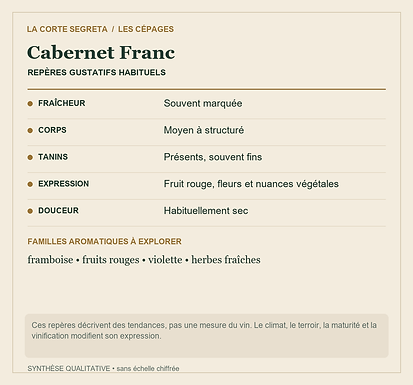
Typical flavour markers for Cabernet Franc — a qualitative overview by La Corte Segreta. Terroir and winemaking can alter the profile.
Cabernet Sauvignon: structure, blackcurrant and an unexpected family connection →
Merlot: an inviting texture, an origin long shrouded in mystery →
Tignanello: the courage to change Tuscan wine →