Sauvignon Blanc: expressive freshness and a red-grape relative
Expressive freshness and a red-grape relative

Doris Schneider, Julius Kühn-Institut (JKI), Federal Research Centre for Cultivated Plants, Institute for Grapevine Breeding Geilweilerhof, 76833 Siebeldingen, Germany · Original photograph · Reproduction authorised by JKI/VIVC with attribution to the source
A grape from western France
Sauvignon Blanc is one of western France's great white grape varieties, with longstanding ties to the Loire and Bordeaux. Its exact geographical origin remains debated, so we avoid assigning it a single birthplace as a certainty. Today, it holds an important place in several Italian wine-growing areas, particularly in the north-east. It can be made into wine on its own or join a blend, where its aroma and freshness provide contrast.
Cabernet Sauvignon's white-grape parent
One of its most surprising stories comes from genetics: together with Cabernet Franc, it is a parent of Cabernet Sauvignon. The shared name reflects this relationship, revealing how grape varieties’ histories develop through natural crossings, sometimes identified centuries later.
In the vineyard
The vine can be vigorous. Its small, often slightly elongated berries form compact bunches; managing foliage and moisture matters to keeping them healthy. Temperature, ripeness and harvest date noticeably alter the aroma. Slower ripening can preserve acidity; different conditions place more emphasis on ripe fruit. Vineyard work allows a particular expression to be chosen without making it identical everywhere.
In the glass
Typical characteristics recall grapefruit, other citrus fruits, flowers and sometimes blackcurrant bud or herbaceous nuances. Some wines also show more tropical fruit. Often dry and lively, Sauvignon can nevertheless feature in sweet wines when the harvest and winemaking allow it. In blends with Sémillon, it can take on a rounder texture. At La Corte Segreta, we always distinguish aromatic intensity from the amount of sugar: a highly aromatic wine can remain perfectly dry.
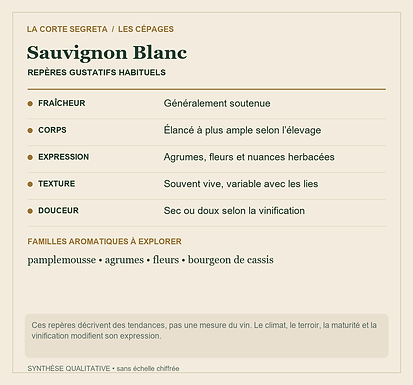
Typical flavour characteristics of Sauvignon Blanc — a qualitative overview by La Corte Segreta. Terroir and winemaking influence the profile.
Cabernet Sauvignon: structure, blackcurrant and an unexpected family connection →
Sémillon: from dry whites to grapes concentrated by noble rot →
Noble rot: the grape's strange alchemy →