Moscato Bianco: the grape's fragrance, from fruit to flowers
The grape's fragrance, from fruit to flowers
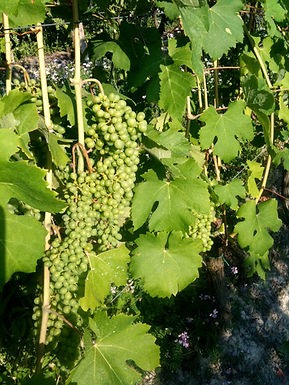
Moscato Bianco in Piedmont, before véraison, June 2011. Megan Mallen, Wikimedia Commons, CC BY 2.0. · Original photograph · CC BY 2.0
An aromatic identity
Moscato Bianco is the small-berried white Muscat. The word Moscato is not always enough to identify a bottle, because the Muscat family includes several distinct varieties. In Piedmont, Moscato Bianco is at the heart of Asti DOCG and Moscato d'Asti. Its appeal lies in its readily recognisable aromatic expression: the grape's fragrance carries into the wine, accompanied by flowers, fruit and sometimes vegetal nuances.
In the vineyard
The small berries take on yellow and golden shades as they ripen. Quality depends on the choice of plots, ripeness and preserving freshness. Selection work also shows that not all Moscato Bianco vines produce exactly the same intensity or balance. Some selections emphasise flowers, others fruit or acidity that is useful for sparkling wines and dried grapes.
Moscato at the heart of Asti
Asti DOCG is based on Moscato Bianco, in an area spread across the provinces of Asti, Alessandria and Cuneo. In the sweet versions, production methods retain some of the natural sugar and a very recognisable fruit expression. Sweetness is therefore not an inevitable quality of the grape: it depends on fermentation. A Muscat can also be made into a dry wine. That is why a highly fragrant nose alone cannot reveal the sugar content in the glass. In the 19th century, Carlo Gancia gave Piedmontese Moscato fresh impetus: in 1865, his spumante marked a milestone in Italian sparkling-wine history. This journey continues in our archive entry on Asti and its history.
In the glass
Typical markers evoke fresh grapes, orange blossom, peach, apricot and sage. We love this combination of immediate fragrance and freshness. In a sweet wine, bubbles and acidity can bring liveliness; in a dry wine, the contrast between fruity fragrance and the absence of sweetness changes our perception. Zibibbo, or Muscat of Alexandria, has a different identity: discovering both helps us stop treating all Muscats as a single grape. Terroir, ripeness and production alter the sensations.
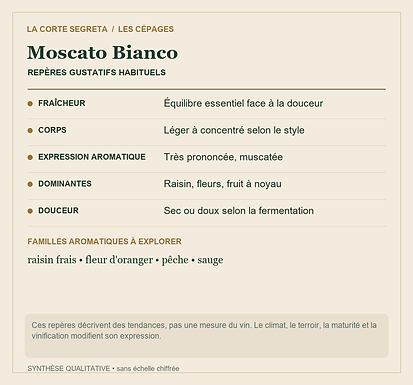
Typical flavour markers for Moscato Bianco — a qualitative overview by La Corte Segreta. Terroir and winemaking can alter the profile.
Asti: the story behind the bubbles →
Gancia: the drive of an Italian sparkling-wine pioneer →
Muscats: fragrant grapes, several distinct varieties →