Gancia: the drive of an Italian sparkling-wine pioneer
From Chivasso to Canelli, a producer connecting Moscato, underground cellars and the history of spumante.
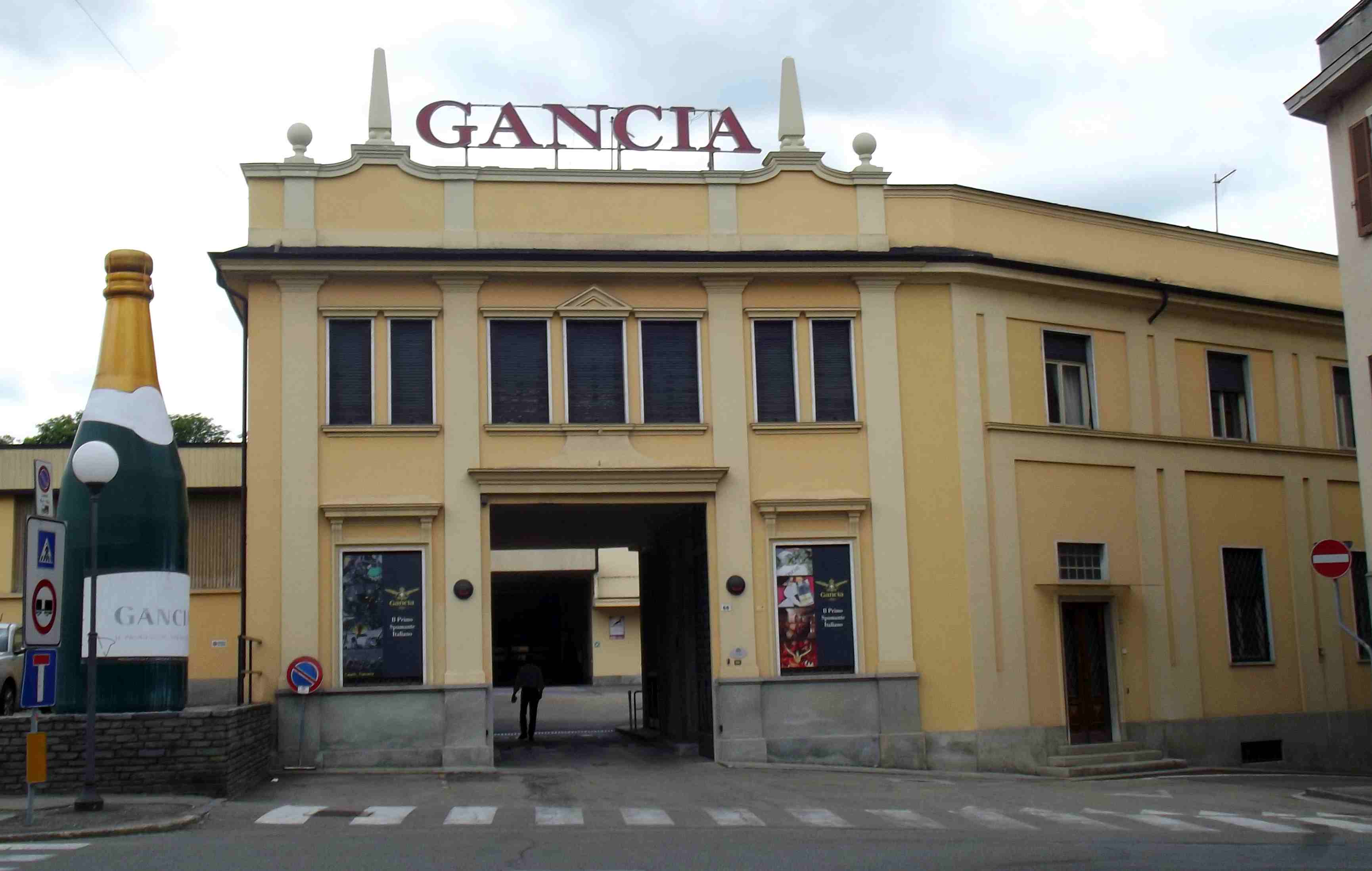
Gancia's historic premises in Canelli, Piedmont — F Ceragioli, Wikimedia Commons, CC BY-SA 3.0. · Original image · CC BY-SA 3.0
At La Corte Segreta, our glass of Asti bears a name that belongs to the history of Italian sparkling wine: Gancia. This producer is based in Canelli, in the province of Asti, Piedmont. Its journey interests us because it tells a story of travel, research and a way of giving Moscato a new expression. Behind a sweet, fragrant glass lies an adventure that began in the mid-19th century.
Carlo Gancia's journey
Carlo Gancia was born in Narzole in 1829. After training in Turin, he travelled to Reims in 1848 to learn sparkling-wine production at Piper-Heidsieck. Back in Italy, he founded Fratelli Gancia in Chivasso with his brother Edoardo in 1850. His ambition was to adapt the techniques learned in Champagne to Piedmont's grapes.
In 1865, work with Moscato led to the spumante that marked Gancia's history. The business later moved to Canelli, where the brothers established production in a former customs depot near the railway. We love this meeting of invention and infrastructure: for a wine to travel, it also needs cellars, transport routes and places where production can grow.
Another landscape beneath Canelli
The historic cellars form a network of vaulted galleries beneath the town. They recall the time involved in making and storing wine. Canelli and Asti Spumante form one component of the Piedmont vineyard landscape inscribed on the UNESCO World Heritage List in 2014. The vines above ground and the spaces below thus belong to the same cultural history.
Gancia's identity also took shape through images. In 1896, Cesare Saccaggi created a poster for Moscato Spumante. In the 1920s, Leonetto Cappiello in turn designed posters, including the famous butterfly woman. The producer's museum preserves these images, labels and films. The bottle's history meets that of art and ways of celebrating.
The Moscato in our glass
The Asti Gancia we offer is made from Moscato Bianco, also called Moscato Bianco di Canelli. It is gently pressed: the first juice is retained, then kept chilled to preserve the grape's aromas. Its golden colour, acacia and wisteria flowers, hint of sage and honey accents accompany a sweet, fruity, delicate palate.
Today, this cuvée uses the Martinotti method, with fermentation in a pressurised tank. Cooling interrupts fermentation at the desired point, leaving some of the grape's natural sugar. This production method differs from the bottle-based traditional method used in Carlo Gancia's early work. The DOCG designation also ties Asti to its origin and precise production rules.
At La Corte Segreta, we chose this glass for its fragrance, sweetness and fine bubbles as an aperitif. Its history extends the pleasure: a journey between France and Piedmont, Moscato becoming sparkling, and a producer whose cellars and images have accompanied generations of shared moments.
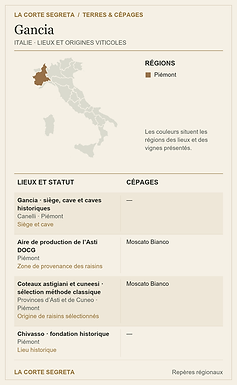
Gancia: documented regions, locations and grape varieties. Mapping: ISTAT boundaries, distributed by openpolis / geojson-italy, CC BY 4.0. Projection and colours adapted; a regional location map, not a cadastral map. Map boundaries · CC BY 4.0
Asti: the story behind the bubbles →
Moscato Bianco: the grape's fragrance, from fruit to flowers →
Martinotti: bubbles born in a tank →
Traditional method: bubbles born in the bottle →
People in this story