Müller-Thurgau: a scientific creation, a name long misunderstood
A scientific creation, a name long misunderstood

Rosenzweig · Original photograph · CC BY-SA 3.0
The work of Hermann Müller
Müller-Thurgau is the creation of Swiss oenologist Hermann Müller, who came from the canton of Thurgau. The cross was made in Geisenheim in 1882, and selection work continued, notably in Wädenswil. This grape tells a different story from that of old varieties rediscovered in the countryside: it was born from a research project designed to bring together qualities in both the vineyard and the winery. It later found a place in northern regions, particularly the vineyards of the Italian Alps.
The surprise of its true parentage
For a long time, it was thought to come from Riesling and Silvaner. The name Rivaner preserves a trace of that earlier belief. Genetic analysis revealed a different parentage: Riesling and Madeleine Royale. The grape had not changed; our knowledge of its history had become more precise. This story reminds us why we distinguish between a repeated tradition and a verified identification.
In the vineyard
Müller-Thurgau ripens relatively early and can be productive. Attention to yields, site conditions, airflow through the canopy and harvest quality helps preserve a clear expression. In cool regions, its early ripening can be an advantage when the season is too short for later varieties.
In the glass
Typical expressions are delicate, with flowers, apple or pear and sometimes a slightly muscat-like note. That does not mean it is a Muscat. The palate often has gentler acidity than Riesling, with moderate body. Many wines aim for freshness to be enjoyed while young, but residual sugar depends on the winemaking. At La Corte Segreta, we value this aromatic finesse as an expression in its own right.
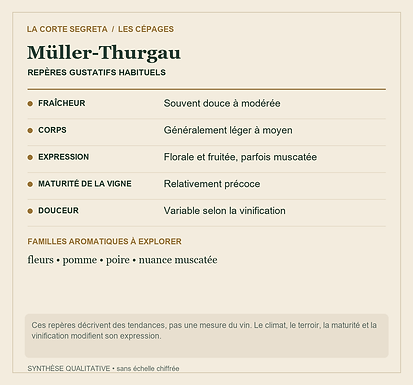
Typical flavour characteristics of Müller-Thurgau — a qualitative overview by La Corte Segreta. Terroir and winemaking influence the profile.
Riesling: freshness across styles and years →
Muscat grapes: fragrant grapes, several distinct varieties →
Gewürztraminer: pink berries, intense aromas, several balances →