Riesling: freshness across styles and years
Freshness across styles and years
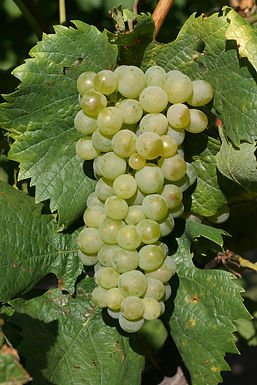
Doris Schneider, Julius Kühn-Institut (JKI), Federal Research Centre for Cultivated Plants, Institute for Grapevine Breeding Geilweilerhof, 76833 Siebeldingen, Germany · Original photograph · Reproduction authorised by JKI/VIVC with source attribution
A date in the archives
Riesling is deeply connected to the vineyards of the Rhine and cool-climate regions. The earliest known written mention is dated 13 March 1435: an expense for plants appears in Klaus Kleinfisch’s accounts for Count Johann IV of Katzenelnbogen in Rüsselsheim. This date celebrates a surviving document, not the grape’s exact birth. It shows how a line in an account book can become a milestone in wine history.
Ripeness that takes its time
Riesling ripens slowly and can benefit from a long end to the season. Well-exposed slopes, stones that release heat and the proximity of certain watercourses matter in several of its historic regions. Its grapes can retain considerable acidity while gaining ripeness. This combination allows very different expressions: a slender dry white, a gentler wine or a concentrated sweet wine, depending on the harvest and winemaking.
In the glass
Young expressions often suggest lemon, apple, peach and sometimes flowers. The palate frequently rests on sustained freshness. With time, some bottles develop a note reminiscent of petrol. Residual sugar can soften the sensation of acidity without removing its presence.
Do not rely on the name alone
Riesling is not Welschriesling, often called Riesling Italico, nor is it Müller-Thurgau. The latter is, however, its offspring: our Müller-Thurgau article explains this cross. At La Corte Segreta, we appreciate this precision because two similar names can conceal very different flavours. Comparing Riesling with Gewürztraminer helps distinguish sustained freshness from a fuller, more fragrant expression.
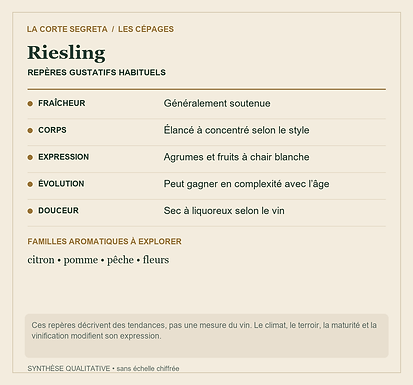
Typical flavour characteristics of Riesling — a qualitative overview by La Corte Segreta. Terroir and winemaking influence the profile.
Müller-Thurgau: a scientific creation, a name long misunderstood →
Antinori: six centuries and the courage to pass on a legacy →
Noble rot: the strange alchemy of the grape →