Negroamaro: the character of Salento's reds and rosés
The character of Salento's reds and rosés

Negroamaro: a bunch on the vine. Doris Schneider, Julius Kühn-Institut (JKI), Institute for Grapevine Breeding Geilweilerhof, Siebeldingen. Reproduction authorised with credit. · Original photograph · Reproduction expressly authorised by the VIVC record with the stated credit; no CC licence presumed
A heritage of Puglia
Negroamaro is an emblematic grape of Salento in southern Puglia. Its precise origin remains uncertain, but its long establishment in the region is part of its identity. Its name has prompted several explanations: some see a reference to black colour and bitterness, while others connect Latin and Greek words both meaning black. These interpretations do not establish a single etymology with certainty.
A family of grape varieties
Genetic research has identified Negroamaro as one of the parents of Malvasia Nera di Lecce, alongside Malvasia Bianca Lunga. This parentage casts regional blends in a different light: two varieties that complement each other in the glass also share a family connection. Negroamaro can be made into wine alone, but also features in reds and rosés whose balance is built through several grapes.
The story: different ripening in the same family
In 1994, research in Puglia's vineyards identified vines with considerably earlier ripening. This work led to recognition of Negramaro Precoce, also called Cannellino, which ripens noticeably before ordinary Negroamaro. The case shows that wine heritage can also be discovered within already familiar plots by observing differences in behaviour. However, Cannellino's characteristics should not be applied to every Negroamaro wine.
In the glass
In dry reds, we often find ripe fruit, rounded substance and a finish that may retain a hint of bitterness. Some expressions show Mediterranean herbs; a very ripe harvest or oak ageing changes the fruit and texture. Rosés offer another perspective, more delicate and fresher according to their production. At La Corte Segreta, its appeal lies in this diversity, beyond the image of a southern red that must be massive. The chart's markers mainly concern dry reds and remain indicative: vintage, terroir, extraction and ageing determine the wine.
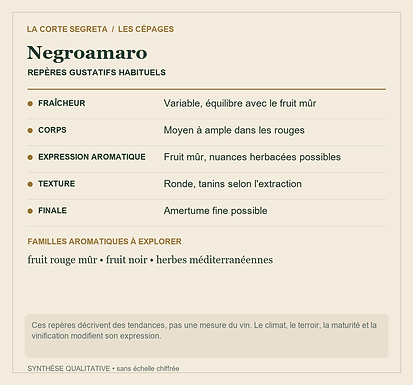
Typical flavour markers for Negroamaro — a qualitative overview by La Corte Segreta. Terroir and winemaking can alter the profile.
Leone de Castris: three centuries of Salento and five roses →
Tormaresca: Puglia between two seas and two horizons →
Malvasia Nera di Lecce: a Salento family connection revealed by genetics →