Leone de Castris: three centuries of Salento and five roses
Salice Salentino, Puglia — a story of family, grape varieties and a rosé that became an emblem.
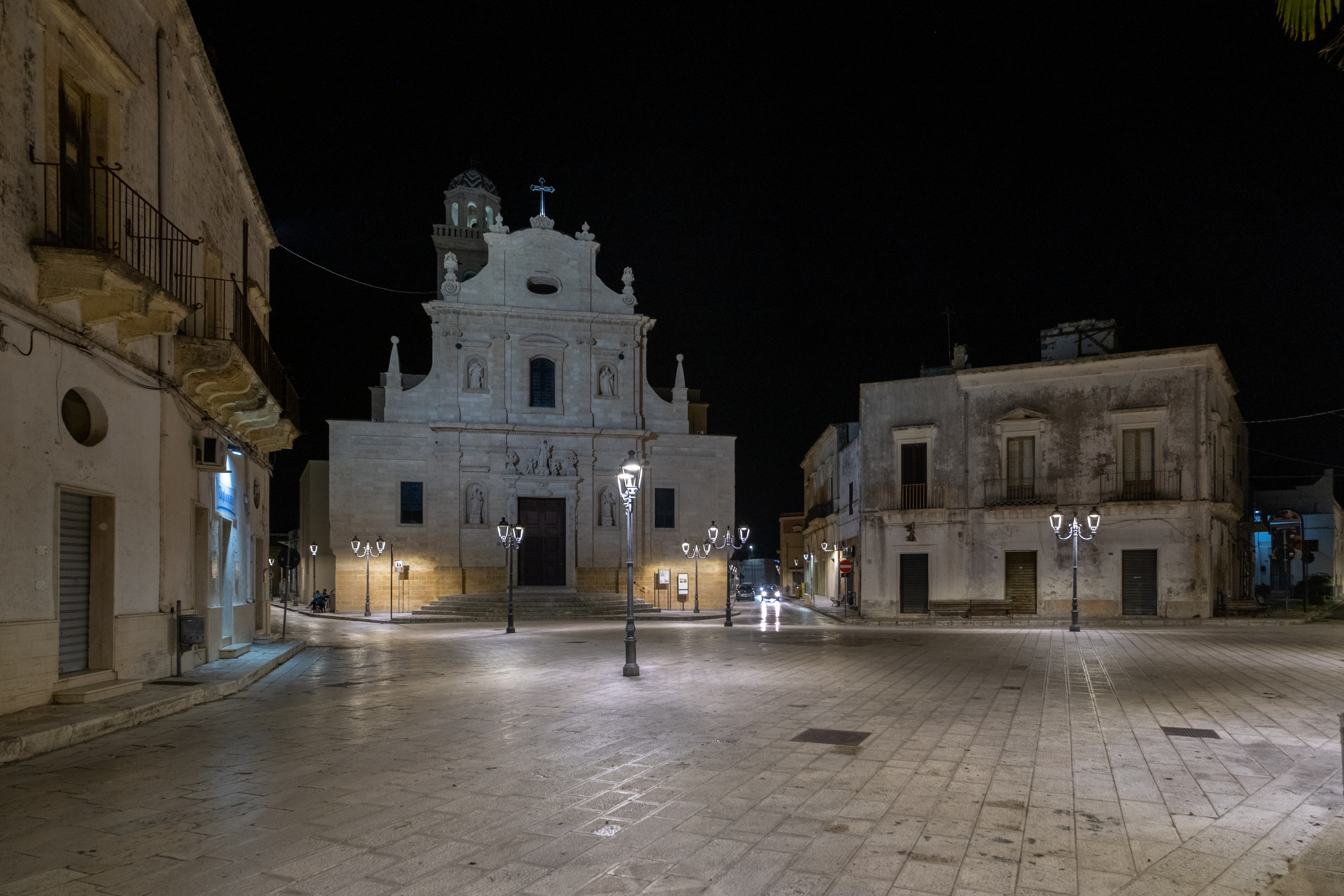
Salice Salentino, Puglia: Santa Maria Assunta church, in the town that is home to the historic Leone de Castris winery. — Dbuccarella · Original image · CC BY-SA 4.0
A winery born in Salento
In Salice Salentino, in the north-west of the Salento peninsula, Leone de Castris has a history that begins in 1665. Oronzo Arcangelo Maria Francesco, Count of Lemos, founded a winery there among the vines. Captivated by the area, he later sold possessions in Spain to develop his land in Salento. Vines grew alongside olive trees and wheat: from the outset, wine belonged to a wider agricultural landscape, the life of a family and the life of a region.
For a long time, the early trade was in bulk wine. A decisive step came with Piero Leone Plantera and Lisetta de Castris: in 1925, the producer began bottling its wines under the name Leone de Castris. A place, a craft and an identity could now travel together. We appreciate this development: behind a label lies the moment when a producer decides to establish its own signature.
Why five roses?
Five Roses appeared in 1943, a pioneer among Italian rosés bottled and sold commercially. Its name leads to the contrada Cinque Rose, near Salice. Family history links these five roses to the birth of five children over several generations. During the Second World War, General Charles Poletti, responsible for Allied supplies, wanted a large quantity of rosé with an English name. Cinque Rose thus became Five Roses: a few words were enough to connect a place in Salento to another world.
The Anniversario cuvée, created in 1993 for the fiftieth anniversary of Five Roses, continues this story. What appeals to us is that a rosé can carry as much history as a great red. Its place at the table is about more than a colour or a season: it can also tell the story of how a region reached beyond its borders.
The many faces of Puglia
Leone de Castris works with a particularly rich heritage of grape varieties: Negroamaro, Malvasia Nera, Primitivo, Susumaniello, Verdeca, Aleatico and Ottavianello, alongside varieties including Chardonnay and Sauvignon. These names do not describe the same expression under different labels. Instead, they introduce distinct characters within a producer that remains tied to its Salento origins.
On our wine list, Il Lemos introduces Susumaniello through an IGT Salento wine. Its ripe fruit and spicy nuances accompany a pronounced tannic presence. Villa Santera explores Primitivo within DOC Primitivo di Manduria, with a full, warm red featuring plum and black cherry. Five Roses Anniversario offers yet another perspective, centred on Negroamaro and the history of rosé.
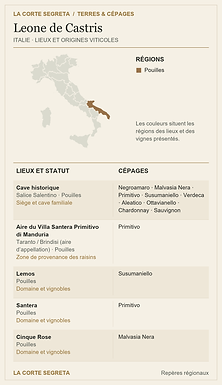
Leone de Castris: documented regions, locations and grape varieties. Mapping: ISTAT boundaries, distributed by openpolis / geojson-italy, CC BY 4.0. Projection and colours adapted; a regional location map, not a cadastral map. Map boundaries · CC BY 4.0
Susumaniello: an old voice of Puglia rediscovered →
Primitivo: an Italian name, a history that crosses the Adriatic →
Negroamaro: the character of Salento's reds and rosés →