Tormaresca: Puglia between two seas and two horizons
Antinori’s venture in Puglia, from Salento to the Murgia.
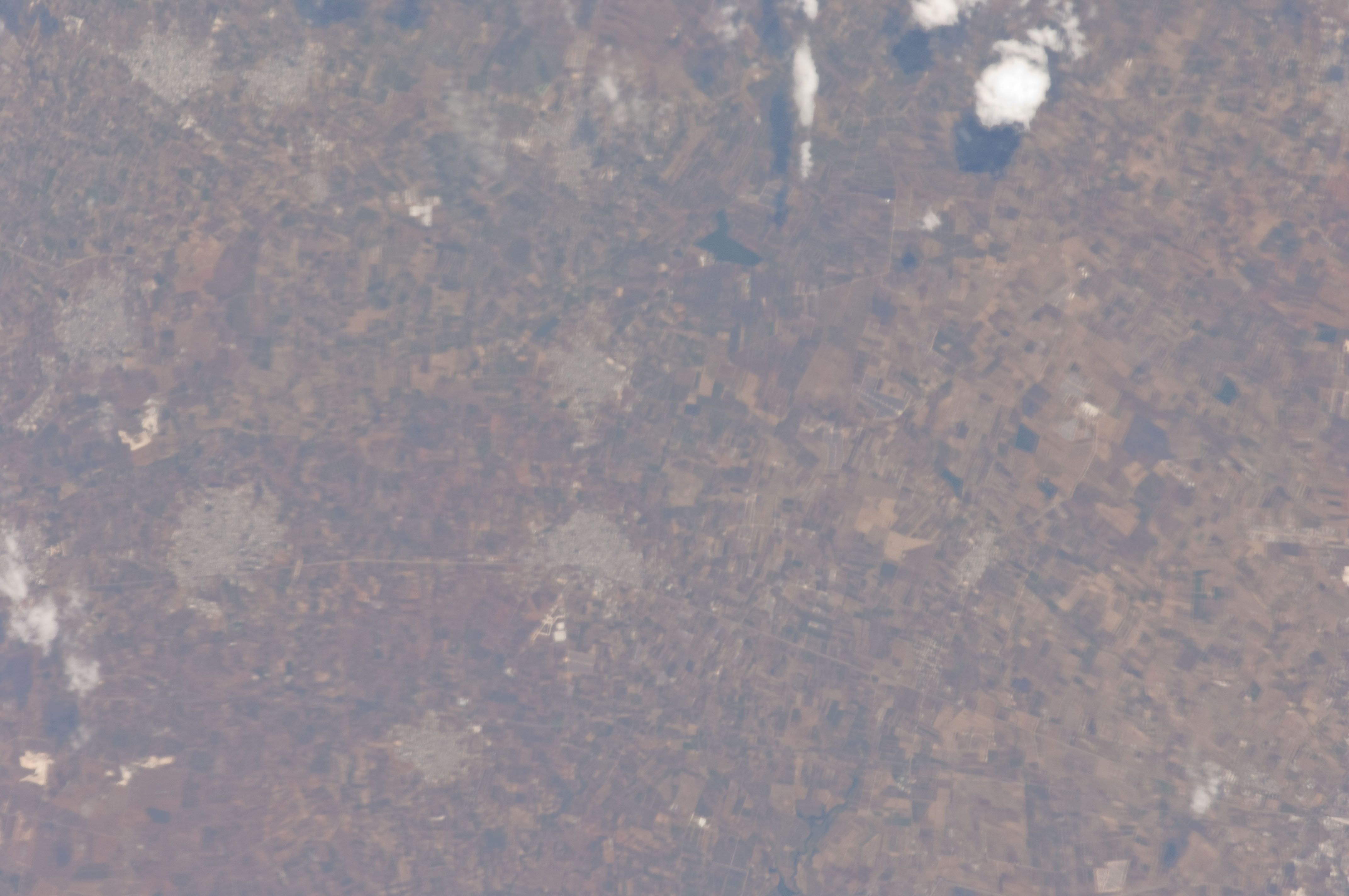
Salento and the Adriatic coast seen from the International Space Station on 2 July 2011 — NASA / Johnson Space Center, Wikimedia Commons, public domain. A regional view that does not identify Tormaresca’s plots. · Original image · Public domain
At La Corte Segreta, Tormaresca allows us to introduce several sides of southern Italy. NePriCa Primitivo and Trentangeli tell the stories of different grapes and landscapes. Their history connects with that of the Antinori family, who chose to commit to Puglia in 1998.
A fresh view of an ancient wine region
In the 1990s, Piero Antinori and winemaker Renzo Cotarella travelled through the region and explored the diversity of its terroirs. The project took shape around two horizons: the inland Murgia and Upper Salento, close to the Adriatic. The idea was to give a precise expression to the grapes of these places by combining local agricultural heritage with contemporary work in the vineyard and cellar.
This beginning interests us because it shows that a family with several centuries behind it can still choose new roots. Puglia is not a uniform backdrop: Manduria’s red soils, the limestone of the Murgia and coastal landscapes do not ripen grapes in the same way.
A masseria preserving Salento’s memory
Masseria Maìme is in San Pietro Vernotico, in the province of Brindisi, near the Adriatic coast. The farm complex retains a courtyard and a chapel dedicated to Saint Paschal, witnesses to its history dating back to the 17th century. Around it, vines stand alongside olive trees. Today, the property is described as covering 500 hectares, including 350 of vineyards and 85 of olive trees.
One distinctive feature is visible directly in the landscape: traditional alberello training, with low vines, coexists with trellised vineyards. Negroamaro has an important place in this Salento identity. This connection between agricultural architecture, olive trees and vineyards resonates with us: wine belongs to an entire regional culture.
Manduria, then the heights of the Murgia
Tenuta Carrubo, in Fragagnano in the province of Taranto, lies within the Primitivo di Manduria area. Its 40 hectares of vineyards are devoted to Primitivo on red soils with a limestone component, at an altitude of around 120 metres. Here too, training methods combine alberello and trellising.
The project’s history also includes Tenuta Bocca di Lupo in Minervino Murge, now presented as a distinct identity within the Antinori family. Trentangeli is now associated with this estate in the official range. We distinguish this origin from that of Tormaresca’s current Salento properties: it explains the presence of Aglianico in a project often instinctively associated with Primitivo.

Tormaresca: documented regions, locations and grape varieties. Mapping: ISTAT boundaries, distributed by openpolis / geojson-italy, CC BY 4.0. Projection and colours adapted; a regional location map, not a cadastral map. Map boundaries · CC BY 4.0
Primitivo: an Italian name, a story that crosses the Adriatic →
Aglianico: the depth of the south, the patience of the vine →
Antinori: six centuries and the courage to pass on a legacy →