Tenuta San Guido: the private wine that changed Bolgheri
Sassicaia, Cabernet and a preserved landscape between hills and sea.
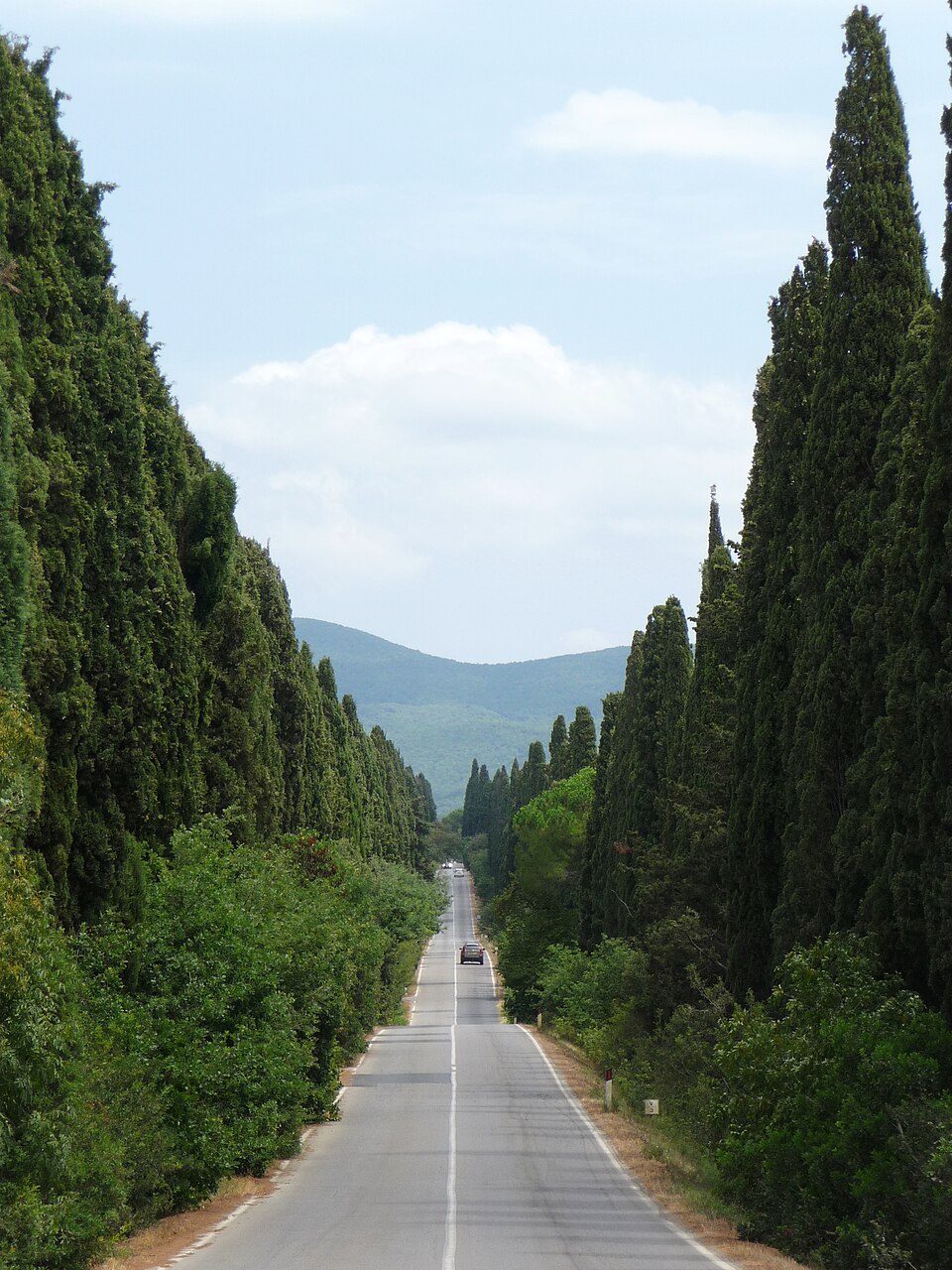
Viale dei Cipressi in Bolgheri, Tuscany — Lucarelli, Wikimedia Commons, CC BY-SA 3.0. A view of the territory, without depicting San Guido’s plots. · Original image · CC BY-SA 3.0
At La Corte Segreta, Sassicaia represents a decisive chapter in Italian wine history. It was born at Tenuta San Guido in Bolgheri’s territory, within the municipality of Castagneto Carducci, Tuscany. The property stretches from hills towards the Maremma coast: around 2 500 hectares, only a small part occupied by vines.
A personal choice that became a benchmark
Mario Incisa della Rocchetta, born in Rome in 1899, married Clarice della Gherardesca in 1930. Passionate about fine wines, he tried an unusual path for this part of Tuscany: planting Cabernet Sauvignon. In 1944, the first hectare was planted near Castiglioncello, high on the estate.
The wine remained a family affair for a long time. From 1945 to 1967, it was chiefly drunk within the family’s private circle. The story is remarkable: a bottle that became world-famous began as personal research, patiently pursued away from the market. The first commercial vintage was 1968; it was released in 1971.
The stone, climate and name
The name Sassicaia evokes stony ground. The estate’s soils combine limestone, marl, pebbles and clay. They vary by area: no single soil sums up the whole property. The sea’s proximity and the hills provide a setting where exposure and airflow matter as much as the nature of the ground.
Sassicaia’s vineyards notably include Castiglioncello, Aia Nuova, Cerreta, Sassicaia di Sopra and San Martino. The wine combines Cabernet Sauvignon and Cabernet Franc. Across the estate, Merlot also features in other wines, including Guidalberto. We therefore need to distinguish the producer’s cultivated grapes from Sassicaia’s specific blend.
An appellation carrying a single wine’s name
Sassicaia helped demonstrate the potential of Bolgheri reds. Initially recognised as a subzone, Bolgheri Sassicaia obtained an independent DOC in 2013. This appellation is reserved for this wine and its defined area. Its distinctiveness echoes our archive article on DOC designations: behind the label’s letters are an origin and precise production rules.
An estate where vines are not the whole story
San Guido also houses the Padule di Bolgheri nature reserve and a heritage connected to racehorse breeding through Razza Dormello Olgiata. These activities remind us that the estate is a living landscape. Vineyards represent around 5 % of its total area; our map locates the main places without claiming to draw cadastral boundaries.
This adventure continues in the history of Super Tuscans, which helped change perceptions of Italian winemaking expertise.
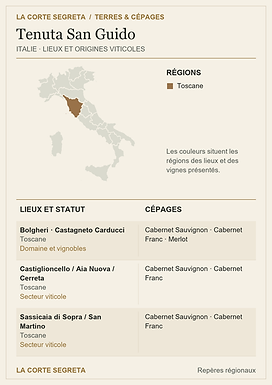
Tenuta San Guido: documented regions, locations and grape varieties. Mapping: ISTAT boundaries, distributed by openpolis / geojson-italy, CC BY 4.0. Projection and colours adapted; a regional location map, not a cadastral map. Map boundaries · CC BY 4.0
Sassicaia: the dream of Bolgheri →
Super Tuscans: the wines that changed perceptions of Italy →
Cabernet Sauvignon: structure, blackcurrant and an unexpected parentage →
Cabernet Franc: red fruit and the finesse of an illustrious parent →
Label story · Le Difese, the wild boar’s tusks →
Label story · Guidalberto, the oratory at the end of the cypress avenue →
Label story · Sassicaia, the star and the Bolgheri name →