Velenosi: an ambition born in the hills of Marche
Ascoli Piceno, the Tronto valley and the grapes that give the region a voice.
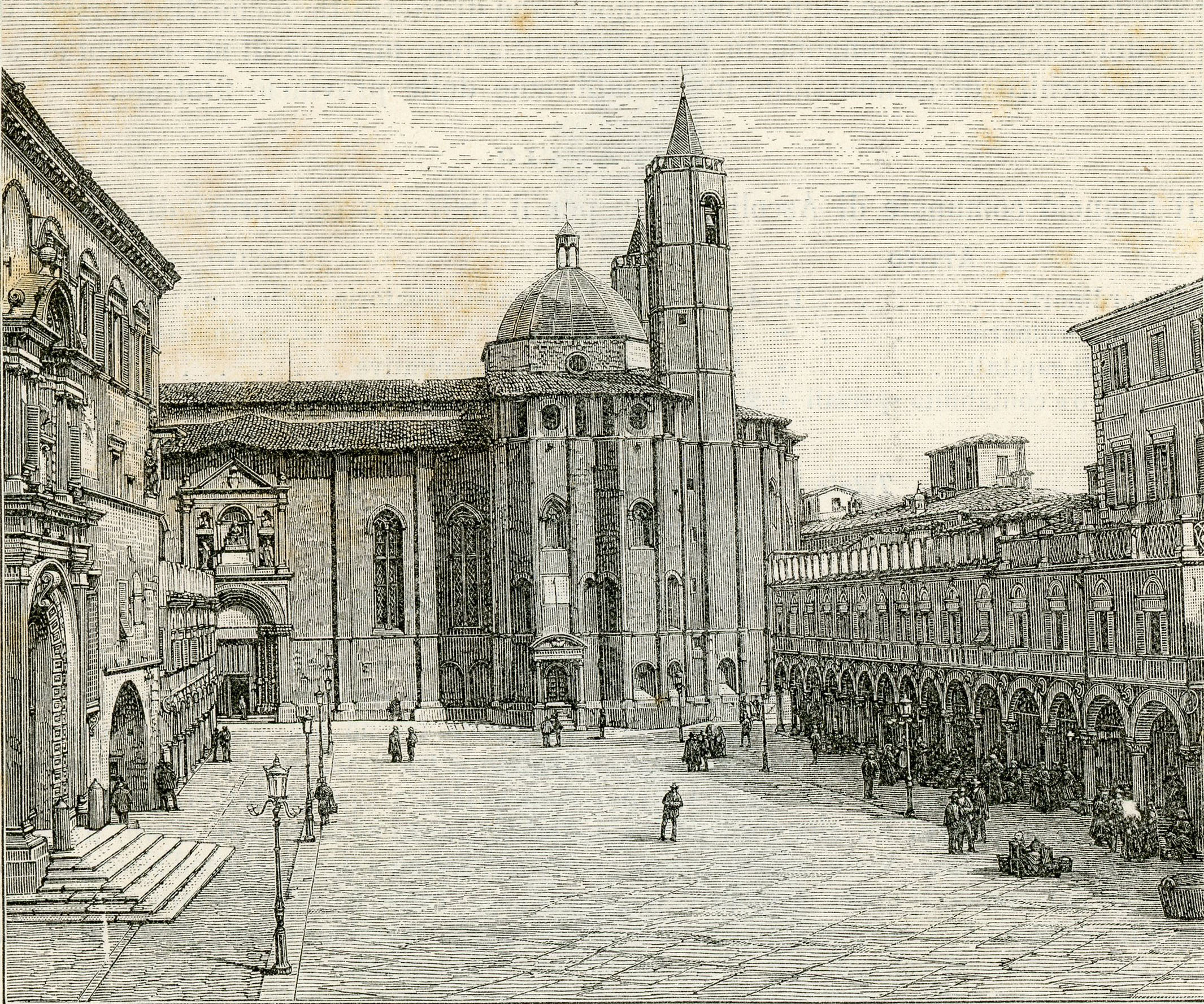
Piazza del Popolo in Ascoli Piceno, an engraving published in Gustavo Strafforello’s La patria in 1898 — Wikimedia Commons, public domain. A historical view of the city where Velenosi is based. — Gustavo Strafforello, La patria, 1898 · Original image · Public domain
At La Corte Segreta, Velenosi offers two very different experiences in the glass: the white Pecorino from Offida and the red Roggio del Filare. These wines take us to Marche, on Italy’s Adriatic side. The heart of the business is in Ascoli Piceno, near the hills of the Tronto valley.
1984: starting young, building patiently
Angela and Ercole Velenosi founded the winery in 1984. They were two young entrepreneurs who chose to build a winery in an area with a wine-growing tradition. The business developed around the hills of Ascoli, then in several neighbouring areas. Paolo Garbini joined this story in 2005.
We like this journey: not every great wine story begins in the Middle Ages. Some begin with a recent decision, then grow through harvests, technical choices and generations. At Velenosi, identity is built in particular by showcasing regional grapes and paying attention to harvest timing.
Roggio: a red that marks a milestone in the story
The first Roggio del Filare was produced in 1993. This milestone came less than ten years after the winery’s founding. The wine brings together Montepulciano and Sangiovese in the Rosso Piceno Superiore appellation. Its vineyards are in Castorano, on soils with a clay component, at an altitude of around 200 metres.
It reflects a characteristic of this part of Italy: Montepulciano can meet Sangiovese without losing its roots in Marche. The appellation’s name also reminds us that Montepulciano refers here to a grape, while the Tuscan place of the same name belongs to a different wine-growing story. At the table, this distinction makes the wine list easier to understand.
Land around the Tronto and beyond
The producer’s agricultural holdings include Ascoli Piceno, Castorano, Monsampolo del Tronto and Castel di Lama. Velenosi also has vineyards in Ancarano, in Abruzzo, and in San Marcello, in the Castelli di Jesi area. This network of places explains how one producer can offer different expressions; the grapes and appellations must remain connected to their actual areas.
In the Ascoli and Offida area, Pecorino offers another perspective on the landscape. For the Villa Angela range’s Offida DOCG Pecorino, grapes are selected from vineyards in Ascoli Piceno and Offida, between 200 and 300 metres, on medium-textured soils tending towards sandiness. Guyot training and ageing on fine lees are part of its production.
Two faces on our wine list
We offer Roggio del Filare Rosso Piceno Superiore and Offida DOCG Pecorino. One gives the red wine a full, structured presence; the other introduces a regional white with pronounced freshness. We enjoy this complementarity: Velenosi allows us to broaden our discovery of Marche through two grapes and two very different ways of accompanying the table.

Velenosi: documented regions, locations and grape varieties. Mapping: ISTAT boundaries, distributed by openpolis / geojson-italy, CC BY 4.0. Projection and colours adapted; a regional location map, not a cadastral map. Map boundaries · CC BY 4.0
Montepulciano: Abruzzo’s red grape, between mountains and the Adriatic →
Sangiovese: a red thread through central Italy →
Pecorino: the return of a white grape from the Apennines →