Castello di Verrazzano — from Chianti to the shores of New York
In Greve in Chianti, an ancient castle, the memory of a navigator and the Cappellini family’s organic work.
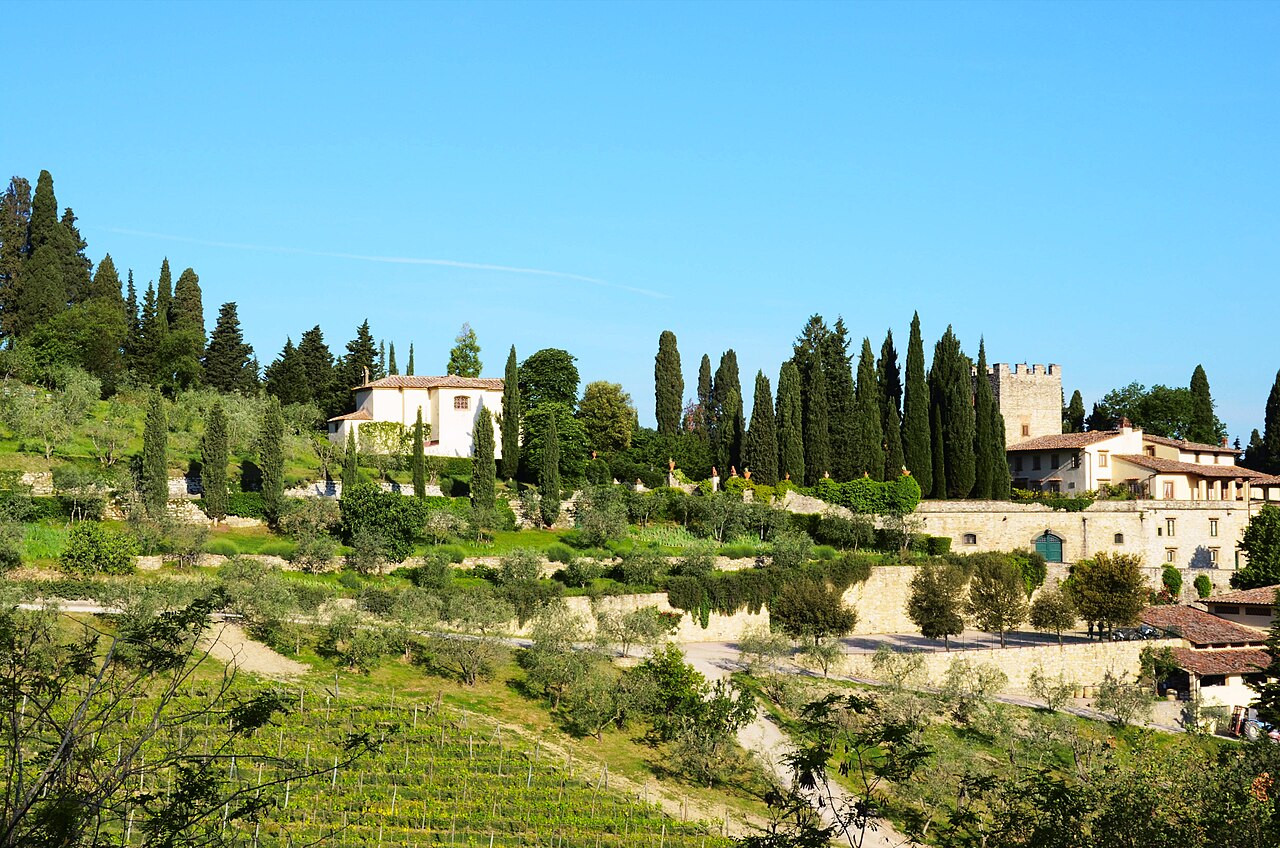
Castello di Verrazzano in Greve in Chianti, at the heart of Chianti Classico. — Alfredo Borba · Original image · CC BY-SA 2.0
A castle and a long memory of vines
Castello di Verrazzano stands in Greti, in the territory of Greve in Chianti, south of Florence. The landscape combines slopes, vines, olive trees and woodland. Vineyards and olive groves are recorded here in a manuscript from Passignano Abbey dated 1150. This agricultural memory precedes the wine producer we know today by several centuries.
The castle is also the birthplace, in 1485, of Giovanni da Verrazzano. In 1524, the navigator explored New York Bay. The name on a Chianti bottle thus joins an episode in Atlantic history. The castle preserves this connection with the traveller whose name the great New York bridge now bears.
Three stones between Tuscany and New York
This connection took material form in 1963. Three stones from Castello di Verrazzano were sent to New York for the construction of the Verrazzano-Narrows Bridge. Three stones from the bridge travelled the other way and were placed in the castle. This exchange gives a very tangible presence to a story crossing the ocean.
After the property passed to the Ridolfi in 1819, a new chapter began in 1958 with Luigi Cappellini. He acquired the estate, restored the castle and began rehabilitating the vineyard. The Cappellini family has maintained this work since. Historic buildings and vines together contribute to the producer’s identity.
Sangiovese at the heart of the vineyard
The estate’s 230 hectares include 52 hectares of vines. Plantings rise across Greve’s slopes, on clay-limestone soils. Sangiovese, Merlot, Canaiolo, Cabernet Sauvignon and Colorino make up the red grape plantings. Trebbiano Toscano, Traminer and Malvasia Lunga del Chianti are also grown. These grapes allow several wines to be made while keeping Chianti Classico as a reference point.
Vineyard management combines manual harvesting, mechanical grass management and fertilisation practices suited to organic farming. For us, this precision matters as much as the castle’s age: it connects heritage with present-day vineyard work. The producer also makes Riserva wines, a Gran Selezione and a Vin Santo, each following its own ageing journey.
The organic Chianti Classico on our list
Chianti Classico is a DOCG, a designation governing origin and production. Castello di Verrazzano’s organic bottling combines 95 % Sangiovese and 5 % complementary red varieties. Ageing includes eighteen months in large French oak casks, then at least four months resting in bottle. Sangiovese thus keeps the principal role in a wine patiently prepared for the table.

Castello di Verrazzano: documented regions, locations and grape varieties. Mapping: ISTAT boundaries, distributed by openpolis / geojson-italy, CC BY 4.0. Projection and colours adapted; a regional location map, not a cadastral map. Map boundaries · CC BY 4.0
Sangiovese: a red thread through central Italy →
Merlot: an inviting texture, an origin long shrouded in mystery →
DOCG — Denominazione di Origine Controllata e Garantita →