Firriato: one Sicily, several landscapes in the glass
From the hills of Trapani to Etna and Favignana — the Di Gaetano family's terroirs.
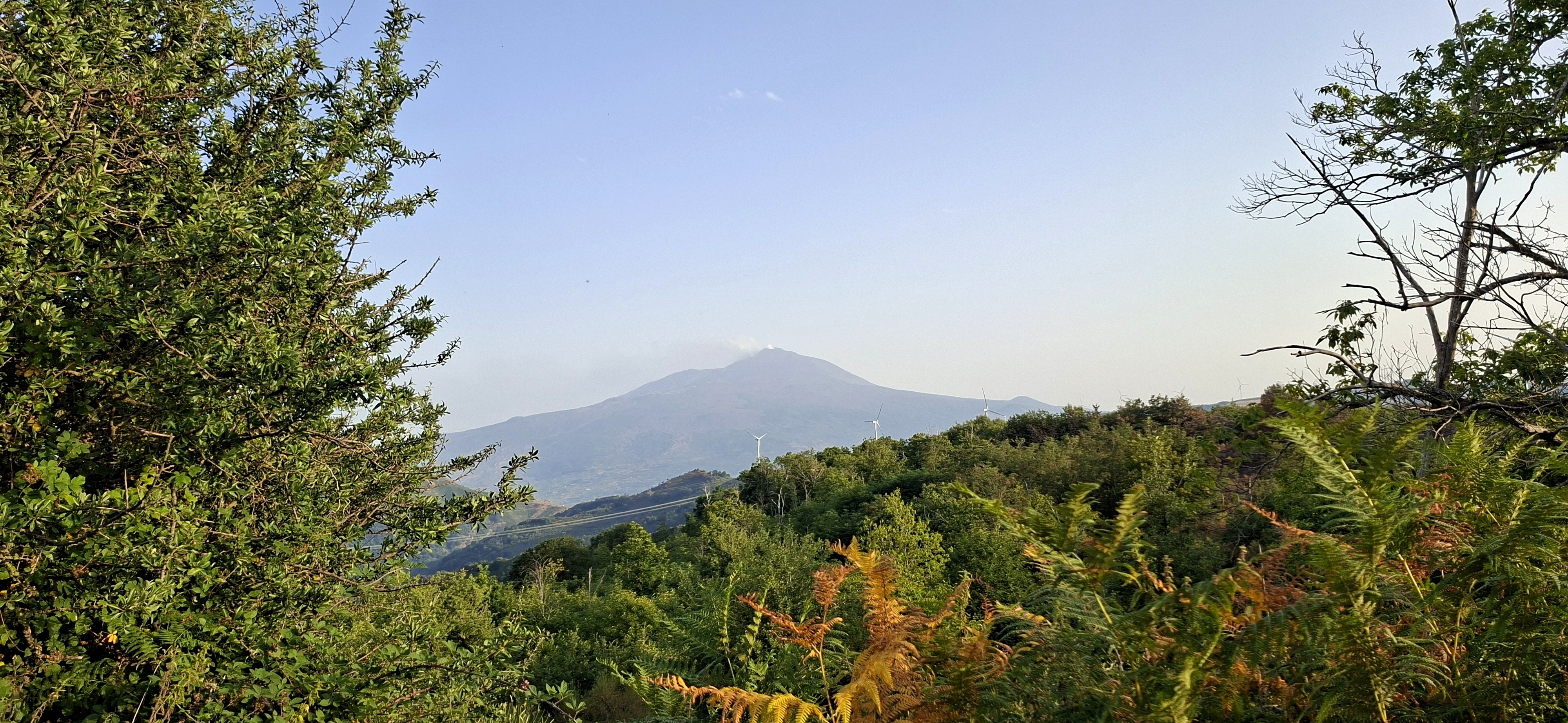
Etna at sunset, seen from the entrance to Floresta, Sicily. A regional landscape evoking Firriato's volcanic dimension. — Effems · Original image · CC0 1.0
A family and a vision of Sicily
Firriato was born in 1984 from the drive of Salvatore and Vinzia Di Gaetano. It began in the countryside around Trapani, between the sea and the silhouette of Erice. The name evokes an enclosed plot: cultivated, defined land whose particular qualities are patiently learned. The producer developed from this simple conviction: to tell Sicily's story, you must begin by looking at its vines and understanding what changes from one place to another.
This story interests us at La Corte Segreta because it makes visible a diversity sometimes hidden behind the single word ‘Sicily’. One island can encompass Mediterranean hills, high-altitude volcanic land and vineyards almost at the water's edge. These settings are not interchangeable. They contribute to different patterns of ripening, balances and ways of managing the vines.
From Trapani to the small island of Favignana
Around Trapani, Baglio Sorìa preserves a 17th-century rural complex. Sicilian and international grapes grow here: Nero d’Avola, Catarratto, Cabernet Sauvignon, Merlot or Syrah. Borgo Guarini gives this meeting another setting, with varieties including Grillo and Zibibbo. The estates of Dàgala Borromeo and Giudeo complete this exploration of western Sicily.
At Calamoni, on Favignana, the sea's proximity changes the vine's environment. Firriato works here with Grillo, Catarratto, Zibibbo, Perricone and Nero d'Avola. An island does not need to be vast to offer a distinctive expression. We also like this part of the story for its modest geographical scale: a few hectares, identified grape varieties and a very particular landscape are enough to open another chapter.
Vines that have endured through time
On Etna's northern slope, Cavanera Etnea lies within the territory of Castiglione di Sicilia. Nerello Mascalese and Nerello Cappuccio grow alongside Carricante and Catarratto. Soils formed by lava flows are not uniform; the different contrade form a collection of sites that must be understood separately. The producer also preserves a pre-phylloxera vineyard here: old vines on their own roots, survivors from a time before the phylloxera crisis transformed Europe's vineyards.
This ancient presence, near historic palmenti where grapes were once processed, gives the producer particular depth. Current techniques do not erase what remains of the past. Firriato's work on Etna combines these traces with precise research into sites, varieties and their expressions.
Firriato on our wine list
Le Sabbie dell'Etna red and white take us to DOC Etna and its grape varieties. Bayamore explores different combinations: Merlot, Syrah and Frappato for the red; Inzolia, Chardonnay and Viognier for the white. Jasmin presents Zibibbo made into a dry wine, reminding us that a highly fragrant grape does not necessarily yield a sweet wine. Branciforti completes the producer's presence in our selection.

Firriato: documented regions, locations and grape varieties. Mapping: ISTAT boundaries, distributed by openpolis / geojson-italy, CC BY 4.0. Projection and colours adapted; a regional location map, not a cadastral map. Map boundaries · CC BY 4.0
Nerello Mascalese: freshness and definition from Etna's slopes →
Carricante: acidity and precision in Etna's whites →
Zibibbo: Pantelleria's Muscat, between wind and fragrance →