Masciarelli: Gianni’s perspective on Abruzzo
Four provinces, one family and grapes that changed their place in Italian wine history.
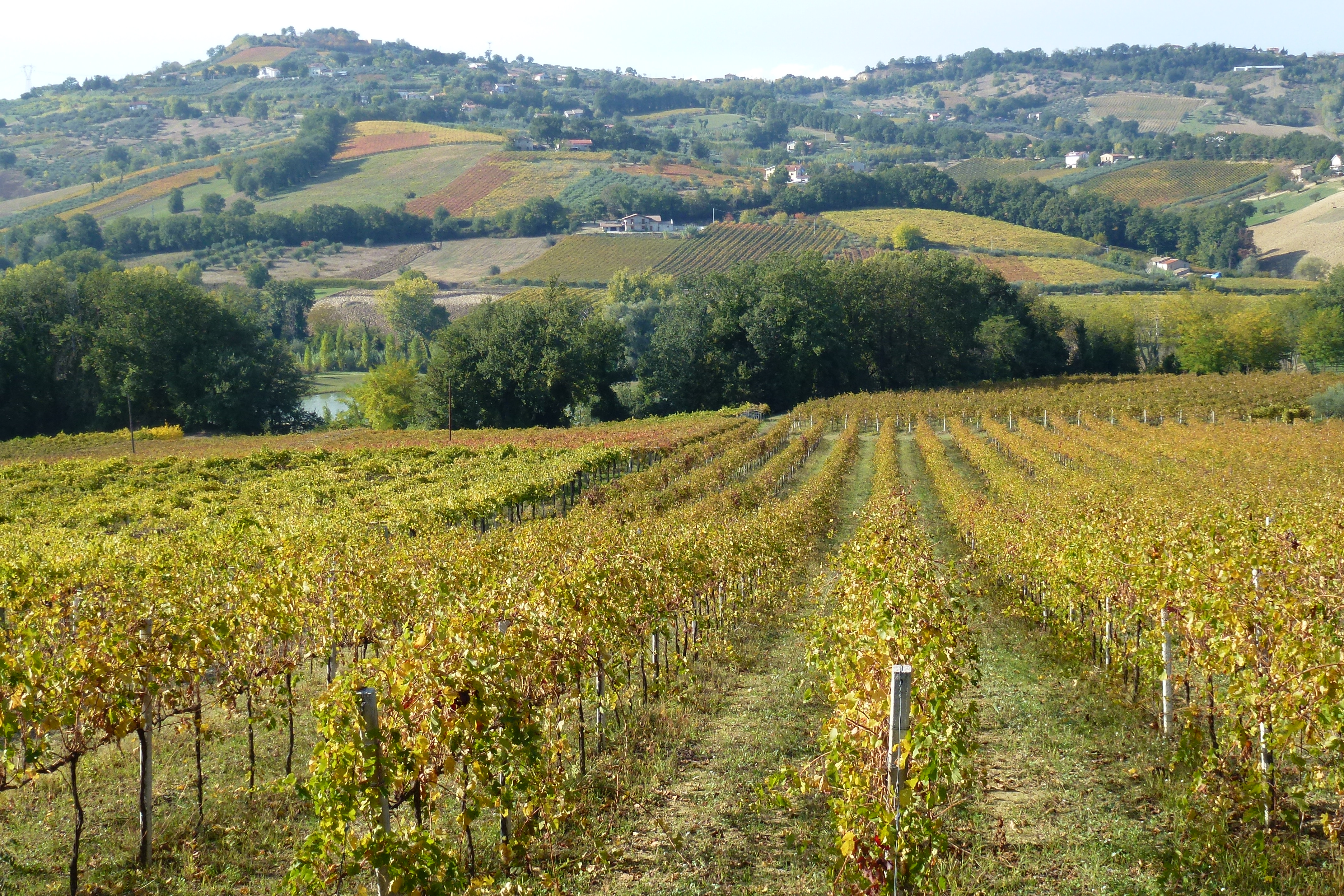
Vineyards in the Foro valley, viewed from the territory of Casacanditella, Abruzzo. — maury3001 · Original image · CC BY 3.0
A conviction born among the vines
In 1981, Gianni Masciarelli founded his winery in San Martino sulla Marrucina, in the province of Chieti. His passion for vines came notably from his grandfather Umberto. As a young man, he also discovered Champagne and returned to Abruzzo with an ambition: to give his region’s grapes an expression that would attract attention beyond its borders.
His approach helped develop local viticulture and winemaking, notably through Guyot training and the use of French barriques. This was more than simply changing tools. The work sought greater precision in vineyard and cellar, making Montepulciano and Trebbiano d’Abruzzo the protagonists of a new ambition. The Masciarelli name remains connected to this change in perspective.
A family continuing the journey
Gianni met Marina Cvetic in 1987. Their personal story accompanied shared work in the winery. Today, Marina and their daughter Miriam Lee continue this adventure. For us, that continuity matters: behind a famous name is also the way a direction is maintained when those who first opened it are no longer there.
A story gives this legacy a particularly simple form. Marina found two seven-hundred-litre French barrels in the cellar, bought by Gianni but never used. For the 2010 harvest, they became the starting point for La Botte di Gianni: a white and a red, made and then aged for thirty months. Objects left in a cellar thus opened a new chapter rather than remaining only memories.
Abruzzo across its four provinces
Masciarelli grows vines in all four provinces of Abruzzo. Around Chieti, San Martino sulla Marrucina, Bucchianico, Casacanditella and Ripa Teatina notably host Montepulciano, Trebbiano, Cococciola, Pecorino and Cabernet Sauvignon. Loreto Aprutino, in the province of Pescara, contributes its expressions of Montepulciano and Trebbiano.
In the province of Teramo, the estates of Controguerra, Corropoli, Nereto, Colonnella and Tortoreto extend this understanding of the vineyards. At Ofena, in the province of L’Aquila, Merlot and Cabernet Sauvignon find an inland environment marked by large temperature differences. This spread explains why an Abruzzo producer cannot be reduced to one landscape: the sea, hills and mountains contribute to different places.
Villa Gemma, a doorway to the producer
The Villa Gemma range began in 1984 with a Montepulciano d’Abruzzo. The red Villa Gemma on our list is made from Montepulciano grown in San Martino sulla Marrucina. It belongs to the DOC Montepulciano d’Abruzzo. Ageing in French oak barriques accompanies a powerful, elegant wine, where ripe fruit meets spices, cocoa and liquorice. We love this expression for its depth and for the time it invites us to take: behind the red’s body, we find Gianni’s ambition and the character of his land.
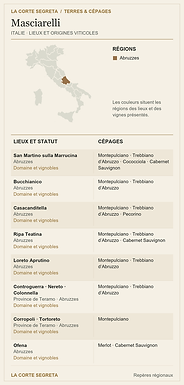
Masciarelli: documented regions, locations and grape varieties. Mapping: ISTAT boundaries, distributed by openpolis / geojson-italy, CC BY 4.0. Projection and colours adapted; a regional location map, not a cadastral map. Map boundaries · CC BY 4.0
Montepulciano: Abruzzo’s red grape, between the mountains and the Adriatic →
Pecorino: the return of an Apennine white →
DOC — Denominazione di Origine Controllata →