Nestore Bosco — Abruzzo in a family's memory
From Pescara to Nocciano, a winery founded in 1897 where the time given to wine meets agricultural and artistic history.
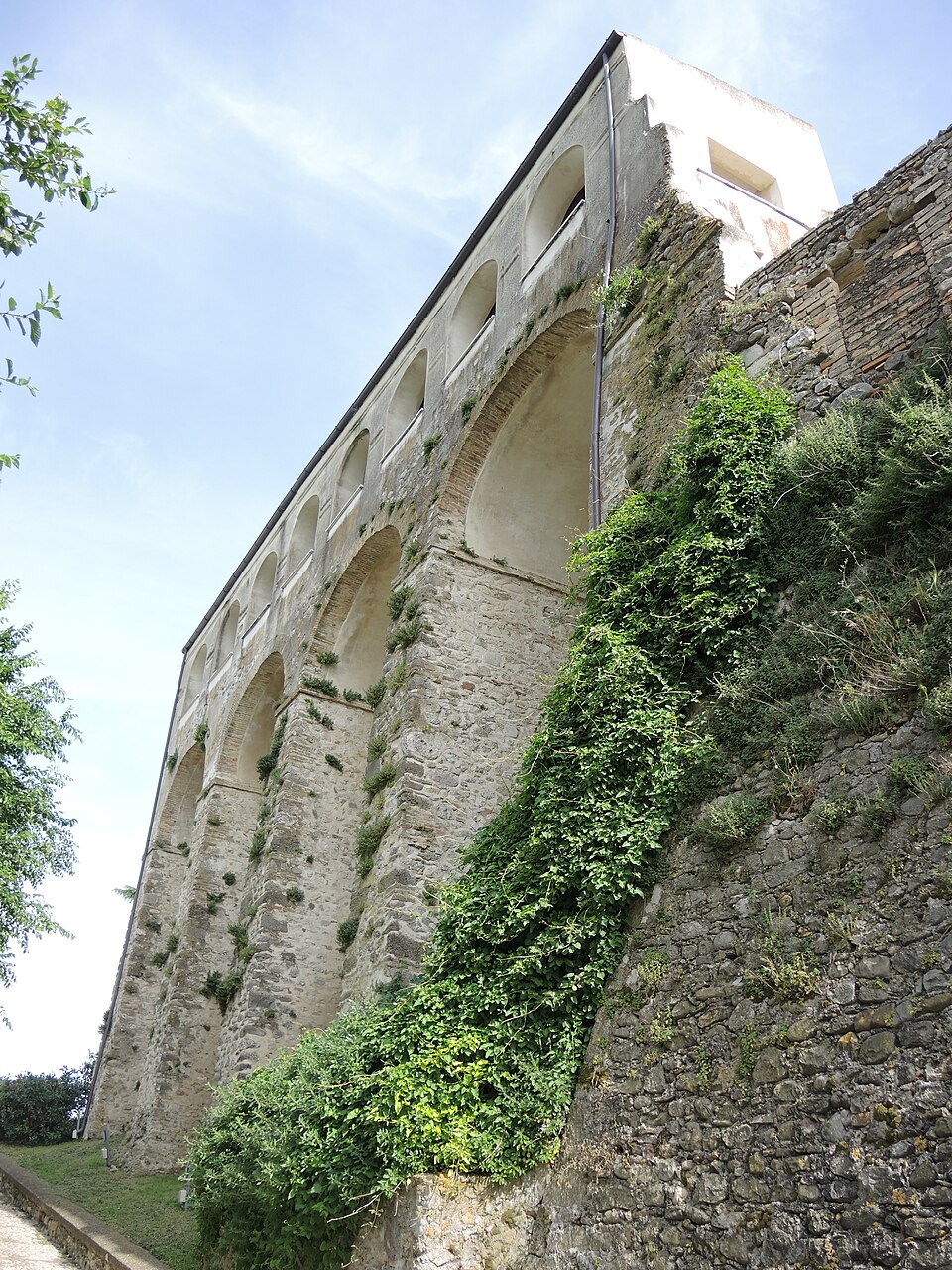
De Sterlich-Aliprandi castle in Nocciano, province of Pescara. A landmark of the village that is home to the Nestore Bosco winery. — Pietro · Original image · CC BY-SA 4.0
An Abruzzo story beginning in Pescara
The story of Storiche Cantine Bosco Nestore began in 1897, when Giovanni Bosco founded the winery on Pescara's Colli Innamorati. His wife Giulia and their son Nestore belong to this first chapter. The Bosco name has accompanied winemaking in Abruzzo for several generations. Today, the producer is based in Nocciano, inland in the province of Pescara.
The move from Pescara's hills to those of Nocciano in the early 1980s changed the winery's organisation. Underground galleries were fitted out for maturation and bottle storage. From 1990, Nestore and Stefania became involved in running the business. The fifth generation in turn joined this family story in the early 2020s.
When wine meets writers and artists
In 1979, the writer Mario Soldati visited the winery, still in Pescara, and left a dedication that remained in the family's memory. In 1996, the sculptor and artist Pietro Cascella created the Pan label for the producer, with the stylised face of the god of woodland and nature. Wine thus became a meeting point for local culture, creativity and agriculture.
This attention to memory is also found in Nocciano's tunnels. Nestore junior installed a collection of rural and ethnographic objects there, some dating from the late 19th century. The ageing spaces therefore also hold traces of an agricultural world. Large oak vats, barrels and bottles stand alongside tools and everyday objects.
The inland vineyard
In Nocciano, the producer lies between the great mountain landscapes of the Maiella and Gran Sasso, in an inland area influenced by the Adriatic. Its vines and wines belong to this Abruzzo landscape. Montepulciano holds a major place in the range, alongside whites made from varieties including Trebbiano d’Abruzzo, Pecorino, Chardonnay and Passerina.
Montepulciano d'Abruzzo gained its DOC in 1968. This appellation ties the wine to Abruzzo and its emblematic grape. Here, Montepulciano refers to a grape variety: the name helps us understand the wine's composition. In the Bosco range, several cuvées give it different expressions, from reds intended to be drunk young to wines that spend longer maturing.
Don Bosco, the time given to a Riserva
Don Bosco Montepulciano d'Abruzzo Riserva is made exclusively from Montepulciano. The soils are stony and calcareous; harvesting takes place around the end of October, followed by fermentation in stainless steel with prolonged maceration. Ageing then takes place in oak casks and barrels, before a rest in bottle in the winery's underground galleries.
This Don Bosco Riserva is on the wine list at La Corte Segreta.
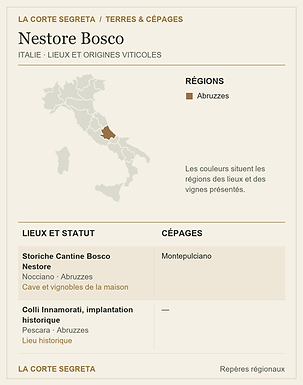
Nestore Bosco: documented regions, locations and grape varieties. Mapping: ISTAT boundaries, distributed by openpolis / geojson-italy, CC BY 4.0. Projection and colours adapted; a regional location map, not a cadastral map. Map boundaries · CC BY 4.0
Montepulciano: Abruzzo's red, between mountains and the Adriatic →
Pecorino: the return of a white from the Apennines →
DOC — Denominazione di Origine Controllata →