Ritterhof: the landscapes of Alto Adige in the glass
In Caldaro, a family winery and partner growers work landscapes between valleys and hillsides.
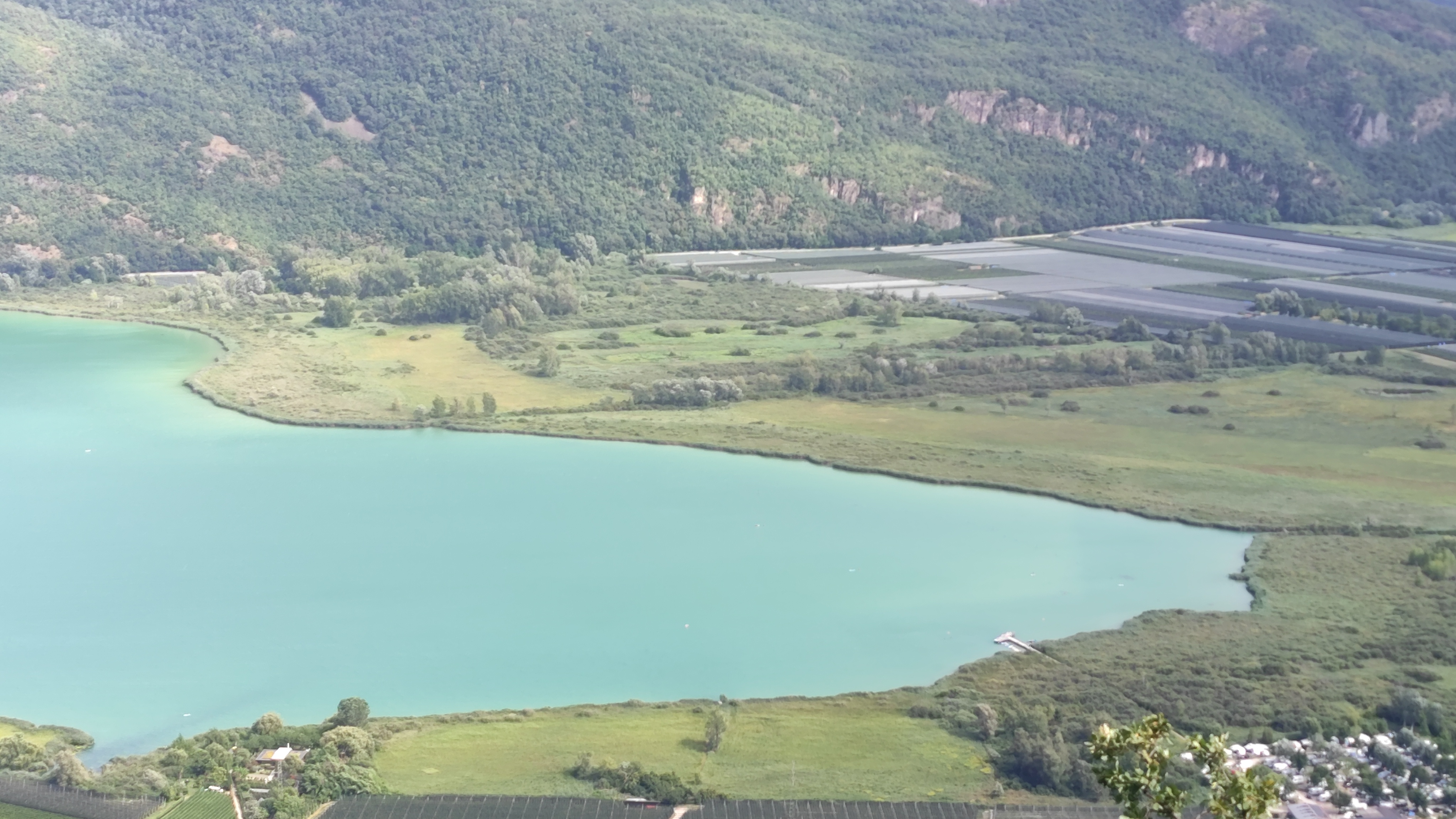
Lake Caldaro, in the landscape where Ritterhof is based — Boboseiptu, Wikimedia Commons, CC BY-SA 4.0. · Original image · CC BY-SA 4.0
At La Corte Segreta, Lenz opens a window onto Alto Adige. Ritterhof is based in Caldaro on the Wine Road, in the province of Bolzano. We like this region for the diversity it brings to an Italian wine list: villages where languages meet, rapidly changing terrain and vines growing on hillsides as well as valley floors.
A winery that became a family business
Ritterhof was founded in 1967 by the Swiss Emil Nüesch. In 1999, the family running Roner acquired the winery, and Ludwig Kaneppele took over its management. Eva Kaneppele succeeded him in 2021, representing the family’s fourth generation. The story therefore brings together several stages: a founding, a family acquisition and a further passing on of responsibility.
Loyal partner growers have an important place in this history. Their collaboration connects the winery to several growing areas and allows it to work with a mosaic of origins. These vineyards and the family winery are distinct sources brought together through wine.
A stone bunch of grapes at the entrance
On arriving in Ritterhof’s courtyard, a large bunch of grapes carved in stone catches the eye. It represents Schiava, called Vernatsch in German. We like this detail because it draws attention back to the grape before even entering the winery. Through a very tangible object, it expresses the place of the vine and of a grape strongly connected to local history.
The grapes’ geographical origins include Caldaro, Termeno, Cortaccia, Montagna, Ora and Bolzano. Gewürztraminer, Lagrein and Schiava are among the producer’s important varieties. Alongside them, Pinot Blanc, Pinot Gris, Chardonnay, Sauvignon and Pinot Noir broaden the possible expressions. Diversity also comes from soils and altitudes: a grape name never tells the whole story of what shapes a wine.
Schiava from Lake Caldaro comes from hillsides between 300 and 450 metres. Pinot Noir is grown in Montagna and on Renon, between 450 and 600 metres. For Sauvignon, origins are spread across Oltradige, Bassa Atesina and Renon. These places form a mosaic of origins, rather than a single large estate.
Lenz: the idea of spring
Lenz means spring in German. The name accompanies a white wine from grapes grown in Oltradige and Bassa Atesina, between 250 and 450 metres, on clay and gravel soils. The different varieties are vinified separately in steel before blending. The blend brings these expressions together in a white whose name evokes renewal and freshness.
Apple blossom, floral notes and delicate herbs accompany a fresh, balanced palate. At La Corte Segreta, Lenz interests us for this impression of clarity and the place it gives Alto Adige. Its origins and IGT designation help us locate it; its character brings another possibility to the meal. We thus keep a white on our list that evokes a landscape, a season and the work of several growers united around one winery.
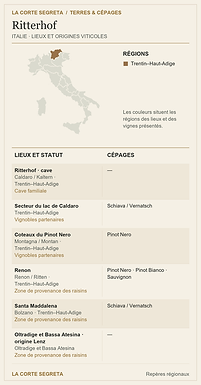
Ritterhof: documented regions, locations and grape varieties. Mapping: ISTAT boundaries, distributed by openpolis / geojson-italy, CC BY 4.0. Projection and colours adapted; a regional location map, not a cadastral map. Map boundaries · CC BY 4.0
Gewürztraminer: pink berries, intense aromas, several balances →
Pinot Blanc: a Pinot mutation long confused with Chardonnay →
Chardonnay: one grape, from taut whites to great sparkling wines →