47 Anno Domini: a Roman road and a contemporary outlook
In Roncade, the Tombacco family brings together the Veneto's history, architecture and research into wine.
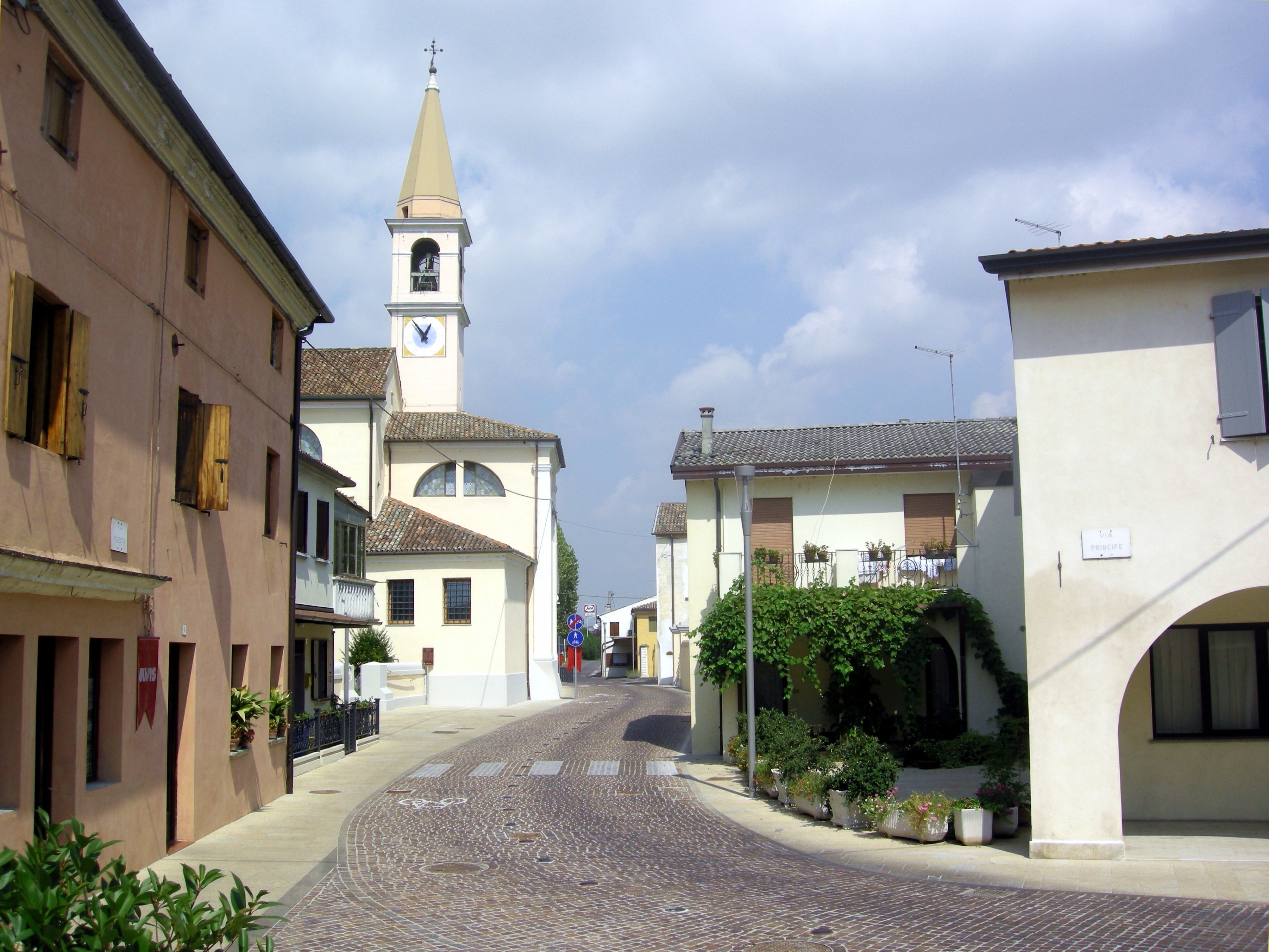
Musestre, in the municipality of Roncade, home to 47 Anno Domini — Cervellin, Wikimedia Commons, CC BY-SA 3.0. · Original image · CC BY-SA 3.0
On our wine list, 47 Anno Domini features through Le Argille, Sauvignon Sottovoce and the Diamante Prosecco wines. The producer is based in Roncade, in the province of Treviso. Its name immediately piques our curiosity: why refer to the year 47 when the winery's architecture is so firmly contemporary? The answer takes us back to an ancient Roman road, then to a family's story of hard work and knowledge passed down through the generations.
What the year 47 means
The name recalls the completion of the Via Claudia Augusta under Emperor Claudius in 46–47 AD. This road connected the Po Valley and the port of Altinum to territories beyond the Alps. The winery lies between Roncade and Silea, along the historic course of its Venetian branch. At La Corte Segreta, we find this connection fascinating: a wine's name can open a door to trade, travel and the long history of a landscape.
The winery's story is that of the Tombacco family. Grandfather Batista returned from the front with few resources and began farming. Successive generations developed the family business; his grandsons Cristian and Andrea established 47 Anno Domini. The vineyards, winery and contemporary project build on experience acquired over time, with the modern setting still firmly rooted in that history.
A surprise in concrete
Le Argille has a particularly surprising origin. In the 1970s, the family's father bought a property near Treviso with old concrete tanks, some of them only partly full. The wine inside might have spoiled; instead, it retained its freshness and fruit. This discovery encouraged the family to revisit a local technique and explore ageing in concrete in greater depth.
Le Argille combines equal proportions of Cabernet Sauvignon and Cabernet Franc. Some of the grapes are concentrated directly on the vine using a carefully managed double-ripening technique. The wines then spend two years in concrete before blending and a further rest in bottle. The vessel allows the wine to mature without introducing the aromas of wood ageing. The bottle, also coated in concrete and sealed with wax, reflects that choice.
The vineyards and the bottle's design
Around Roncade, the clay soils support varieties including Cabernet Franc, Cabernet Sauvignon, Merlot, Raboso and Glera. Sauvignon Sottovoce comes from vineyards in the countryside around Treviso and is made exclusively from Sauvignon. It stays in stainless steel, producing a dry, lively wine with notes of sage, elderflower and tomato leaf.
The Diamante wines bring us back to Prosecco and the Martinotti method, with the second fermentation taking place in a tank. The Extra Brut is very dry; the Extra Dry offers a rounder feel. Their bottle was designed by Raimondo Sandri, starting with models shaped in clay before moving on to glass. We love this meeting of craftsmanship, design and wine. At La Corte Segreta, these different cuvées give the producer a distinctive place: from the Sauvignon's lively freshness to the bubbles and the depth of the Cabernets, the Veneto finds expression in several forms.
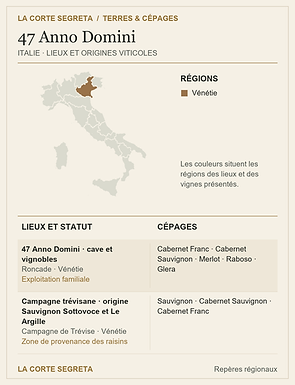
47 Anno Domini: documented regions, locations and grape varieties. Mapping: ISTAT boundaries, distributed by openpolis / geojson-italy, CC BY 4.0. Projection and colours adapted; a regional location map, not a cadastral map. Map boundaries · CC BY 4.0
Tombacco — a Venetian story, a Biferno from Molise →
Prosecco: from imperial courts to our table →
Cabernet Franc: red fruit and the finesse of an illustrious parent →
Cabernet Sauvignon: structure, blackcurrant and an unexpected family connection →