Federico Martinotti: the man behind Italy’s sparkling wines
A scholar from Monferrato, a lifetime of research and an idea that transformed Italian sparkling wines.
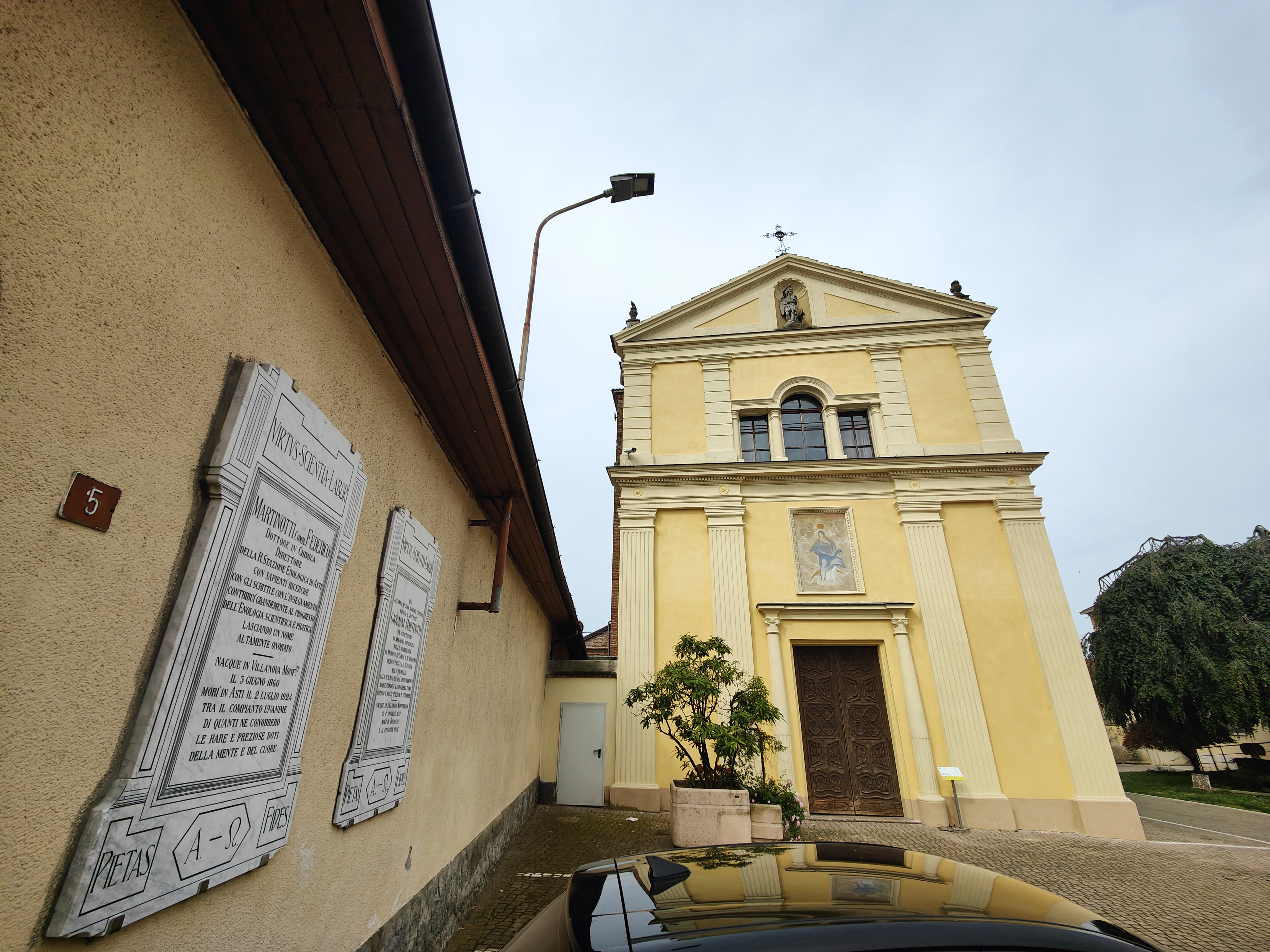
The commemorative plaques for Giovanni and Federico Martinotti beside the San Michele oratory in Villanova Monferrato, his birthplace. Photograph: Al*from*Lig, Wikimedia Commons. · Original photograph · CC BY-SA 4.0
From Monferrato to Turin’s laboratories
Federico Martinotti was born on 3 June 1860 in Villanova Monferrato, Piedmont. He grew up in an environment where vines were part of agricultural life. In Turin, he began studying medicine before turning to chemistry and pharmacy, graduating in 1887.
He then joined the Royal Agronomic Station in Turin, initially as an assistant and later with managerial responsibilities. His research combined laboratory analysis with trials in the vineyards of Monferrato: for him, understanding wine meant knowing the grape as well as its transformation.
Asti: a life devoted to oenology
In 1901, following a competitive selection process, he became director of the Royal Experimental Oenological Station in Asti. He held the post until his death on 2 July 1924, aged 64. During those years, he helped turn research into a practical tool for cellars and winegrowers.
He oversaw the construction of a new station, organised the sharing of knowledge and took an interest in equipment that made winemaking more precise. His career reveals an idea we appreciate: expertise advances when practical experience and science take the time to meet.
1895: changing the scale of sparkling wine
Even before becoming director in Asti, Martinotti was working on sparkling wines. Between 1891 and 1893, he published work on their production and on sparkling Moscato. In 1895, he patented equipment for production in large sealed vessels. Swiss patent CH10711, filed on 12 July, concerned an installation for the continuous production of sparkling wines.
The research sought faster, less costly production than working bottle by bottle, with genuine fermentation in vessels capable of withstanding pressure. This step paved the way for the Martinotti method that we explore in our archive article on bubbles born in tanks.
Martinotti and Charmat: two names, one evolving story
Other researchers had already explored fermentation in large vessels in the 19th century. Martinotti’s contribution was to develop and patent a system that would mark a milestone in Italian oenology.
In the early 20th century, Eugène Charmat improved the equipment and encouraged its industrial development. His British patent, published in 1910, described a system for treating, clarifying and transferring sparkling wines under pressure. The names Martinotti and Charmat therefore tell of two stages in this development: Italian research and the refinements that accompanied its wider adoption.
A researcher who ventured beyond his laboratory
Martinotti also took an interest in filtration, distillation, cellar machinery and combating vine diseases. Faced with phylloxera, he studied the possibilities offered by American vines and grafting. He even carried out grafting trials himself when the necessary skills were unavailable locally.
Another image from his life particularly appeals to us: to show winegrowers the value of mechanisation, he had a motor-powered grape crusher mounted on a horse-drawn cart. Innovation came to meet them, right where they worked.
A surprise: alcohol-free bubbles
Towards the end of his life, during American Prohibition, he also worked on alcohol-free wines and vermouths. After overcoming technical difficulties, he notably developed an alcohol-free sparkling Moscato.
This detail makes his story particularly vivid for us. In an era very different from ours, he was already exploring how to adapt wine to new uses without abandoning the pursuit of flavour. That curiosity echoes our desire to offer the pleasure of an alcohol-free glass.
A legacy found in the glass
The development of the method played a major part in the expression of Prosecco. Tank fermentation highlights the floral and fruity aromas of Glera and the differences between the places where it is grown. Asti also has its own history within this family of sparkling wines: the fermentation of its Moscato must in tank differs from the second fermentation of a base wine.
What the times demanded
Federico believed trials had to begin before the emergency. As phylloxera spread, he warned growers that testing grafts took years. Waiting for the pest to reach a vineyard meant risking a hurried decision and the cost of replanting. For a grower, a mistake could mean years of work. That was the reason to test several approaches while there was still time to choose.
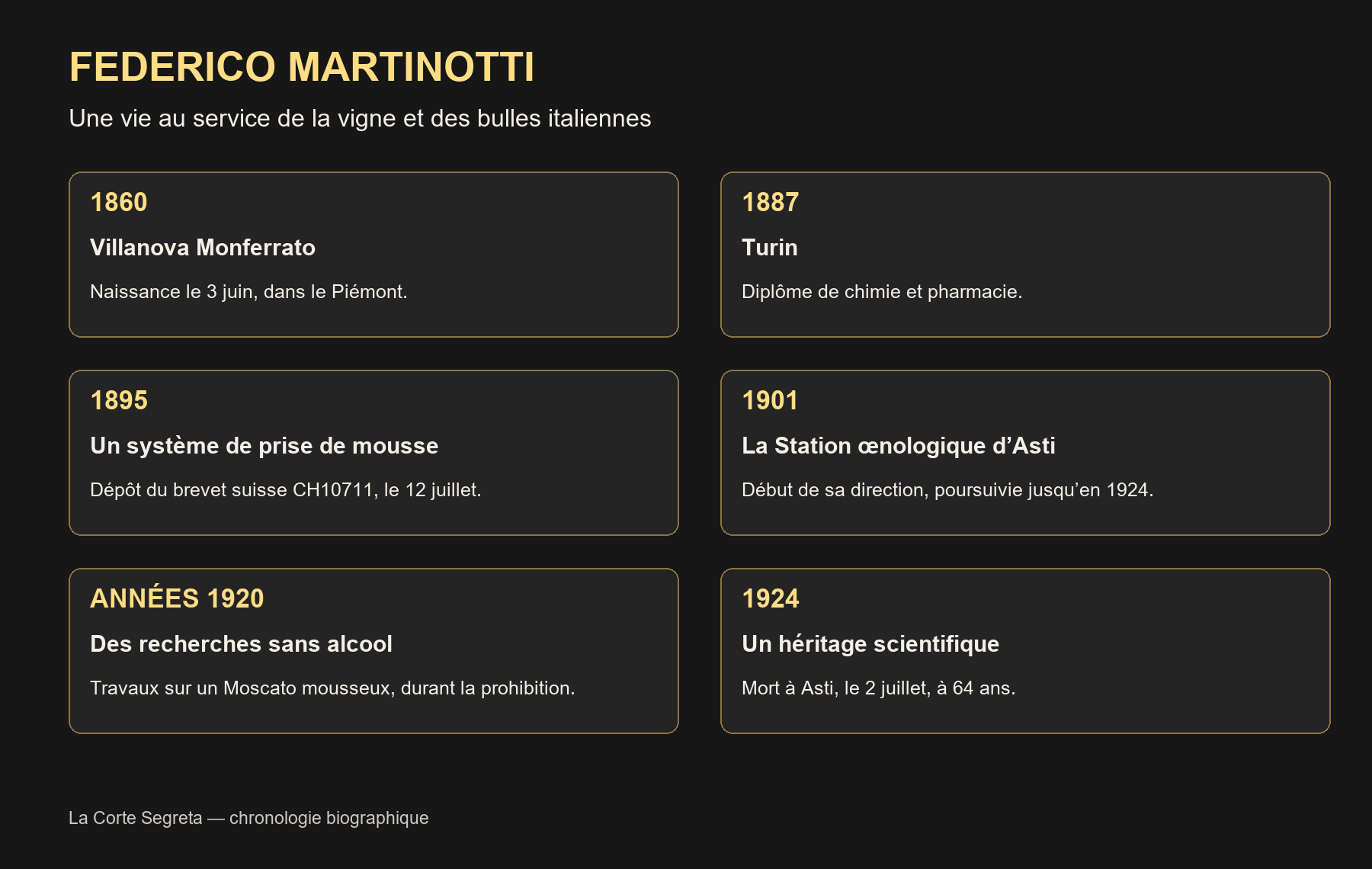
Federico Martinotti: milestones in his life and research — a timeline by La Corte Segreta.
Martinotti: bubbles born in tanks →
Prosecco: from imperial courts to our table →
Asti: the story behind the bubbles →
Phylloxera and ungrafted vines: a tiny insect, a European crisis and two ways of growing vines →
Sources